A recent Facebook exchange was striking. Someone posted a Washington Post article on the latest climate science. It predicted a temperature rise of 8 degrees Fahrenheit by the end of this century if no systemic changes are made to reduce our carbon output. The better case scenario — in which world governments implement their current promises to cut emissions — would keep the warming to only 6 degrees.
Another person responded, “This is so heartbreaking I don’t know how I can hold it.”
An increasing number of people note with horror the destruction caused by the current level of carbon in the atmosphere, which has caused the earth to warm by just over 1 degree. Compared to a decade ago, when I first learned of the gravity of climate change, there has been an enormous upswell of fear, concern, and protest.
Flat denial of the problem has decreased significantly, and this is heartening. The vigor of the climate activist community has impressed me, and I no longer feel that I am holding this alone. But there is a persistence of denial at all levels. Many educated, politically active people I meet do not follow the climate science closely enough to realize how dire our situation really is.
I constantly give people my elevator speech on the math: “350 parts per million (ppm) carbon dioxide in the atmosphere is considered the maximum safe level for the planet to continue to support life as we know it. We are currently at 389, and our carbon output raises that number by 2ppm/year.” I was raised by scientists, and for me this is the only thing that matters: the well-established, peer-reviewed validity of those numbers, and their implications. But I often get a dismissive or blank response. Looking at the statements of the major environmental groups is no more reassuring. Committed to pushing for “realistic” policy changes, they willfully deny the warnings of the earth.
“I don’t know how I can hold it.”
We cannot hold it alone. We face a real threat of total destruction of our species (along with most of the others). It would be foolish to consider this irrelevant to our mental health, especially when we know that it is already so taxed by the haste and stress and violence of our culture. I do not think that the rise in the use of anti-anxiety meds and antidepressants can be unrelated to the climate crisis. We know in our bones, in our collective unconscious–in some deep way–that we are destroying the earth, and with it, ourselves.
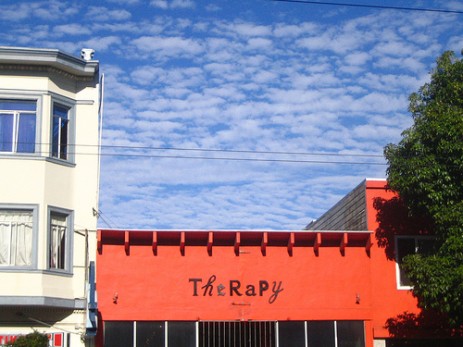
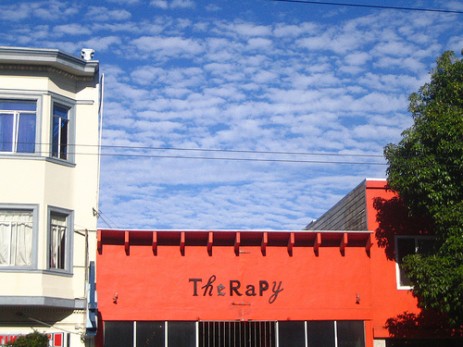 The skies may be blue, but a storm is coming — get help while you can.rick via flickrMy own investigations of personal psychotherapy to help with this grief, along with many anecdotal reports from friends and fellow activists, has convinced me that traditional one-on-one therapy does not help us to “hold” this tragedy. Focused on enabling the individual to function in the world, it fails to recognize the illness of the culture. One can easily feel blamed for “obsessing” about things too large to change, or be accused of overdramatizing, or diagnosed with manic disorders or depression. The diagnosis that addresses the individual as being separate from the world is of no use at all.
Part of our intention for the JP Green House is to create a community space for events, workshops, songfests, book groups, potlucks–what have you–that relate to sustainability and climate change. Putting forth that intention has had the always-mysterious effect of leading me to the right people to work with. If you are craving a community of support for your grief, fear, and anger at the destruction of the planet, for your fears about yourselves and your children, I can offer a few ideas here.
Common Security Clubs: First, a model I helped create! Common Security Clubs are a growing movement of small gatherings around the country that function to educate, support, and encourage action in the face of the economic meltdown. While the focus of the 5-session curriculum is mostly on the economic crisis, good connections are made to the environmental situation, and one of the premises of the materials is to gently teach participants that we are not going back to a growth-based economy. I have both led and participated in these groups, and can attest to their effectiveness, and to the intimacy they provoke as people share their lives with each other. The curriculum is free and available to all at CommonSecurityClub.org.
Earth Circles: Although I know less about this model, it is also small-group work focused specifically on addressing the participants’ fears about the future and climate change. An excellent free curriculum can be found at Earth-Circles.org.
Lastly, if you are fearful, despairing, agonizing over your children’s future on this planet, I highly recommend a new book called Ecotherapy: Healing with Nature in Mind (edited by Linda Buzzell and Craig Chalquist). It was after reading this book that I knew what I had to do at the JP Green House: create space to air climate grief and rage. A collection of essays written by therapists and deep ecologists, it is full of wisdom about our collective diseases, elegant writing, and apt criticism of the field of psychology. I could quote it all day. Here is just one example, to wrap up, from eco-therapist Mary-Jane Rust:
“I felt as if I were a therapist on the Titanic. We might be doing fine work in the therapy room, but nobody was mentioning the sinking of the ship. If a client brought a dream of a ship in danger, would it not be strange to understand this only in terms of her inner world, and to ignore the dream’s message warning of the danger to the outer world?”
The ship is sinking. Can we save it, save ourselves? We do not know, and while we hold the question, we can only hold each other.