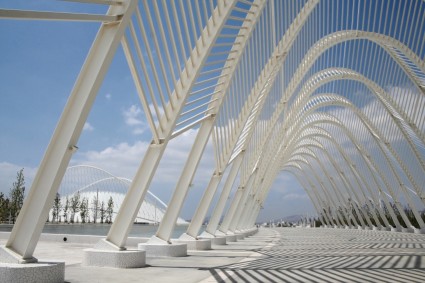
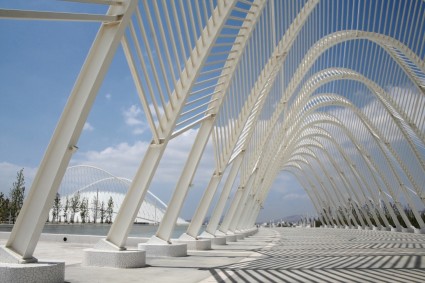
 Arches, now deserted, built for the 2004 Athens Olympics. As healthcare reform shipwrecks and climate legislation lurches toward a similar fate, President Obama is … preparing to jet to Copenhagen to shill for Chicago as 2016 Olympic site? Really?
What an absurd and ignoble use of time and prestige. When I think of the Olympics, I remember the spookily quiet, deserted “Olympic Village” by the railroad tracks I encountered in Turin while visiting for Slow Food’s Terra Madre conference last year. Built just two years before for the 2006 winter games, the edifices already seemed rundown and shabby. They certainly had nothing to do with the otherwise-lively streets of central Turin.
And that city may have gotten off easy. In his Planet of Slums, Mike Davis gives a scathing reading of what the Olympics mean for host cities.
The modern Olympics have an especially dark but little-known history. In preparation for the 1936 Olympics, the Nazis ruthlessly purged homeless people and slum dwellers from the areas of Berlin likely to be seen by international visitors. While subsequent Olympics–including those in Mexico City, Athens, and Barcelona–were accompanied by urban renewal and evictions, the 1988 Seoul games were truly unprecedented in the scale of the official crackdown on poor homeowners, squatters, and tenants: as many as 720,000 people were relocated in Seoul and Injon, leading a Catholic NGO to claim that South Korea vied with South Africa as “the country in which eviction by force is most brutal and inhuman.”
I can’t figure out why any city would actively lobby to host the games. Once the crowds have cleared out–and the poor have been evicted from the central city–what’s left? Already, the City of Chicago’s economic-benefits forecasts fro the hoped-for ’16 Olympics are looking embarrassingly bloated.
Moreover, a recent study by researchers from the National Bureau of Economic Research and the Federal Reserve Bank of San Francisco suggests that the economic benefits of of hosting Olympic games are mainly spectral. The authors find:
The costs of holding such events seem considerable. Further, any enduring benefits derive mostly from infrastructure investments that the host city could choose to make independently of the games.
Those infrastructure benefits can range from hulking structures that quickly fall into disuse, to real improvements in mass transit. (Rather than rally in Copenhagen for Chicago’s Olympic effort, maybe Obama should be rallying his party mates on the Hill for a boost in transit spending?) The authors forge on with a critique of typical Olympic investments:
Much of the spending on the event by local citizens is a substitute from a different leisure activity or consumption good, rather than true additional spending. Moreover, the projects associated with the games typically seem to be white elephants, such as poorly-used sporting facilities associated with idiosyncratic Olympic sports, or hotels and transportation infrastructure built to accommodate a one-time peak demand of just three weeks.
Ouch. The authors did find that countries that host the Olympics get a boost in exports. But they add, devastatingly, that “unsuccessful bids to host the Olympics have a similar positive impact on exports.” In other words, by just bidding for the Games, Chicago has already banked any export benefits it will gain from the Olympics. Actually winning the bid won’t make much difference.
Thus Obama’s journey to boost his hometown’s Olympic bid seems at best Quixotic. He should stop tilting at windmills and get down to the hard work of getting lots of them installed on the ground all over the U.S. That means working the halls of power in D.C., not Copenhagen.