I thought YOU were looking for the sign!

Scientists identify “safe operating space for humanity” in seminal Nature study 20

It is a well-provisioned ship, this on which we sail through space. If the bread and beef above decks seem to grow scarce, we but open a hatch and there is a new supply, of which before we never dreamed.

That, from Henry George’s Progress and Poverty, is how humanity viewed the planet for most of modern history:  a vessel stocked with virtually endless provisions. In the 20th century, however, our view of Spaceship Earth became more sober and more complicated. We realize now that our vessel’s provisions are finite,  we are consuming at rates beyond what can be sustained, and we do not know with any precision how close we are to our limits or what happens if we cross them. “There is one outstanding important fact regarding Spaceship Earth,” said Buckminster Fuller, “and that is that no instruction book came with it.”

Now scientists have taken a first step toward creating just such a manual. In the latest issue of Nature is a groundbreaking new paper called “Planetary Boundaries: A Safe Operating Space for Humanity.” In it, a team of 28 scientists has identified 10 separate biophysical systems crucial to humanity’s flourishing; for each system they have identified a “safe operating boundary” within which humanity must remain if it wishes to maintain the basic environmental conditions in which it evolved.
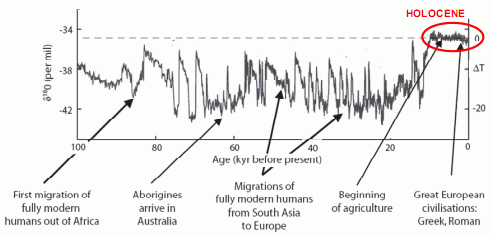
human history and the holocene era
The last glacial cycle of 18O (an indicator of temperature) and selected events in human history. The Holocene is the last 10,000 years. Adapted from Young and Steffen (2009).
Nature

“Human activities,” the scientists warn, “have now reached a magnitude that may trigger irreversible and in a some cases abrupt environmental change by damaging the regulatory capacity of the systems on Earth that keep the planet in the desired Holocene state.”

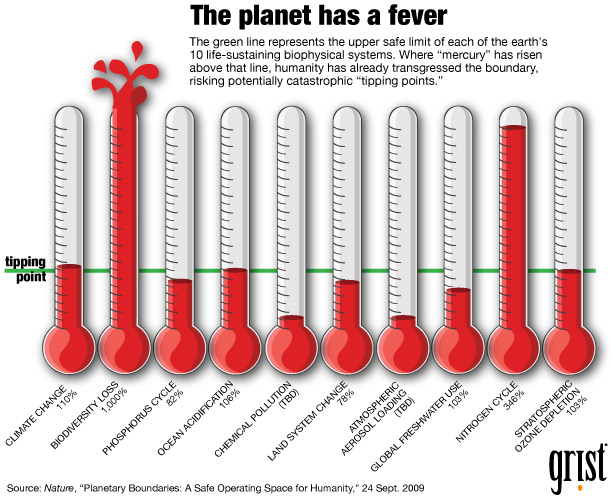
Here’s the bad news about those boundaries, beyond which we risk nonlinear and irreversible consequences: we’ve already transgressed three of them. Here’s the tally:
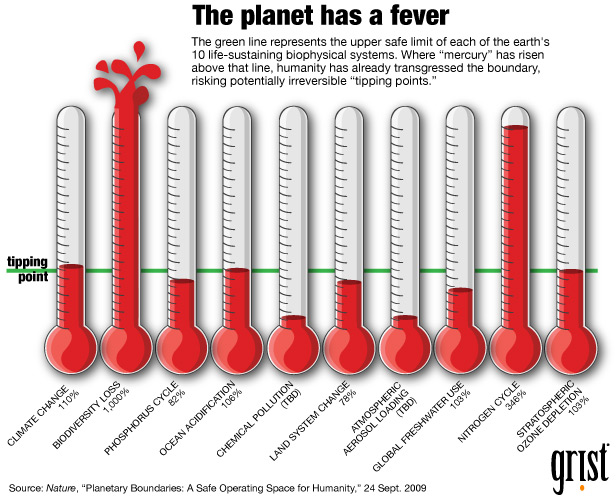
Nature - tipping points

We travel together, passengers on a little spaceship, dependent on its vulnerable reserves of air and soil; all committed for our safety to its security and peace; preserved from annihilation only by the care, the work, and, I will say, the love we give our fragile craft.—Adlai Stevenson

The numbers more or less speak for themselves. If you’re interested in the details, read the full paper in Nature. I’d just make one follow-on point.

Discussion around environmental problems often suffers from what Alex Steffen terms “carbon blindness.” The carbon blind see climate change as a single, overriding, monocausal problem with a targeted solution: reducing CO2 concentrations in the atmosphere. They are susceptible to symptom-chasing solutions like geoengineering with space mirrors or sulfur clouds. But the Nature paper makes clear that as politically, intellectually, or even spiritually inconvenient as it may be, the problem we face is much larger and more systemic than carbon in the air.

There are questions humanity will have to grapple with consciously and deliberately: How can we live in a way that honors our descendents? How should we work, get around, power ourselves, feed ourselves, house ourselves? How many of us should there be? Everyone living has a stake in the answers. In times of trial, it’s useful to recall the words of Marshall McLuhan: “There are no passengers on Spaceship Earth. We are all crew.”

——-

Here is the raw data that scientists used to make their determinations about tipping points (red indicates boundary exceeded):

Earth system process

What is being measured (units)

Proposed boundary

Today’s figure

Pre-industrial figure

Climate change

(i) Atmospheric carbon dioxide concentration (parts per million by volume)

350 387 280

(ii) Change in radiative forcing (watts per metre squared)

+1.0

+1.5

0.0

Biodiversity loss

Extinction rate (number of species per million species per year)

10

>100

0,1-1

Nitrogen cycle (part of a single biogeochemical flow boundary)

Amount of N2 removed from the atmosphere for human use (millions of tonnes)

35

121

ZERO

Phosphorus cycle (part of a single biogeochemical flow boundary)

Quantity of P flowing into the oceans (millions of tonnes)

11.0

8.5-9.5

~ 1

Stratospheric ozone depletion

Concentrations of O3 (DU)

276

283

290

Ocean acidification

Global mean saturation state of aragonite in surface sea water

2.75

2.90

3.44

Global freshwater use

Withdrawals of freshwater for use by humans (km3 per year)

4000

2600

415

Land system change

Percentage of global land cover converted to cropland


15

11.7

Low

Atmospheric aerosol loading

Overall particulate concentration in the atmosphere, on a regional basis

To be determined

Chemical pollution

For example, amounts emitted to or concentrations of persistent organic pollutants (POPs), plastics, endocrine disruptors, heavy metals, and nuclear waste in the global environment, or effects on ecosystem and Earth System functioning thereof

To be determined

David Roberts is staff writer for Grist. You can follow his Twitter feed at twitter.com/drgrist.

Advertisement
Advertisement
  1. chasingcleanair's avatar

    chasingcleanair Posted 12:02 pm
    23 Sep 2009

    That's very interesting study. Indeed, how will we collectively revamp our habits and industries? Progress occurs in tiny pockets but reading about dirty energy power plants popping up in the far east and dirty bunker fuels powering cargo ships, our progress doesn't seem to be enough, soon enough. I'm having challenges revamping my own habits. I'm in L.A. now, once again suffering smoke fallout from fires. I'm headed back to Pacific NW soon, and rather than wait to take train next week with my girlfriend (more sustainable travel choice), I may head directly to LAX and board a plane to get out of here sooner. Living with drought, record temps, low humidity, and strong winds is no fun.
  2. dustydirtroad Posted 12:10 pm
    23 Sep 2009

    This article reminds me of something that we recently read in class this year. It was an article called "To Remake The World" by Paul Hawken, in which he discussed how to change anything that we're doing, we are going to have to change the collective belief of the people. Without everyone changing how they think, there is no way we can convince them to change what they're doing so it will be good for the earth.
  3. Anon92107 Posted 2:17 pm
    23 Sep 2009

    Thanks for proof about how bad off things are for a few tipping points.

    But as bad as this report proves, there are other tipping points that must also be quantified such as:

    population levels,
    clean water supply declines,
    crop yields declines,
    heat waves, storms, floods, droughts, firestorms that cause malnutrition, illness and death,
    insects populations that carry disease such as malaria and dengue,
    rising coastal sea levels and storms,
    forced migration of animals and plants that won't survive,
    ocean acidity,
    coral reef deaths,
    increasing carbon sources from permafrost thaws and vegetation burns or decays,
    etc.

    that is before the entire planet becomes another Easter Island scenario, evolving into Death Valley Earth.

    The worst case scenario fact of life is that scientists have been watching the Keeling Curve go off scale for over 50 years and they just keep blindly following the almighty dollar over the cliff to extinction.

    Our prefrontal cortex is just not evolving fast enough.
  4. amazingdrx's avatar

    amazingdrx Posted 6:40 am
    24 Sep 2009

    This is why wind and solar energy is not enough. Organic agriculture and water conservation, which can go hand in hand, need to be added to the energy re-evolution.

    On the cultural values front a basic shift from quantity of consumption and possesions as a measure of fullfillment to...quality of life as the measure of success. Fewer humans, and that smaller human population living in a symbiotic state with nature.

    Soil nutrients need to come from the waste stream and the water we use needs to be cleaned up and reused over and over.
  5. Howell Haus's avatar

    Howell Haus Posted 11:03 pm
    25 Sep 2009

    "Soylent Green is people" - Burt Lancaster
    1. amazingdrx's avatar

      amazingdrx Posted 11:38 pm
      25 Sep 2009

      Ahhh...you meant Chuck Heston, right?

      http://www.imdb.com/title/tt0070723/
      1. Howell Haus's avatar

        Howell Haus Posted 11:18 am
        26 Sep 2009

        My friend, you are correct ! Same period, completely different man...
  6. Howell Haus's avatar

    Howell Haus Posted 11:23 am
    26 Sep 2009

    You are amazing, Amazing... it is definitely Chuck - slash - Charlton - Planet of the Apes fame, Heston. Don't know why I confused the two, except perhaps I was born in a city named Lancaster - hence, top of mind. I've seen Soylent Green no fewer than a dozen times and it's a sober reminder of the possibilities we're faced with going forward. Pray to the G_d's above and below, and say it isn't so...!
    1. amazingdrx's avatar

      amazingdrx Posted 9:04 pm
      28 Sep 2009

      I really like algae and yeast cultivation for a permanent cure for hunger Howell. The algae feeding the yeast so that all the amino acids and vitamins can be produced.

      With this kind of "soylent green" no people would be needed as feedstock. Feed in biodigested biomass derived fertilizer, sunlight, water, and out comes perfectly balanced ready to eat or dry and store...food.

      This is already scientifically and technically feasible, maybe someone like Dean Kamen, with his water purifier design for the whole world, could make an algae/yeast nutrition device that fits with the water purifier.

      The solar collectors for growing the algae would add to the water purification capacity through solar evaporation. There is no technical or scientific reason for hunger or thirst anymore, it's all financial and political.
  7. Howell Haus's avatar

    Howell Haus Posted 11:02 pm
    28 Sep 2009

    And using the new Electrolux 3D food printer (products for the next 90 years), it would be so easy to disguise them as colorful, variable chunks of schmatter, schmeat, schmeeses and schmegetables... no body (opposed to nobody) would know the differensch...
  8. latecommer Posted 12:19 pm
    29 Sep 2009

    Very strange that they should identify a problem with biodiversity since 10,000 years is a totally insignificant time period for such studies. It is like saying this week is hot so the century is hot.
    Biodiversity does not happen by what WE do, it only happens after an extinction, where open niches for diversity are created by the death of what was before.
    Sorry, your 28 scientists obviously had no Paleogeologists on their panel. Geology 101 is where this is learned, and a quick review of any text could refresh their memories. this appears to be a "sky is falling article"
  9. John Faust Posted 12:40 pm
    29 Sep 2009

    The recent news that humanity consumed the planet's net primary production (NPP) for this year on September 25 should clarify why so many of these critical indicators are nearing or have exceeded important thresholds. Of course, only one of the ten indicators needs to exceed a critical threshold (tipping point) in order to destabilize the planet, causing it to move uncontrollably to what might be an inhospitable state for humanity. It is already inhospitable for many of our fellow travelers.

    Though all of these indicators on the planet's new instrument panel are important, there is probably only one we need to use for steering -- biodiversity. In fact, if the present changes in all the other indicators actually improved biodiversity, we should applaud our interventions in the planet's bio-geochemical cycles. That's the way healthy living systems work -- they grow richer and more resilient. Sadly, that isn't what's happening.

    I suspect that rather than engage in some bright green high tech solutions, we should think about what it might take to extend, by a few days each year, that date when humanity has consumed the the Earth's NPP. We need to do that until we have made room not only for our descendants but our companion species as well. Until biodiversity trends are reversed, we are in trouble. Shrinking humanity's impact is far more effective that offsetting its consequences.
  10. latecommer Posted 5:48 pm
    29 Sep 2009

    News is what it actually is, a media event not science.
    Is this a refereed paper? The point is that we as humans can't change biodiversity. Biodiversity happens when a spot for a new specie occures. Of course we can change the balance in any ecological sector by the introduction of a non native specie, but bio diversity happens through evolution not through the hand of man.
    It is very misleading and quite false to imagine that human beings can effect biodiversity.
    Changes in biodiversity have happened five times in the past 600 million years; 512 million years ago following the Early Cambrian mass extinction, 439 million years ago after the End Ordovecian extinction, 365 million years ago after the Late Devonian extinction, 250 millon ya after the Permian Triassic extinction, 199 million years ago following the End Triassic extintion, and the KT extinction 65 million years ago. That is the science of the issue...everything else is speculation.

    And while we are on the subject the term "tipping point" has no scientific validity when speaking of the climate. There has never been a tipping point in the history of our climate. The Earth is a self regulating system that man can not unbalance no matter how they try. Tipping points is simply not a term that climatologists use...it is a political term, meant to scare people, and that, I suspect , is what this article is all about since the Copenhagen talks are comming up.
    Just another attempt to scare the uniformed with a sky is falling story. I am sorry to see that many of you have fallen for it.
    As Stephen Hawking said: "We've got to start adapting, we've got to start understanding how sever the changes are and that there's very little we can do to stop them"
  11. Howell Haus's avatar

    Howell Haus Posted 6:10 pm
    29 Sep 2009

    Mr. David Roberts, author of this article, what say you to Latecommer ? I have to believe Latecommer is doing nothing to change his behavior, i.e., adapting to the situation. If in fact there is very little 'we' can collectively do to affect the changes in our environment, then laws, morals, and what's emerged as our civilizations - are of no consequence and we should all shite anywhere we like... like 'animals'... Like one of those things that makes you go hmmm !
  12. latecommer Posted 8:56 pm
    29 Sep 2009

    In my opinion, and remember my opinion is that of a professional in the field, there is no known way we can effect biodiversity except by introducing a non native life form into a new environent.
    Perhaps you do not understand what biodiversity is. Websters defines it as; biological diversity in an environment as indicated by numbers of different species of plants or animals". Not the numbers of individules in a species, but the number of species in the environment. It has been used incorrectly by the authors.
    Every attempt to introduce non-native species has been disasterous to the residents of that environment.
    I have no doubt you mean well, but your logic is very faulty when you jump from my statement to your conclusion... and insulting as well
    1. theregoesmymind Posted 12:32 am
      30 Sep 2009

      WE are non-native life-forms, and we are constantly introducing ourselves into new environments all over the planet.
  13. Howell Haus's avatar

    Howell Haus Posted 11:44 am
    30 Sep 2009

    Latecommer... even professional's can be putzes. Get a grin on, take a breath of air, turn around in 'your environment' and see what little or big thing you can improve. The damage is done, no amount of authoring will change it, and it's time for all of us collectively to consider what we have introduced into every environment where we tread and retrace our steps as much as possible - back to natural.

    Quoting Masanobu Fukuoka from his book The One-Straw Revolution, "It is easy to lay out the simple foods of a natural diet on the dining table, but those who can truly enjoy such a feast are few'. Such a statement requires an understanding of natural, similar to your mention concerning biodiversity. My point being, what we have now is neither natural or biodiversified as nature could/should have evolved - due to misguided intentions (misguided by innate greed, ego and an unequivocal lack of understanding).

    If you yourself push the red button that sets off a hydrogen bomb that destroys the entire biodiversity of an island, are you still saying that man has no control over said biodiversity ? I beg to differ, sir ! And no apologies if I seemed insulting. We, and our fellow planetary inhabitants are in a dilemma. Some of us are busy seeking solutions while others are splitting hairs quoting Webster... Please try to see the intent of the author, which is to help all of us improve our understanding of what's happening, which should give us all more of an inkling of the seriousness of our choices and where we spend our energies... thanks in advance for understanding !
  14. latecommer Posted 2:26 pm
    30 Sep 2009

    I am not as distressed as you seem to be. I do not agree with much of this article, because I am not a "man bad - nature good" person to the extent you are, and I am aware that there have been times in the recent past where degradations to the natural resources were much worse than today. Where I live today NATIVE human beings use to set fires to plant crops, and to drive game wild into pits. I don't blame them either, that is what they knew...
    But I will tell you what I have done in the direction you seem to lean, and why that led me to read this article.
    About 5 years ago I bought a 28 acre piece of land that had been abused. It bordered a river, on it was a 1950's style house trailer dying a miserable death. Much of the rest was a dump...it appeared the former owner could not part with old washmachines, stoves, junk cars, and auto parts. I cleaned that all up. Planted about 40 or 50 NATIVE trees, tore down a dirt and rock dam that for some reason had been built across a dry creek (over the next couple of years) this area flooded at high water and became the wet land it had been. I put in several 20 ft posts with platforms which now are homes to two breeding pair of Bald Eagles. I also transplanted patches of NATIVE grass back into areas that had been dump sites. I then built a small cabin (450 sq ft) on the highest little hill and planted NATIVE species of bushes and low trees around it. I can now sit on my porch and watch and enjoy ducks and geese in season, racoons, deer, and river otters that live along the river, and in what my wife calls "our swamp".
    That is how I deal with my principles of conservation. Now if I could just get rid of the NATIVE mosquitoes I would be completely happy....good enough for you?
    As for the insult... that often happens when one jumps to conclusions about something or someone they could have no way of knowing.

    As to Webster....remember words mean something, or they mean nothing at all.
  15. Howell Haus's avatar

    Howell Haus Posted 2:49 pm
    30 Sep 2009

    My apologies, touche' and well done, fine sir. I have utmost respect for what you've done. Now, please beg forgiveness of author David Roberts... he is only the messenger !

    I will add, that as much as I seem 'steamed', what's really bugging me is human complacency and denial. Our behavior is at best, parasitic. Even where the poorest of us survive, we still decimate our natural surroundings, overall. For proof, look at Ethiopia, which was once forested. We have surpassed 'natural'. Few are returning..

    I don't know the answers. I came without anyone asking why I should. Now I'm here, and without any say in where I'll be. My only request is when I'm gone, lay nothing with me and dig the hole deep enough that I don't kill the nut tree they plant above my remains. After all, I came from a nut... might as well return to one !
  16. latecommer Posted 9:03 pm
    30 Sep 2009

    My wish is that my dead body feeds the wild animals high in the Sierra Nevada's in one of several favorite locations, failing that, on Ceder Mesa in Utah; from which I once saw a thunderstorm ,from above,pass below me along the San Juan River goosenecks .

    What better place for the spirit to wander?

    Of course this is not practical (or legal) but ashes seem so sterial.
    I suppose it will do to finally die up there some day when I am 105 and being pursued by a suspicous husband.

    I am, I admit, very short with alarmist proclimations...anyone can see they are being presented in a well planed and carried out campaign to stir up support for the December climate meetings.
    It should bother all of us that science is being unethically used as a political tool...no matter the value of the cause.
    It is dishonest to present uncertain hypothetical climate projections based on climate models that have not been varified, and have not confirmed to empirical evidence, as "very likely".
    I am 100% toward making every inch of the world a better place, but I do not want to see the money that could be used for that, spent to combat a hypothetical problem. One I am convinced by more than 30 years of experience, three years of intense study of climate and over 300 peer reviewed papers and a score of books read, is not happening.
    I have a balance library and have studied the science of both. I have found that I am in the company of more than 32,000 American scinentist who have singed a statement refuting the Carbon Dioxide climate driver.
    http://www.oregonpetition.com
    Of course I am not infailable, but I am convinced that while man has effected climate, the majority of the climate changing actions of man have been physical in poor land use world wide, and a small but barely measurable effect from the 1% per year additionin atmospheric carbon dioxide.
    Nearly all pro AGW scientific papers have used 10,000 years as the base year for the claim of unprecidented warming.
    There is a good reason for that...12,700 we entered The Younger Dryas...a period of very cold (about 6C lower)climate for about 1500 years, at the end of this period in the space of 50 years the temperature rose 12 to 14 degrees C.
    This of course is a much greater rise in temperature than the most ambitious figure of the climate models used by IPCC.
    The point is that life, including our Stoneage ancestors, not only survived, but thrived.

    History is my thing, the history of the geologic Earth is the most interesting, most objective, and most satisfiying to me.
    What is happening to our climate know as happend at least 10 times in the past 1100 years.
    What is, was. What will be has been.

Add a Comment

You are not logged in. Thus, you cannot post a comment. If you have an account, log in. If you don't have an account, well, by all means go make one! Meet you back here in five.

Hello, Visitor!    Why not register?

Advertisement