
Extra largesse

Fossil fuel subsidies dwarf clean energy subsidies; Obama wants to eliminate them 13

One often hears opponents of clean energy say that renewable sources are too expensive; they can’t get by without subsidies; they can’t compete in a “free market.” One of the many reasons this is a daffy argument is that there is no such thing as a free market, certainly not in energy. Existing energy sources, fossil fuels, have benefited from a century of subsidies and supporting infrastructure—and are still subsidized lavishly relative to their scrappy little competitors.

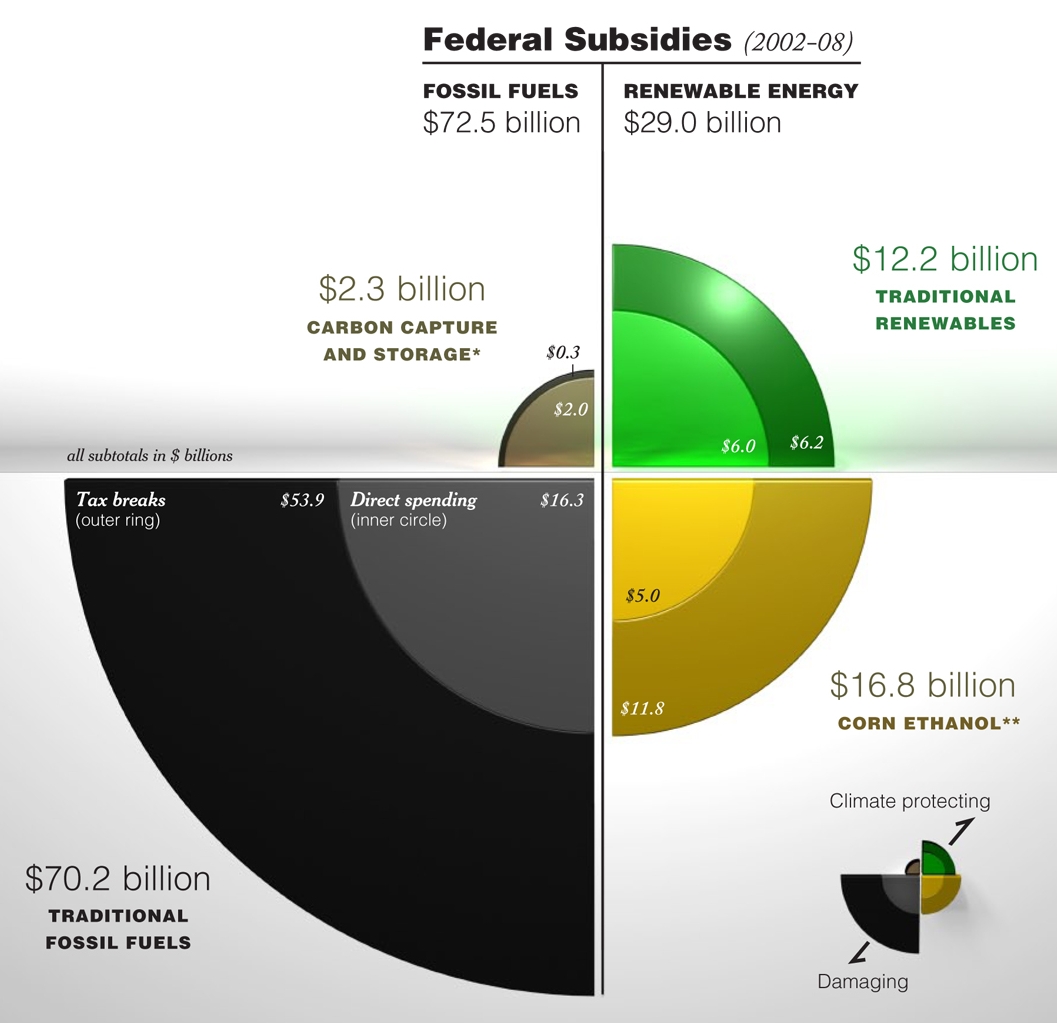
This is a point enviros often make, but a new report from the Environmental Law Institute and the Woodrow Wilson International Center for Scholars puts some teeth in it. “Estimating U.S. Government Subsidies to Energy Sources: 2002-2008” makes a fairly simple point, captured in this graphic:
energy subsidiesPublicly funding climate change.Environmental Law Institute

As you can see, fossil fuels received the vast bulk of federal subsidies during 2002-2008. This is true in terms of direct spending, but especially true in terms of tax breaks. Conservatives, of course, don’t want to acknowledge that tax breaks are subsidies. They want to call them “incentives” and accuse anyone who proposes repealing them of “raising taxes.” It happened during the debates over the 2007 energy bill—a version that would have rolled back some oil industry tax breaks was filibustered to death by Republicans under the guise of fighting “new taxes.”

Industry takes the same line. Jack Gerard, head of the American Petroleum Institute, is outraged anyone would call into question his precious subsidies incentives. Based on his statement, his defense is that, well, taxpayers get a good bargain for all those subsidies!

Expect that battle to heat up soon. As Steve Kretzmann reported on Grist last week, a leaked letter (PDF) from an Obama advisor to the other members of the G20 reveals that the administration plans to push for elimination of fossil fuel subsidies. Says the letter: “The G-20 should commit to take the lead in eliminating non-needs based fossil fuel and electricity subsidies and to provide technical assistance to non-G20 countries taking steps to reduce fossil fuel and electricity subsidies.” Obama reinforced the point yesterday in his speech before the UN, in which he said, “Later this week, I will work with my colleagues at the G20 to phase out fossil fuel subsidies so that we can better address our climate challenge.”

We’ll see how that goes.

A few stray notes

  • This report is actually quite conservative. It did not include any number of things that could be considered indirect or implicit subsidies. It didn’t include military spending to defend oil in the Middle East, spending on the electricity grid, or transportation spending. Those things don’t go exclusively to fossil fuels, but if there was a way of including the share that goes to fossil fuels, the fossil subsidy number would go way, way up. Infrastructure spending has more or less exclusively supported fossil fuels for decades now.
  • While the main thrust of the report is the predominance of fossil fuel subsidies, obviously another lesson is that corn ethanol receives subsidies wildly out of proportion to its usefulness. But we already knew that.
  • The report also didn’t include nuclear power—would be very curious to see where it ended up.
  • In his speech Obama touted his work with the World Bank to finance clean energy, but it’s worth noting that the World Bank is still heavily funding dirty energy projects. Obama needs to lean on them.

David Roberts is staff writer for Grist. You can follow his Twitter feed at twitter.com/drgrist.

Advertisement
Advertisement
  1. mwildfire Posted 6:02 am
    23 Sep 2009

    Thanks! Clean, simple graphs like that aren't used enough.
  2. EarthFire08's avatar

    EarthFire08 Posted 8:18 am
    23 Sep 2009

    Jack Gerard is in high-pitch drill-baby-drill mode, complaining about the "delays" in more offshore drilling. He also appears to be in lie-baby-lie mode, condemning the Woodrow Wilson report as "ludicrous" because it includes money for LIHEAP (a program to assist poor people with their energy bills) and the Strategic Petroleum Reserve. The lies are too many to count in the following paragraph quoting Gerard, from an article in the Oil and Gas Journal:

    Despite the publics clear desire for more domestic energy development and the industrys years of experience operating offshore in an environmentally sensitive way, this administration repeatedly has slow-pedaled this plan which would benefit all Americans, especially in these tough economic times, he said. New oil and gas development could create thousands of jobs, add over a trillion dollars to government coffers, strengthen Americas energy security and encourage our economic recovery. Its time to end the delays.

    http://www.ogj.com/index/blogs/washington-pulse/s-blogs/s-OGJ/s-washington-pulse/s-post987_5311474413428470551.html

    My question is -- would Jack and his oil/gas companies be willing to do all of this drilling MINUS all of the subsidies that make it profitable -- and perhaps even to factor in the externalities associated with GHG emissions / climate change? Does he know that federal dollars are being expended right now to improve hurricane forecasting so that operators of oil rigs along the Gulf Coast might have a few extra hours to hunker down and protect the rigs from fiercer and more damaging hurricanes, a result of burning the oil these rigs produce?

    It's time for the fossil fuel industry and its mouthpieces to come clean and admit that it has had a long, free ride on the back of the taxpayer, and the real delay has been in letting it go on much too long for the health of the energy economy and the health of the planet.
  3. veritone Posted 9:36 am
    23 Sep 2009

    I remember my Father telling me how John F Kennedy campaigned on eliminating the "oil depletion allowance," but stopped talking about it part of the way through the campaign because Big Oil halted the flow of contributions to the Democratic Party. Exxon-Mobil makes in excess of $30 Million profit per day these days and that's but one of the members of the API. That's an awful lot of influence to throw around and our elected reps usually come real cheap. Bribe them with merely tens of thousands of dollars and they'll give their graft-purveyors billions in public benefits.
  4. Sean Casten's avatar

    Sean Casten Posted 9:45 am
    23 Sep 2009

    David:

    Re: your question on nuke, the 2 year old GAO analysis here:

    http://www.grist.org/article/you-know-what-they-say-about-a-guy-with-a-big-footprint

    (which also errs on the heavily conservative side) gives a directional sense. They show $6.2B in R&D credits, far in excess of $ going to any other source, but leave out the big benefits that nuke has historically received in the form of rate payer guarantees to regulated utilities, insurance, waste disposal, etc. But it's a start... and corroboration of your larger point.
  5. amazingdrx's avatar

    amazingdrx Posted 9:48 am
    23 Sep 2009

    Once again this shows that shifting "incentives" (tax breaks) and subsidies from fossil and nuclear energy directly to tax breaks and subsidies for renewable energy, especially a national high voltage direct current power grid, could be done without raising taxes or cap and trade.

    It's a tax and revenue neutral path to national energy security and economic revival. And energy security and economic recovery is THE way to avoid anymore oil or energy/resource caused wars.

    Here's another thought, maybe if we didn't import oil from regions that support and harbor terrorists, we could remain a free society, where extraordinary restrictions are no longer needed. No more multi-faceted long national emergency for anti-constitutional forces to justify their push for official state kidnapping, torture, and murder.

    That's got to be a good thing.
  6. biscuits Posted 11:39 am
    23 Sep 2009

    To be fair, fossil fuels are a much higher percentage of the energy portfolio, and proportional to that, the disparity isn't as dramatic.

    But also to be fair, as David stated, this doesn't account for externalized costs -- how much does the state absorb in environmental disasters and clean up? Health care issues? Flooding from mountaintop removal?

    In Kentucky alone, an amazing study by MACED shows that mining and burning coal is costing KY about $115 million per year -- http://www.maced.org/coal/exe-summary.htm
    1. Duckhorn Posted 6:26 pm
      23 Sep 2009

      Thanks for the link. As someone who lives in Kentucky, the report was a real eye-opener. Coal takes its toll.
  7. ajdeem Posted 12:00 pm
    23 Sep 2009

    I think it's a good idea to at least try to push ourselves away from fossil fuels and work towards better energy sources. However, I'm not sure if this is the right way to do it. The world doesn't take change too lightly and we might be causing harm by trying to remove fossil fuels quickly. I'm not saying we shouldn't, but is the world ready? Is the older generation ready? I'm sure the new generation is, since a lot of the responsibility to fix this mess lies on our shoulders, but there is more to do than just removing fossil fuels. We also need to work on recycling and sustainable living.
  8. Charles Komanoff's avatar

    Charles Komanoff Posted 11:42 am
    24 Sep 2009

    My take is different from Dave's and most commenters': I'm struck by how low the ELI subsidies figure is. Their 7-year figure of $70.2 billion for conventional fossil fuels equates to just 12 cents per million Btu! (I divided $70.2B by the 594 Quads of FF's consumed in the U.S. 2002-08.)

    By comparison, FF prices in that period averaged around $8 per million Btu for crude oil, $6 for natural gas (at wellheads) and $1.50 for coal delivered to power plants. Mash that together to $5 or more per million Btu and you see that the subsidies figure is a paltry 2-3% of FF prices.

    Dave's point that the ELI figure is too conservative is well taken, but even doubling it gets you to just 5% (that is, FF subsidies equate to just 5% of fossil prices).

    Fossil fuel subsidies are loathsome, stupid and wrong. But it's fantasy to think that eliminating them would make renewables and efficiency considerably more competitive.
  9. JD_Williams Posted 8:36 am
    25 Sep 2009

    If we want to move away from fossil fuels and begin the process of becoming more energy independent, we must first cut down on the subsidization of fossil fuel production and consumption. Instead, we should focus our efforts on finding and supporting cleaner, renewable energy sources. However, simply eliminating the subsidies for fossil fuels is not the answer. It's going to be a long process to become energy independent; we need to invest in new technologies and make them as efficient as old ones if we want to see people buy into them. This is most easily done by providing subsidies and incentives for people using and testing new energy sources. With time comes change, and we are all witnesses to an energy revolution; it's nice to see the government is supportive of change in a broken system.
  10. GRLCowan's avatar

    GRLCowan Posted 9:04 am
    25 Sep 2009

    Fossil fuel subsidies are loathsome, stupid and wrong. But it's fantasy to think that eliminating them would make renewables and efficiency considerably more competitive.

    Not acknowledging that fossil fuel subsidies plus fossil fuel taxes net out to a large subsidy from the citizenry, to the government, is loathesome, stupid, and undignified.

    Government subsidizes certain clean energies out of its fossil fuel income. Those that can readily grow to cancel that income get no subsidy.

    (How fire can be domesticated)
  11. frantique1 Posted 6:14 am
    29 Sep 2009

    Without question these subsidies must be eliminated - perhaps gradually, but none the less eliminated. Energy production must be turned around ASAP
  12. cdehaes Posted 7:15 am
    06 Oct 2009

    As already said, a very clear set of graphics, thank you very much.
    Would you be able to let me know if this includes the subsidies to the international travel/transport industries? As far as I understand no fuel duty is charged on any fuel used for air/sea travel/transport. Given their disproportionate damage to the environment (air travel because the level at which it happens, sea travel because of the type of oil they use) it would be interesting to know what the level of their 'incentive' is.

Add a Comment

You are not logged in. Thus, you cannot post a comment. If you have an account, log in. If you don't have an account, well, by all means go make one! Meet you back here in five.

Hello, Visitor!    Why not register?

Advertisement