 In Meat Wagon, we round up the latest outrages from the meat and livestock industries.
——
Earlier this month, The Wall Street Journal reported that the Brazilian firm JBS–the globe’s largest beef processor–was on the verge of buying U.S. chicken giant Pilgrim’s Pride. Although the companies have since remained mum on the tie-up, rumors of an imminent deal continue to swirl.
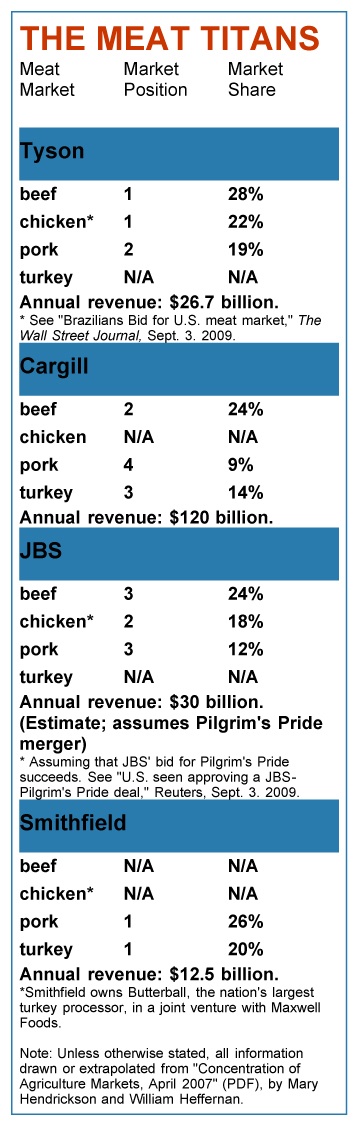
While we await and announcement, it’s worth considering what the U.S. meat industry would look like if JBS swallowed Pilgrim’s Pride. Essentially, it would look like this: four giants (JBS, Tyson, Cargill, and Smithfield) lumbering across the landscape, towering over and stepping on their farmer suppliers.
As it stands today, JBS processes 10 percent of the beef consumed worldwide. If the Pilgrim’s deal goes through, it will have large positions in the U.S. beef, pork, and chicken markets.
The move seems like a play to go toe-to-toe with Tyson, the only other company with large positions in those three commodities. As one industry observer put it on the AgWeb blog, wielding such large positions across commodities gives Tyson leverage with big retailers for shelf space. He writes:
I know that Tyson’s multi-meat capabilities give them an advantage over competitors who lack their diversified market exposure and can’t offer big retailers a full line of meat case products.
JBS’s move, if it goes through, augurs fierce competition between the few remaining meat processors–which means severe downward pressure on the prices received by farmers, fewer and yet larger factory animal farms, and yet more incentives to take short cuts and compromise worker safety and public health.
It’s too early to say whether the Obama Justice Department is serious about reigning in the unchecked market power of our few remaining meat processors. If JBS and Pilgrim’s Pride finalize this deal, we’ll have our first real test.
*
More info:
— Brazilians Bid for U.S. Meat Titan, The Wall Street Journal
— U.S. seen approving a JBS-Pilgrim’s Pride deal, Reuters
— Concentration of Agriculture Markets, April 2007 [PDF], by Mary Hendrickson and William Heffernan