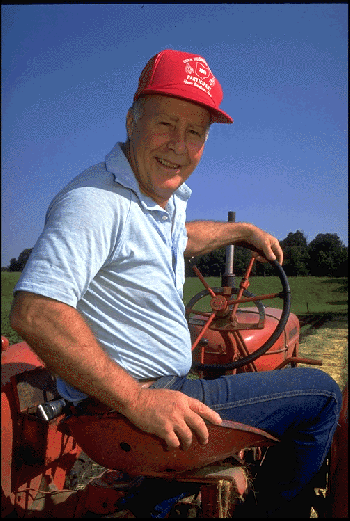
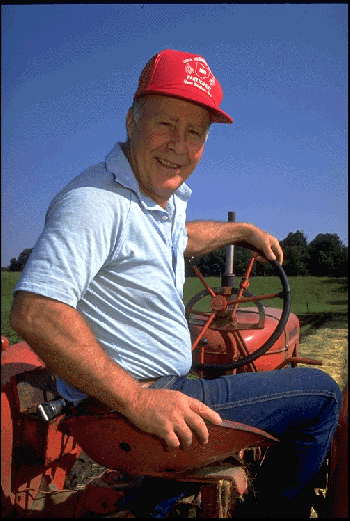
 Gene Logsdon on his farm.Gene Logsdon is one of the clearest and most original voices of rural America. He’s a farmer in Ohio not far from his boyhood home, and is a writer to boot; he’s published more than two dozen books; some of which include Living at Nature’s Pace: Farming and the American Dream and The Contrary Farmer. Wendell Berry calls Logsdon “the best agricultural writer we have,” and his farm a slice of Eden. But most importantly, Logsdon loves farming. So now that more and more people are seeking out locally grown foods, I asked Gene a few questions about one of his specialties: small-scale grain raising.
——–
M.M.: In Small-Scale Grain Raising you write that, “We have become a nation dangerously dependent on politically motivated and money-motivated processes for our food, clothing, and shelter.” In light of the current economic crisis, how can growing your own food help people achieve a greater sense of independence?
G.L.: The politicians and corporate puppet masters have been successful over the past century in convincing people that ‘independence’ is an idea for the country as a whole, if even that, which is what enables the government to protect our ‘independence’ by spying on its own citizens. Or on defining it as the freedom to buy a bunch of crap as prices that can only support slave wages. Happily, nearly any of us can see through this with just a little prodding-and our Latest and Greatest Depression does the trick pretty well, or the prospect of something like Peak Oil for that matter. Independence only really means something when it applies to individuals, to families, to communities. That’s what people are yearning for, and growing your own grains is about as basic to true independence as you can get. And anyway, industrial food doesn’t even taste all that good!
Describe your concept of the garden “pancake patch.”
The pancake patch is just a sort of cute way to refer to plots of grain grown for homebaked goods. The concept is what the whole book is about.
What are the main differences between the commercial grain grower and the small-scale grain grower?
The commercial grower raises large acreages of grain, using large equipment and methods that encourage soil erosion, usually uses chemical fertilizers and pesticides, and genetically modified seed. The small-scale grower raises small plots not as prone to soil erosion or compaction, and often grows the grains organically or with minimal chemical applications or genetically modified seed.
When Small-Scale Grain Raising was first published in 1977, the locavore, organic, sustainability, CSA, and whole-foods movements were barely beginning. Now that eating locally is becoming more mainstream, how do you see local farming-and specifically grain growing-progressing in the next thirty years?
I think the commercial method of large acreages, huge equipment, where the grain may move faraway to animal factories and the meat, milk and eggs shipped back to where the grain was grown will become too expensive and inefficient to survive. A mere sixty years ago every local area had several flour mills, and many bakeries and breweries. Worked fine. In another 30 years we will be well on our well to the same kind of local, decentralized food economy.
Do you have to be a market farmer to grow your own grain?
Anybody who knows how to garden can grow grain. And if you don’t know how to garden yet, grain is as good a way to start as any.
Can you talk a bit about the current economic climate surrounding grains and the products made from them–for example, flour?
The grain markets are extremely volatile at the moment. Last summer’s historic highs have collapsed. Right now corn, for example is about $3.80 a bushel, about a breakeven price considering the high costs of seed, fertilizer, equipment, and land. The predicted increasing demand for grain from other countries has not materialized. On the other hand, specialty grain growers and flour producers, especially organic products, still have a fairly good price to work with.
What do you think has sparked a new (or renewed) interest in homegrown grains?
The uncertain economy, of course. People are looking for ways to save money, or more precisely, for a way of life less dependent on the regular economy.
A message from
Your support keeps our climate news free.
Grist is the only award-winning newsroom focused on exploring equitable solutions to climate change. It’s vital reporting made entirely possible by loyal readers like you.
At Grist, we don’t believe in paywalls. Instead, we rely on our readers to pitch in what they can so that we can continue bringing you our solution-based climate news. Donate today to keep our site free.