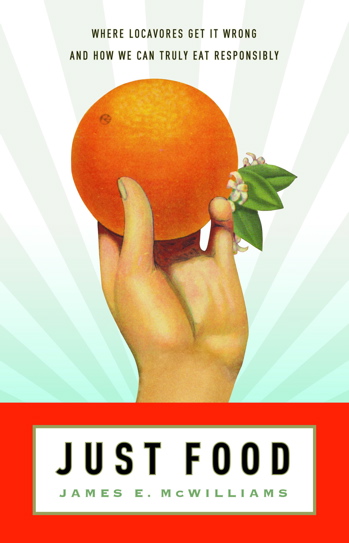
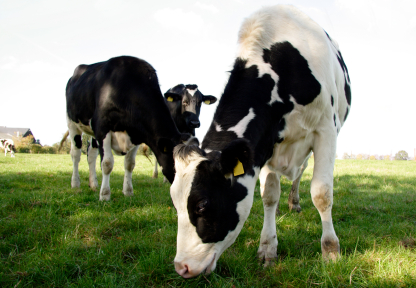
 Cows on pasture: potential solution, or menace to society? What is just food? One might answer: food produced without causing undue ecological damage, food grown under production systems that allow workers and farmers to earn livable wages, food that’s healthy, accessible, and affordable to everyone who eats.
To James E. McWilliams, author of the new book Just Food: Where Locavores Get It Wrong and How We Can Truly Eat Responsibly, just food is certainly much more than food produced and purchased locally, and his book wags a contrarian finger at the “locavores” who believe purchasing food grown close to home somehow makes it more just, fair, or better for society and the planet.
“The locavore approach to reforming our broken food system has serious limits-limits that our exuberant acceptance of eating local has obscured,” McWilliams writes. In their application of a simplistic valuing methodology (judging food purely by how far away from one’s plate it originated), he claims, these 100-mile dieters could potentially do more harm than good, if they succeeded in their apparent mission to force the entire world’s eaters to choose food grown within a short drive of their kitchen table.
The problem with this argument is its irrelevance. The few truly orthodox locavores who presumably exist (do you know even one?) aren’t close to persuading the world to eat the way they do. To devote an entire book to debunking the impulse to eat closer to home doesn’t address the points raised by food and farm activists. At their most relevant, today’s alternative eaters illuminate the systemic problems created by industrialized food provisioning: negative impacts on the global climate as well as significant deterioration in water quality, soil quality, local economies, worker justice, and human health.
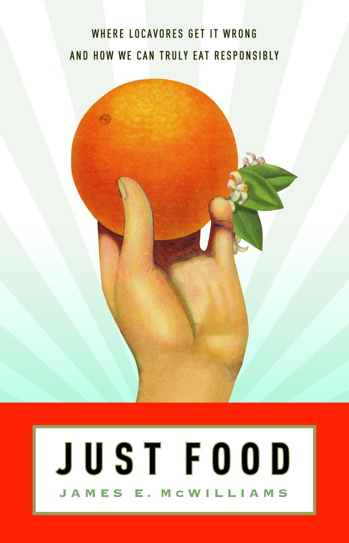 McWilliams reduces the message of the food movement to a simple prescription–eat local–and proceeds to debunk it. Yet it’s hard to believe any thoughtful person could imagine that eating locally would address this multitude of issues. One imagines, rather, that consumers, when faced with a system they don’t support, are voting with their dollars for the only alternatives they can find-local food at the farmers market and organic products at the store. What McWilliams seems to miss is that these purchasing choices don’t make people fundamentalist locavores or organic purists. The locavores I know don’t view shopping consciously as a solution; they view it as a protest.
The author often categorizes proponents of alternative food systems–first locavores, then organic advocates, then those who object to genetically modified crops–as wild-eyed extremists in need of some firm schooling on “a golden mean of producing food.” McWilliams’ vision of this agricultural golden mean promotes lifecycle assessments over food miles, and judicious pesticide use over organics. He preaches the potential of genetically modified cassava to feed starving Africans, dismisses grass-fed beef because it can’t be scaled up to meet current demand, and advocates a drastic increase in freshwater aquaculture to meet demands for animal protein.
Again and again, one gets the uncomfortable feeling that McWilliams creates fanatical straw men in order to make his own presentation of facts seem like a rational alternative. “The problems that I have with organic agriculture have less to do with how it is currently practiced than with the inflated claim that it’s the only alternative to today’s wasteful conventional production,” he writes. But do any serious proponents seeking more sustainable alternatives to conventional agriculture claim this?
As he continues on his mission to disabuse the ecological faithful of their trust in growing organically, McWilliams uses the fact that sometimes organic growers use toxic natural compounds to knock organic off what he perceives to be its high horse of purity, and then cites the work of Bruce Ames, a controversial Berkeley scientist, to support the view that many modern pesticides don’t hold the same risks as their older counterparts. Despite devoting pages to each of these points, they do little to move McWilliams towards his chapter’s supposed conclusion: that organic should fall within a “continuum of farming systems.” A discussion of the pros and cons of organic and conventional production, and a studied evaluation of other farming systems along such a continuum, would have been a good start.
McWilliams’ defense of modern pesticides leads him to a contradiction. If pesticides aren’t so bad, one wonders why the author’s measured support for GMO crops hinges in part with the argument that they allow for a reduction in pesticide use. Or do they? “To be sure, there are many studies that show the exact opposite-that is, that GM crops have done nothing to reduce pesticide use,” McWilliams writes.
Paying little heed to such inconvenient tangles in this chapter or others, McWilliams hurtles forward down the path of measured (the man loves his middle ground) support for GM crops. In his rush to the middle, though, the author misses some important facets of the GM debate. For example, he glosses over evidence that GM technology hasn’t managed to boost yields, much industry hype to the contrary; and he ignores the vested interest in today’s crop of herbicide-tolerant genetically modified seeds: namely, that the companies that sell seeds with herbicide resistance also peddle the herbicides that must accompany their product.
This blithe obliviousness to the profit-seeking motives of the GM seed industry allows McWillams to argue for development of GM technology for “subsistence oriented” crops so they might thrive in dry or salty soils. This argument falls short on economic and theoretical grounds. While Monsanto can make billions of dollars per year selling Roundup Ready corn and soy (and Roundup) to industrial-scale farmers, there’s little cash to be made selling, say, drought-tolerant cassava to African smallholders. So what entity is going to develop such seeds? McWilliams’ answer: the Gates Foundation. But while the aims of the foundation are admirable, there’s plenty of evidence that Gates, like McWilliams, doesn’t really understand hunger in Africa.
Gates and McWilliams, in promoting biotechnology as the solution to Africa’s food troubles, take a shortsighted view of hunger, seeing it only through the lens of yield shortages and disregarding the ample historical evidence that hunger in developing countries has at least as much to do with world trade, democratic failures, poverty, and conflict as they do with the lack of a salt-tolerant sorghum seed.
 McWilliams: courageously manning the middle of the road. The most sensible recommendation McWilliams makes is that if we want to lesson agriculture’s impact on natural systems, we need to eat less meat. In forming this argument, he relies heavily on a 2006 report from the Food and Agriculture Organization, almost to the point where one felt reading the report and getting data firsthand might have been a better use of time. McWilliams’ also hypes the importance of life-cycle analyses (LCAs) in pointing out inefficiencies in the food system. LCAs are good tools, but they hardly represent the sort of radical approach that’s “off the public radar screen,” as the author claims, ignored by locavores the world over as they persist in stubbornly clinging to food miles as their shortcut solution for determining a food’s ecological footprint.
McWilliams’ stated goal in writing Just Food was to lay a blueprint for “how we can truly eat responsibly.” He’s right in pointing out that eating locally and organically alone won’t result in the creation of a just food system, and that there’s much work left to do if the aim is sustainability in food provisioning. Yet his book fails to outline any sort of considered analysis of what a “truly” responsible food system might look like. Instead, the author wastes time promoting himself as the arbiter of rational thinking about the food system, an antidote to those rabid locavores and organic purists crowding the aisles of Whole Foods and farmers markets who vainly believe they’ve found the solution to our food systems’ problems.
One imagines McWilliams, a historian at Texas State University, might have written a book more in tune with his academic training, perhaps an examination of the rise of the varied movements of local eating, organic growing, fair trade, and healthy food access. He could have combined this historical survey with an analysis of what these movements mean in the greater context of our increasingly globalizing food system, and concluded with how they might be woven together into a forward-thinking approach that moves us toward the “just food” he claims to care so much about. Instead, we’re left with a treatise that focuses more on taking Alice Waters and Slow Food advocates down a peg than on putting forth innovative solutions to the problems within our food system. While this might be the author’s idea of fun, it’s ultimately a childish way to make a point, and a disappointing strategy on which to hinge a book.