You're not from around here, are you?

‘Localwashing’ in pictures—bogus marketing at its finest 32

Local food, local goods, local everything is in, as you’ve no doubt heard. Local is fresher. Local burns less shipping fuel. Local keeps the wealth nearby.

Naturally, there’s money to be made off local, so big businesses are muscling into the game. The emerging term is localwashing—a variation on greenwashing wherein businesses claim to be local when actually ... you get it.

“The ingenuity of the food manufacturers and marketers never ceases to amaze me,” said author Michael Pollan, who’s done more to articulate the need for local in the food realm than maybe anyone else. “They can turn any critique into a new way to sell food. You’ve got to hand it to them.”

Here’s a look at some prime examples of that ingenuity/absurdity/deception.


Citgo
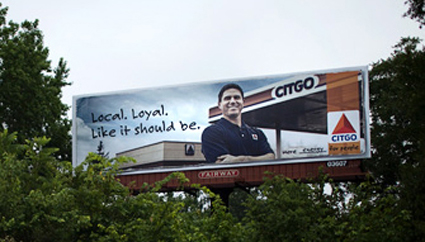
Citgo-localCourtesy NEAFP.comCitgo: “Local. Loyal. Like it should be.” The crop of new billboards from the petroleum company owned by Hugo Chavez’s Venezuelan government makes sense only if the rather undemocratic president lives around the corner from you. Which he doesn’t.


Jonathan Hiskes is a Grist staff writer. He reports, tweets, eats, asks questions, self-promotes, looks out windows, and wonders if it could be like this.

Advertisement
Advertisement
  1. kurtseitz Posted 4:36 pm
    04 Sep 2009

    Sorry folks, but you're a bit off regarding Citgo, which is clearly advertising that Citgo stations are locally owned and operated (true). You're also off with the anti-Venezuela propaganda that continues to permeate conventional news outlets. Venezuela is at least as democratic as the US. (The NY Times has been on the anti-Chavez bandwagon for awhile... check out FAIR's alert from 2007: http://www.fair.org/index.php?page=3046 .)
    1. solar greg Posted 4:42 pm
      07 Sep 2009

      Chavez democtratic?? Closing news media because he feels like it? that is democratic? Confiscating private companies assets because it's in the countries best interest. He recently intervened the two biggest coffee distributors and took over. Have you ever heard him speak??After the insulting way he kept interrupting the guy from Spain in the UN, and was finally told to shut up, his reaction was to say he could close down Spanish companies in Venezuela. If you think Chavez respects democracy you must be watching too much TV.  
    2. solar greg Posted 4:57 pm
      07 Sep 2009

      Chavez is Castro's pupil. If there is a threat to democracy, it is Chavez!Just listen to his Anti American speeches or find out what he is doing to the news media. He has shut down anybody who oposes his Regime. We buy oil from our enemies!Let's just stop buying oil, specially from Venezuela.
      1. OldMajor Posted 6:07 pm
        09 Sep 2009

        Opposing the policies of the United States and opposing democracy are two different things.
    3. kurtseitz Posted 3:57 pm
      08 Sep 2009

      The essence of buying local is simplicity: knowing the person you are purchasing from and knowing the source of all the ingredients (which are few, preferably). Admittedly off-topic, but to rebut the Chavez comments (which in no way means that I support Chavez): http://www.guardian.co.uk/film/2009/sep/03/oliver-stone-south-of-the-border-hugo-chavezhttp://www.commondreams.org/archive/2007/11/23/5398http://www.venezuelanalysis.com/news/4780
      1. solar greg Posted 6:07 pm
        08 Sep 2009

        If you want to say hi to your hero, he is celebrating with Kadafi his 40 years of rule, taken by force.He just passed a law called "Delito Mediatico" which means Media Crimes. It can put people in jail for 4 years for saying anything the government considers not true. It even punishes people with jail if they withold information from the authorities.Sorry if I keep on the same theme but this is serious stuff and the effort to distort the truth is huge! 
  2. Matt Petryni Posted 6:06 pm
    04 Sep 2009

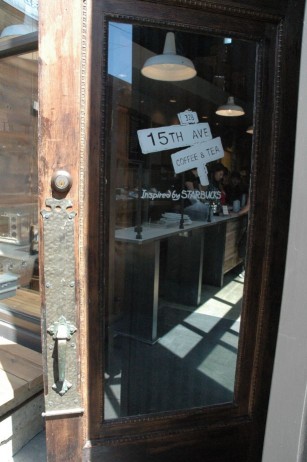
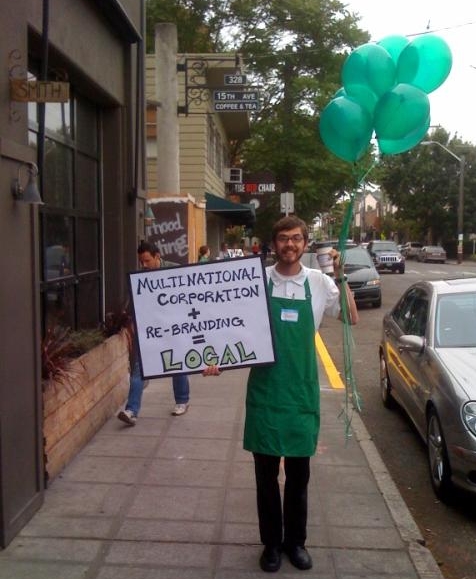
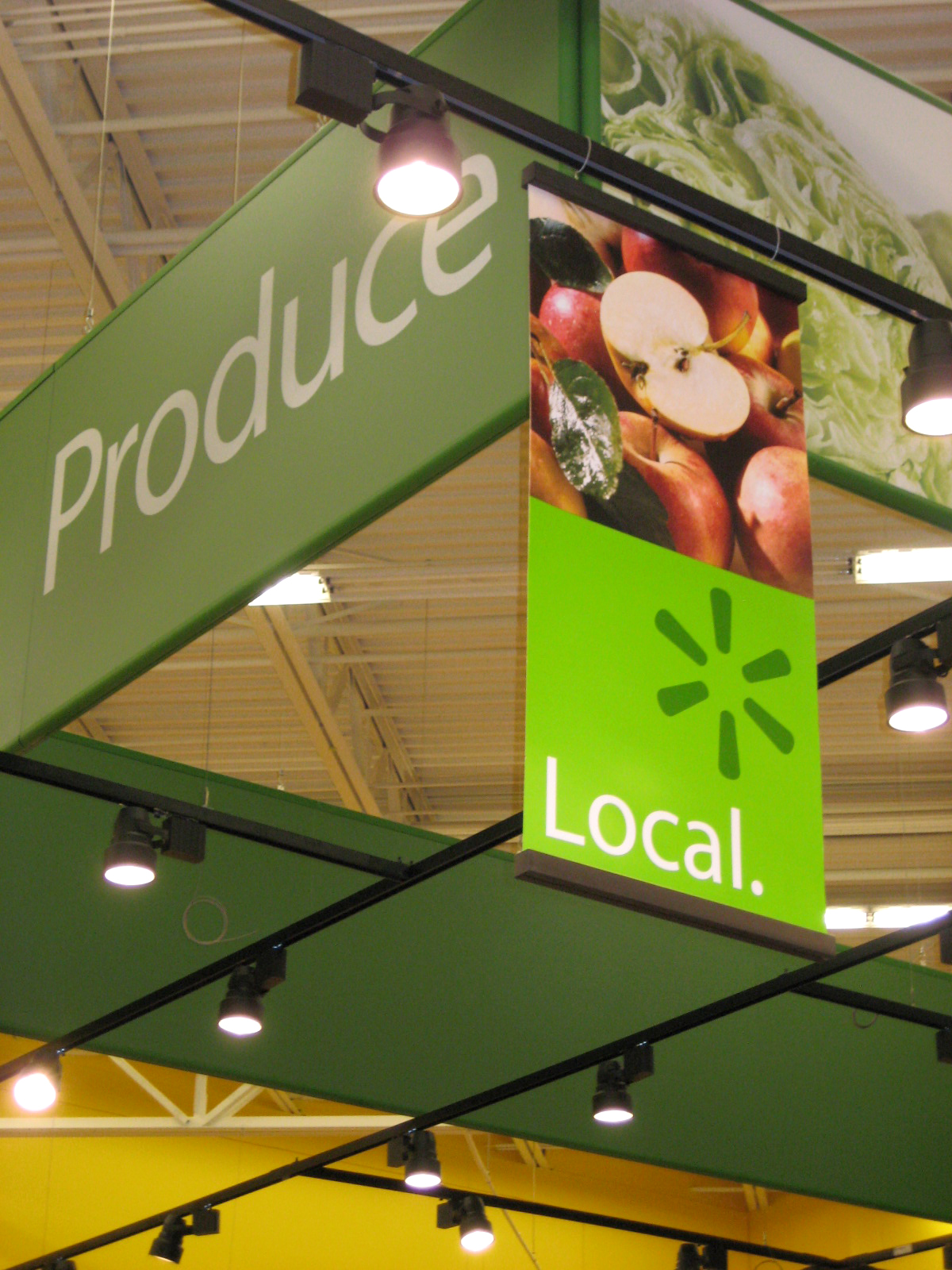
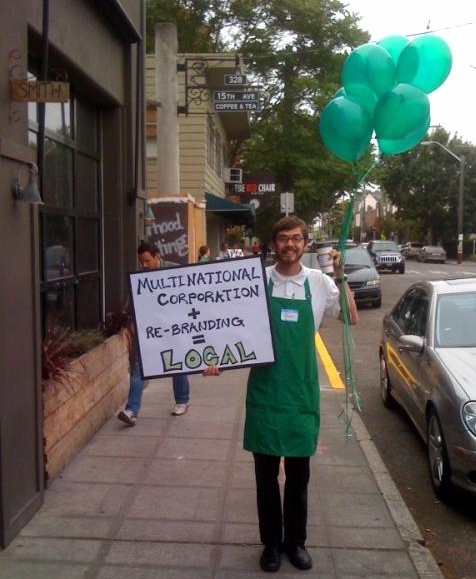
    This is an interesting article. I knew this phenomenon was obviously coming: at least here in Seattle, being "local" means a great deal for business. This is likely part of why there was such outrage when Starbucks - which, by the way, is ironically a local company in the sense they are headquartered here - rebranded itself as "15th Avenue Coffee and Tea" on Capitol Hill.While this case of "localwashing" was relatively minor by national standards (especially when compared to something like Wal-Mart's ambigious "Local" sign), it garnered a lot of attention locally. Less talked about is the more casual localwashing, like a radio ad I heard the other day for Fred Meyer: "When it comes to produce, buy fresh, buy local at Fred Meyer." I almost threw up in my mouth a little bit.Ultimately, this whole experience comes with some good news: consumers are receptive to at least some form of a grassroots education campaign. We knew that already, probably. As Stacy Mitchell points out, these advertising gimmicks are evidence that consumers are simply now more aware of the value of buying local, though some may not know where that value comes from.The real downside could be that some consumers may not be quite receptive enough, such that they can be duped into shopping "local" at Wal-Mart by a cheap vinyl sign. Other consumers might still be stuck in the old days of retail purchasing, where one assumes the price point is the only price point, if you get my drift...Hopefully both phenomena are a increasingly temporary problem, especially if consumer consciousness about the value of buying local continues to rise as it has been so far, and if more consumers begin to consider both externalized and internalized costs of a product when they're deciding whether or not to make a purchase.
  3. William Verde Posted 7:58 pm
    04 Sep 2009

    I submit that the only certainties in life are death, taxes, and smart marketers will use and embrace whatever sells, or might sell, their product.  Even should the green/sustainability/progressives "win", at the end of the day, the buyer should ALWAYS beware.  The green business movement, conscious consumer movement, global corporate resistance movement - whatever you want to call it - needs to continue educate, call out the Liars and Tricksters, and offer authentic alternatives.  Good post, Jonathan!
  4. Des Emery Posted 9:15 pm
    04 Sep 2009

    "Local" is an interesting word.  Like being "new and improved" it is now being expropriated by the advertising industry in efforts to make consumers believe their acceptance and purchase of a product will somehow impact on their neighbours.  Perhaps true enough.But politics can also enter the equation.  Buying merchandise locally can easily become the protectionist "Buy American" mantra expanded from a local exhortation into a national law.  Unfortunately.
  5. OldMajor Posted 10:01 pm
    04 Sep 2009

    Buying American isn't such a bad idea.  We've seen good-paying manufacturing jobs turn into less-good-paying sales jobs in the last 30-40 years at least in part because there hasn't been enough effort by Americans to buy American.  Penny-wise and pound-foolish.  Buying local is generally a good idea, but buying thoughtfully is better.  Advertising is designed to take the place of thought - ignore it.  Or don't really ignore it, but think it through.
    1. Des Emery Posted 5:54 pm
      05 Sep 2009

      Oldmajor sounds pretty patriotic, and presents some logical ideas.  But logic also dictates that buying American (which does contribute to the support of your neighbour) obliges you to reject buying anything made or grown anywhere else in the world, like French wine, Italian cheese, or Japanese automobiles.  It also implies that you are willing to forego the sale of American-made goods to France, Italy or Japan, since those countries are equally as apt to buy stuff "locally" made or produced in France, Italy or Japan. Or Canada.In the interests of full disclosure, I am a patriotic Canadian.  I must admit that I am somewhat disgruntled that California, in it's Buy American fervour. actually tore up certain pipelines which had been installed in a legal bidding process won by a Canadian pump manufacturer.  But we are still open to American companies bidding (and winning) contracts.  Remember, protectionism invites reciprocal protectionism.It is one thing to support the local farmer by buying his produce, but quite another to extend the principle to general commerce.  The difference between the two must be carefully scrutinized, and unfortunately there are many companies like the ones illustrating this Grist item which seek to mislead the consumer. 
  6. Tyler Durden Posted 10:35 am
    05 Sep 2009

    I agree with Kurt's comment and I'd emphasize the "at least" portion.  Bush stole two elections, Chavez was fairly and honestly elected, even with the media, which is owned by the wealthy, aligned against him.  Now to the bigger issue in this post.Until and unless most people start paying attention to things other than their disgusting cars, TVs, and cellphones, they will always be fooled by those with enough money and power to do so.  Some people who post here, most notably Dave Roberts, are under the false impression that only big government can save us.  The fact is, as Obama has said, that it takes the people to make real changes.  That's not to say there isn't a big role for government to play, but unless the people take responsibility and exercise some control by methods like voting with their pocketbooks, nothing substantial will change.
  7. mikeyohare Posted 2:31 pm
    05 Sep 2009

    I think it's a good thing that companies are talking local. Many companies start with marketing and their products and services follow. Isn't it good that they're taking a step in the right direction?I also think it's down to us as consumers to look at the company and what they're saying to make our own opinion of whether they are local or not.Michael O'Harehttp://toolbarqueries.google.com/favicon.ico PR: wait...http://www.google.com/favicon.ico I: wait...http://www.google.com/favicon.ico L: wait...http://siteexplorer.search.yahoo.com/favicon.ico LD: wait...http://www.bing.com/favicon.ico I: wait...wait...http://www.semrush.com/favicon.ico Rank: wait...http://www.semrush.com/favicon.ico Traffic: wait...http://www.semrush.com/favicon.ico Price: wait...http://siteanalytics.compete.com/favicon.ico C: wait...chrome://seoquake/content/skin/close.gif chrome://seoquake/content/skin/close.gif
    1. Jonathan Hiskes's avatar

      Jonathan Hiskes Posted 10:16 am
      07 Sep 2009

      Auden Schendler makes the argument, in Getting Green Done, that corporate greenwashing can be good if it presents an opportunity to hold companies accountable. It lets consumers say, "So you're claiming to be green. Here's how to really do it..." I don't completely buy this line of thinking--wouldn't honesty/transparency be a better place to start? But I like the idea of seeing greenwashing/localwashing as an opportunity for progress, rather than something to get all huffy about.
    2. OldMajor Posted 7:09 pm
      09 Sep 2009

      Companies aren't actually being local, they just pretend.  Wal*Mart isn't your local store.  They try to muddy the waters by claiming that "local" just means not via the internet.
  8. Matt Petryni Posted 3:11 pm
    05 Sep 2009

    Well, yeah, you're right, but ultimately it's simply impossible for some companies, like Wal-Mart, to ever be "local." Not only does it totally contradict their entire business model, the profit generated by their company locally will always (in my case) be leaving Seattle for Bentonville, Arkansas. This last fact makes almost any version of "local" peddled by them disingenuous at best and utterly cynical at worst.Not to mention that even localizing their supply chain would cost them tremendously in terms of price point, and is therefore incredibly unlikely. Some companies might be able to become "more local" to the communities where they operate, but it'll be usually be very painful for them to get to anywhere near what we actually mean when we say we want to "buy local."
  9. iansully Posted 3:43 pm
    05 Sep 2009

    Most large supermarkets simply can't truly be "local".  even if you live next door to the greenhouse were they grow the vegetables - which is the kind of quaint idea they want to portray - they'd still drive/ship/fly it to their sorting and distributing centres.In terms of the environment something grown on the other side of the world and then shipped over can use less carbon then something grown in your own town.Local-wash is definitely the latest fad though so we'll have to get used to it.
    1. chelsea.b Posted 11:03 pm
      08 Sep 2009

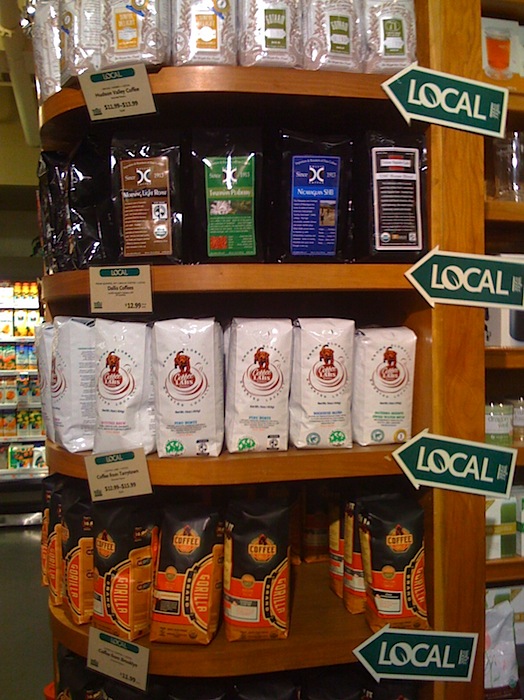
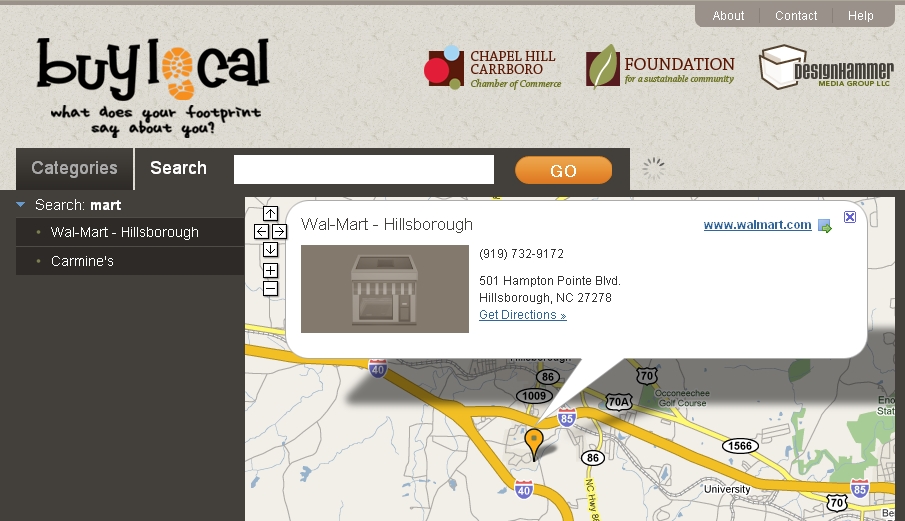
      Many of Whole Foods' local vendors drive the products themselves up to the door of the stores. I work there, so I am both biased and have seen it happen nearly every week of the year at locations all over the US. Because shoppers still want strawberries and cucumbers all year, we are a long way off from an all local grocery store format, but WF is committed to supporting their local communities whenever possible.The coffee company in the picture is a Brooklyn based company, so it's a hard one to call them out on... the raw beans may be grown elsewhere, but they are roasted in Brooklyn. A gray area, maybe, but that is a product "made locally" in New York, IMO. A small business owned by people who live in the neighborhood is supported when that product is purchased.I've got a local soap maker who uses essential oils sourced from plants all over the world. I don't think it is fair for me to say she "doesn't count" as a local vendor because she doesn't grow the plants, process the oils, and create the finished product all within my store's zipcode. And the woman who knits mittens and uses alpaca and wool from Nepal and New Zealand. Does that make her a "global corporation" with a carbon footprint too big to be worth my support? That seems pretty limiting and unrealistic. Unless you want to say that the local label only belongs on *food* grown in the area you are nearly always going to run into materials sourced from elsewhere. 
      1. Matt Petryni Posted 12:43 am
        09 Sep 2009

        Well, it's hard to currently say where we go with this in the long run, or how local we should ultimately demand our products to be. The reason is simply because, like most brilliant ideas, there are a vast number of reasons to support an idea like patronizing local business over that of "chains." It's harder when you get somewhat nit-picky, as in the case of Whole Foods, or the Starbucks experiments in "localwashing" (although those experiments do in fact occur in a town where they are headquartered, employ large workforces, and roast a lot of their beans, just as a non-globalized coffeeshop next door does).In this sort of more gray territory, one rationale might predominate over another. Local economic resilience and diversification may be more important to a given community or consumer than product lifecycle carbon footprint. In another context, knowing and trusting the source of your product might be more important than ensuring local retention of profits. In yet another case, it might be more worthwhile to support a smaller, more independent operation than contribute to the success of an entity which concentrates wealth in the hands of a few, even if that few are "local." Dozens of hypothetical situations exist where one of the benefits of buying local might come into conflict with another, and determining the "best route" might rely primarily on how you prioritize your values.Further, one of the great qualities (and to some, shortcomings) of environmentalism is its explicitly immaterialist nature. Often what is an appropriate route to an environmentalist is not one that can always be specifically proven using empirical fact, but relies instead on other aspects of human experience: nonmaterial aspects. This is obviously not to say they ignore that which is materially proven, they should just use it as but one means to inform their decisions. To many, this holistic approach is viewed as a kind of "earth religion" or environmentalist ignorance that the 35% markup at local restaurants (compared to Applebee's) simply rips them off with no statistically demonstrable personal benefit. However, I'd argue to such critics that enjoying a high quality of life relies on more, and is certainly of greater importance, than merely accumulating material wealth.All that being said, there are a number of clear black-and-white lines in the sketches of an environmentalist philosophy. Generally speaking, buying food from a local producer or locally-owned grocer will be better than buying it from a Wal-Mart. It's arguably better to buy locally-grown food from a Whole Foods than a fully globalized product from a Wal-Mart. (I mean, that is, if you've had realization of the experience of value beyond the materially measurable and monetarily manifest, and internalize that realization into your consumer price point.) Most environmentalists can agree on the route in areas like those.Where there is more reason to differ is cases like those you present: the gray areas. We have to admit in these areas our reasoning is more arbitrary, diverse, and individualized than in the more obvious environmentally sound choices. And that should be okay.
  10. Dave Ewoldt Posted 11:16 pm
    05 Sep 2009

    Putting aside the fact that we should be using much less in the way of fossil fuel, regardless of source, I don't know if I'd rely on the NY Times to be able to point me toward a democratic government. Yeah, Citgo gas isn't local (although the store ownership is), but I sure don't see Obama giving me even as much help as Chavez is giving his people.Comments like that only detract from the veracity of Grist. Please be more careful.
  11. marcie's avatar

    marcie Posted 8:26 pm
    06 Sep 2009

    Glad you got a pic of the citgo billboard, there were a bunch around here but I couldn't find one to send recently. Such BS.
  12. OldMajor Posted 9:10 pm
    06 Sep 2009

    I think there is room for competition between countries that are on an equal footing.  I don't think the US should generally disallow products from Canada.  If there's a specific problem, like dirty tar sands oil or the seal hunt, that is a different matter.  It's not Canada's fault that the US is shooting itself in the foot on health insurance.  I am mostly concerned with imports from countries that unfairly compete by exploiting low-paid labor or a lack of environmental and worker-safety protections.Decisions about trade and competition should be made rationally, taking into account the broadest spectrum of interests involved as possible.  And there should always be an eye towards fairness.
    1. Tyler Durden Posted 11:05 am
      07 Sep 2009

      "Decisions about trade and competition should be made rationally, taking
      into account the broadest spectrum of interests involved as possible."This is a very anti-environmental statement and this idea is what's wrong with global trade to begin with.  The primary issue from an environmental perspective is that moving things around in industrial society causes massive consumption, refining, and burning of fossil fuel, and a lot of noise in the oceans, all of which are very environmentally destructive.  (I will ignore the baloney that claims that buying locally can cause more consumption of fuel; the falsity of this statement is clear on its face.)  Purchasing things from places that have lower environmental standards is a minor issue comparatively, though it's also a major issue.  If you support global trade, you are saying that you are willing to sacrifice the natural environment for money.
    2. Des Emery Posted 5:57 pm
      07 Sep 2009

      Yes, there is a problem with Canada's 'oil sands,' or 'tarsands,' or 'bitumen.'  A tremendous amount of water is required to 'wash' out the oil, the water then stored in tailings ponds large enough to be seen from the space shuttle, and the oil pipelined to American refineries.  Because of the economic turndown in the States, China has purchased interests in the sands and is expected to pipe the oil over the mountains to the Pacific and then ship it to China for refining.  Most Canadians are not happy with either arrangement.But the seal hunt is a different matter.  It is much less anti-animal than, say, raising veal for cuisine or mink for furcoats.  Is it bloody?  Yes.  Is it cruel?  No.  And the seal herds are bigger than ever, taking a lot of cod and haddock.Canada is only one of many countries which have government health plans.  We all are glad we do, and wonder why you - a progressive country which is famed for standing up for 'human rights' - allow insurance companies (like AIG) to dictate what you are allowed to have or have not.  From what I read, it seems that you are only permitted to go to certain doctors instead of having the right to choose your own preferences.  If I'm wrong about that, I stand to be corrected.All of which is to say that 'local' is always better in principle, though not always practical.  Just like bigger is not necessarily always better, though it sometimes works that way.  Individuals have to think for themselves about everything, but we are often too lazy to do the hard work involved in actually 'thinking' things through instead of just reacting.  
  13. dniall Posted 5:21 pm
    07 Sep 2009

    Here's an idea. Why don't we (ie. enviros) rebrand "local" by calling it, say, "assmonkey." Thus reclaiming ownership of the word, if you will. Then if in a few years time, Walmart and Co. co-opt our brand and start hanging "assmonkey" signs in their stores, at least it'd be funny!
  14. SteveH Posted 6:39 pm
    07 Sep 2009

    The thing to remember is that buying local is usually greenwash to begin with.  We know that fossil fuel use is less with most organic produce compared to local, standard food production.  Keeping money out of the distributors' pockets does leave more for the producer, so that's a good thing, but not guaranteed with local products.In a sense, buying local, no matter reduced impacts or increased payment to producers, offers a non-offending way to make more people concerned consumers -- the first step to improving the demand-side conditions for wider adoption of sustainable production.
  15. Surfing Nutritionist Posted 8:30 pm
    07 Sep 2009

    While I agree that clever marketers are exploiting every opportunity that comes there way, we also fall right into their traps.Nearly all big companies that use advertising heavily (the very kind portrayed in this article) do testing with their consumers before they "OK" an ad being launched. One of the very common attributes measured in that world is "believability." What that means is that if you're a person seeing that ad, you would agree that what is being shown is more or less easy to believe. So yes, the advertisers are being clever (and they know full well down the percentage how many of us buy into the idea of "local" but really don't understand what it means) but we are also basically telling them they have a believable ad. We're making it easy for them. Maybe Grist readers and food movement types see right through this stuff but obviously there is a much bigger portion of the population sees these ads as easy to believe. That might be a bigger problem than the advertising itself.If our culture was better educated on the complexities of food/environment/health, we wouldn't believe these kinds of ads and therefore they probably wouldn't get made. Our collective level of education gets played right back to us. 
  16. guade00 Posted 9:05 am
    08 Sep 2009

    Buying local is good. Buying less is even better.
  17. vinniechops Posted 7:47 am
    09 Sep 2009

    We should think twice before we adopt the views of the major US News Media on international issues, such as the legitimacy of Hugo Chavez's presidency. The guy won the presidency with 63% of the vote, that's about 13% than Obama had gotten.Also, as Americans, we should think twice before we start judging what is and what is not democratic. US foreign policy regularly and by default crushes democratically elected leaders all around the world. Including our current administration, take a look at Honduras.Yeah, but anyway...the localwashing thing is messed up. The corporation will co-opt anything! 
    1. solar greg Posted 8:32 am
      09 Sep 2009

      Honduras kicked out a president who violated the constitution. They did it acording to the law. The military did their job and are not in power. Of course you will not see this on the US news. They are too busy dissecting Michael Jakson. Take some time and read the Honduran constitution which was written thinking presicely to avoid the perpetuation of dictators. About winning elections in countries where poverty is great, tax money and drug money goes a long way to convince people to vote for Mr. nice guy. Many of the suporters of Zelaya are Nicaraguans sent by Ortega through the border to make trouble. The majority of Hondurans do not want him back!The main topic actually relates to the deviation we have taken here with Chavez. It's all about information. If people are informed about where products come from, they can choose who they support with their purchase. Disinformation and rightout lying should be denounced. Ask questions.
      1. Tyler Durden Posted 11:16 pm
        11 Sep 2009

        Sorry dude, but you are either clueless or a fascist propagandist.  Zelaya was ousted in a military coup mainly because he raised the minimum wage and also because he was sliding to the left.  The fascists in Honduras decided to draw a line in the sand, and the U.S. is somewhat supporting them.  (The U.S. is the only country in the Americas and Europe that has not cut off all aid to Honduras because of the coup.)  And the so-called constitutional violation you claim Zelaya was guilty of amounted to an advisory ballot measure asking if the Honduran Constitution should be amended to end presidential term limits.  Wow, that's really egregious and deserves being removed from office at gunpoint by the military, doesn't it?Additionally, Honduras is now run by lackeys of the U.S. garment industry.  There is absolutely nothing representative in any way about the current government, which was formed by the thugs who took over and exists to enrich themselves and their corporate masters in the U.S.
  18. EJToll Posted 9:17 am
    09 Sep 2009

    One note about "Shopping local," even when chain stores are promoted. With the property tax wars of the 1970s stripping local government of revenue, many states passed laws allowing local government to earn their revenues from sales tax. A purchase in the home town -- whether from WalMart or Mom and Pop -- will generate sales tax for the local city. A purchase in another city or the unincorporated portions of the county will send those dollars to the other town.However, where revenue STAYS overall is a different picture. The Shop Local organization in Phoenix found that of each dollar spent locally in a locally-owned store, more than 40% of that dollars stays local. In a chain store, it's less than 15%. There are exceptions. If you shop at a chain store with its corporate offices based in the town where you live, more than 50% of the revenue stays local.

Add a Comment

You are not logged in. Thus, you cannot post a comment. If you have an account, log in. If you don't have an account, well, by all means go make one! Meet you back here in five.

Hello, Visitor!    Why not register?

Advertisement