How to win friends and influence people. No seriously, how?

More on No Impact Man and personal eco-behavior 11

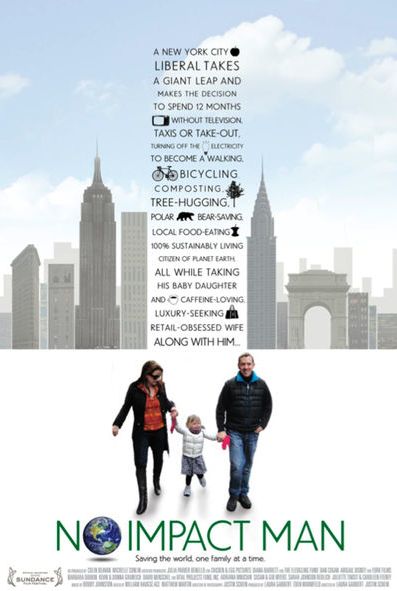
The other day I highlighted a new piece from Elizabeth Kolbert in the New Yorker, which was critical of No Impact Man and other “stunts” in hyper-green living. Mainly I used it as an excuse to point to my old piece on the civic sphere, which, ahem, you should read.

I should have made it clear in the post that I have not read the No Impact Man book (or the other books mentioned in Kolbert’s piece), so I’m not really qualified to comment on whether her criticisms are fair.

Not surprisingly, Colin Beavan—No Impact Man himself—doesn’t think so! Kolbert’s main charge is that personal lifestyle changes like his, no matter how committed or extreme, tend to obscure the fact that the big changes needed are collective—social and political. One person changing doesn’t amount to much.

Beavan wrote me to protest that a) he agrees with Kolbert’s point entirely, b) his book actually contains a whole section toward the end about volunteering for NGOs and going to lobby Congress, and c) he has consistently used his platform to push for social action. One of Beavan’s supporters also mounts a convincing defense in this post. It does seem that, whatever you could say about the other books in Kolbert’s review, she did seem to squeeze Beavan into a box to make a point, a box in which he doesn’t really belong.

You could argue, I guess, that whatever Beavan’s intentions, and whatever he may have said in his book or blog, it was inevitable that the stunt—going without toilet paper, etc.— became the focus. The net cultural effect, even if unintended and explicitly disavowed, was roughly what Kolbert charged. Then again, you could just as easily counter that it’s hard to get people involved in social change, period, and that you have to do whatever you can to get people’s attention to begin with; that’s what the stunt was, something flashy to draw people in and get them thinking. Not like other methods of pulling people into social change are working!

I certainly don’t know the answer; if I knew how to make change, I wouldn’t be a misanthropic shut-in blogger. I will say, though, that it’s extremely easy to second guess other people’s choices, much easier than taking action yourself. Whatever you might think of No Impact Man, Beavan has put skin in the game—real, intense, sustained effort—and that’s a hell of a lot more than most people do. So props.

A final point: if people are going to do these kind of personal-behavior performance pieces,  it’s important that they convey accurate information about the impact of personal behaviors. That is information the public desperate needs. McKinsey found, in a 2008 survey of consumers:

Our study shows that more than one-third of the consumers who want to help mitigate climate change don’t really know how. The top three ways for them to reduce their own emissions are to drive more fuel-efficient cars, improve the insulation of their homes, and eat less beef. Yet when we asked the consumers in our study to name the top three, they fingered recycling, energy-efficient appliances, and driving less. Few consumers knew how eco-friendly it is to shun beef.
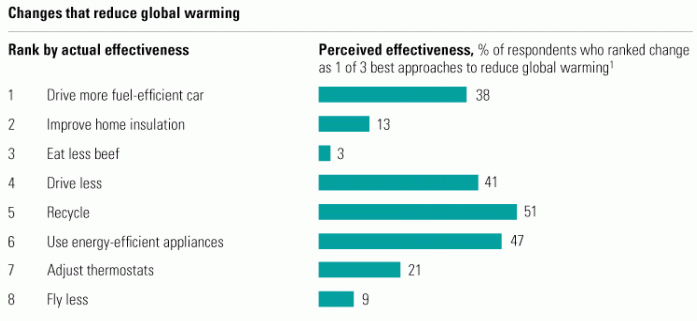
McKinsey - changes that reduce global warmingPeoples is confused.McKinsey and Co.

As you can see, the American people are deeply confused about how to reduce their impact, even if they wanted to. I cringe every time I see someone on TV going on about unplugging power strips—the most time-consuming, irksome,  low-impact change a person can make. If you want to reduce your impact, replace your car with a Prius or take public transit, insulate your home, and eliminate beef from your diet. Do that and you can relax about, say, toilet paper.
David Roberts is staff writer for Grist. You can follow his Twitter feed at twitter.com/drgrist.

Advertisement
Advertisement
  1. katmainomad Posted 3:34 pm
    27 Aug 2009

    There is a subset of us for whom personal eco-behavior is very, very satisfying. Perhaps we come from hard-working, protestant farm people that really enjoy self-sacrifice and a bit of extra labor. Perhaps we want to avoid a taint of hypocracy as we rally against climate change pollution. Perhaps we are self-control freaks who are more able to control ourselves than political process and reap the satisfaction of changing our own behavior for the good. Without being able to quickly rattle off the correct ranking of the above personal measures to reduce carbon emmisions, I am doing all of them (I don't purchase beef at all, don't own a car, and am currently wrapping my house foundation in blueboard). And man it feels good, because none of my letters, blog posts, personal actions, etc seem to have changed my elected official's or the publics position one whit, so at least I can feel good about my own life. I'm not a religious person, and there isn't a union for me, and I'm still trying to find my civil society niche. The groups that feel comfortable to me, like the local permaculture group, don't tend to take civil action but encourage and support personal lifestyles. And I do find some inspiration from folks who live without a fridge or eat completely local or whatever for a year, or more. So more power to them. I don't know if it has the right effect, or really changes public or political action, but it does show some of us some of the ways a more sustainable life can be lived.
  2. Ken Johnson's avatar

    Ken Johnson Posted 7:52 pm
    27 Aug 2009

    Katmainomad,Would your personal eco-behavior be as satisfying if, by reducing your carbon footprint, you were allowing someone else to increase their emissions by the exact same amount, ensuring that your action would have no effect on total GHG emissions? 
    1. Dave from Canada Posted 3:03 pm
      28 Aug 2009

      Sorry, but what K does isn't going to "allow" or disallow anyone else to do anything.People (and moreover, large corporations) are already free to put as much GHGs into the atmosphere as they like.  And at zero cost.Which is why we are in very, very serious trouble.
      1. Ken Johnson's avatar

        Ken Johnson Posted 12:12 am
        29 Aug 2009

        Dave - Have you heard of "cap-and-trade"?
      2. Dave from Canada Posted 8:36 am
        29 Aug 2009

        :-)Yes, and it isn't here yet. And when it is, it won't apply to individuals.
      3. Ken Johnson's avatar

        Ken Johnson Posted 9:16 am
        29 Aug 2009

        But it will apply to individuals' emissions.
      4. Dave from Canada Posted 9:59 am
        30 Aug 2009

        In the indirect and limited sense that behaviours and purchases that result in carbon emissions will cost more (and those that don't will cost less), yes.But will individuals be "allowing" someone else to raise emissions by reducing theirs, as you said earlier?  No.
      5. Ken Johnson's avatar

        Ken Johnson Posted 5:09 pm
        30 Aug 2009

        Under cap-and-trade, you are not individually a "regulated entity". You are not required to hold allowances for your emissions, and you do not own the allowance rights for your emissions.
        So who is required to hold and surrender allowances for emissions resulting from your energy demand, and what would they do with those allowances if you were to stop using fossil-fuel energy?
  3. solar greg Posted 3:34 pm
    28 Aug 2009

    Very few people have the willpower to go without many of the luxuries we all take for granted (in some parts of the world) One of those is hot water for bathing. On the list on #6 you have using energy efficient appliances. Where do you place solar water heaters? This is a little more than going from an old electric heater to a super efficient gas heater. It's more like cutting 20 to 30% off your electric bill.I'm all for changing habits for good, but solar hot water is one step that doesn't require sacrificing comfort at all.
  4. katmainomad Posted 5:54 pm
    31 Aug 2009

    Um, debate on cap and trade aside, yes - I would still get the same satisfaction. The polluter can calm his/her own conscience. That's just based on my internal reward system. Externally, I would be working still to try and actually figure out how to help make a real difference too.I have a problem with the list as well, things such as driving less being ranked below more fuel efficient car - of course this all depends on how much less and how more efficient, without hard numbers (even a range of numbers) the list is pretty meaningless.
    1. Ken Johnson's avatar

      Ken Johnson Posted 9:48 pm
      31 Aug 2009

      You could "calm your conscience" just as effectively by sending your local coal utility or oil refiner a free cash contribution. That is, in essence, what you would be doing by reducing your carbon footprint under cap-and-trade. You would be freeing up surplus emission allowances for Big Oil and Big Coal. But in terms of environmental benefits, your eco-behavior would have "No Impact, Man".

Add a Comment

You are not logged in. Thus, you cannot post a comment. If you have an account, log in. If you don't have an account, well, by all means go make one! Meet you back here in five.

Hello, Visitor!    Why not register?

Advertisement