
 Adam WerbachAdam Werbach’s career is something of a lodestar for the trajectory of the 21st century American environmental movement. A student activist tutored at the knee of the Archdruid himself, the legendary David Brower, Werbach was elected the youngest president of the Sierra Club in 1996 at age 23.
Then business beckoned and he launched a startup, Act Now Productions, to advise companies like Wal-Mart on going green. Global advertising and marketing goliath Saatchi & Saatchi acquired Act Now last year, rebranding it as Saatchi & Saatchi S (for sustainability) and installing Werbach as the CEO.
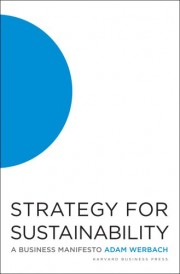
Now he has written Strategy for Sustainability: A Business Manifesto.
“The book came from a basic frustration with the business dogma I confronted as someone who had what I thought were some very simple ideas about how business should work,” says Werbach during an interview at Saatchi & Saatchi S’s offices in San Francisco’s Mission District. “It became clear to me they didn’t hold the same fundamental business notions I did. They lacked a singular strategy that brought in the concepts of sustainability.”
The book, which joins a shelf of sustainable business titles published in recent years, is essentially a how-to guide for companies to reframe the way they do business in a carbon-constrained, Twittering world.
“To be successful, you need to peel off the green blinders and start thinking of sustainability as a new tool set, like information technology or globalization, that can help you reinvigorate a business,” Werbach writes.
In fact, Werbach would like to take the environment out of environmental sustainability.
“The battle I’m trying to fight in the business world is to adopt a broader definition of sustainability that is not just about environmental sustainability,” says Werbach, who at 36 sports a touch of gray in his hair. “That’s a limiting factor to sustainability. What are the tools you need to be around for the long term? What is your long-haul strategy?”
In other words, casting sustainability as a green thing allows companies to compartmentalize such efforts rather than make them part of the corporate DNA.
Still, even in an era when mainstream environmentalists are more likely to lunch with corporate suits than file suits against them, such talk is sure to rankle.
 But the message may resonate among the younger generation for whom the thought of corporate environmentalism does not cause cognitive dissonance. For instance, the MBA students I talked to who signed up for the Environmental Defense Fund’s Climate Corps saw nothing incongruous about pursuing green goals from within the Fortune 500. In fact, the point was to change corporate America from within.
And those are exactly the people Werbach is trying to recruit with his book. “The world of corporate change is still underpopulated with people who have a sustainability mindset and experience,” he says. “There’s a better chance I’ll be arguing with six people about who has the best idea when I’m with activists, which is great. It’s more likely I’ll be lonely and looking for help when I’m working with a company.”
In his book, Werbach lays out “Seven Tenets of a Strategy for Sustainability”:
- Natural resources will become increasingly scarce and expense.
- Massive demographic change is coming.
- People are the most important renewable resource.
- Cash flow matters more than quarterly earnings.
- Every organization’s operating environment will change as dramatically in the next three to five years as it has in the past five.
- A chaotic external world requires internal cohesion and flexibility.
- Only the transparent will survive.
Like other books of the genre, Werbach’s contains his own PowerPoint-friendly jargon — sustainability-speak, if you will. He advocates an approach he calls “STaR mapping” to analyze a company’s strategy in terms of social, technological, and resource changes. Then a company needs to decide on a “North Star goal” — “the strategic direction toward which an organization drives to reach greater sustainability.”
Werbach presents case studies of companies that have pursued sustainable strategies, like Clorox, whose Green Works natural cleansers have been endorsed by the Sierra Club.
It remains to be seen whether corporate America embraces sustainability as way to gain a long-term competitive market advantage or just as a marketing strategy. But signs of change abound.
Late last month, Werbach was invited to give a talk on sustainability at Apple’s headquarters in Silicon Valley. The iPhone and Mac maker has long been a whipping boy of groups like Greenpeace for its lack of environmental disclosure and reluctance to jump on the green bandwagon crowded by Dell, Hewlett-Packard, and other tech stalwarts.
Apple also came in for a fair share of criticism in Werbach’s book.
“I don’t know a lot of people who have strict critiques of Apple who are invited to go speak there,” he says. “A friend from a previous incarnation invited me down. His instructions were to say whatever I wanted. I was shocked they would say that. We had a really open conversation about what I thought they could do better.”
And Werbach at least practices what he preaches: I learned about the Apple meeting through his Twitter feed.
Find out more at the Strategy for Sustainability website.
Read Todd Woody’s past Green State columns.