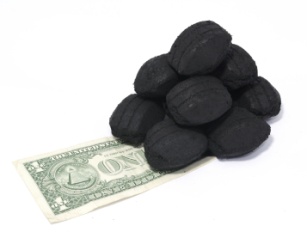
 Special Series: What’s the deal with offsets?Photo illustration by Tom Twigg / GristImagine a system that can:
- (potentially) store billions of tons of carbon in soil for centuries;
- dramatically reduce agricultural waste, forest debris and some municipal solid waste, thus eliminating the production of greenhouse gases that result from their decomposition;
- generate energy to both power itself and a surplus for use in surface transportation or electricity generation; and
- greatly increases the productivity of agricultural soil, thus reducing the need for expensive and polluting fertilizers.
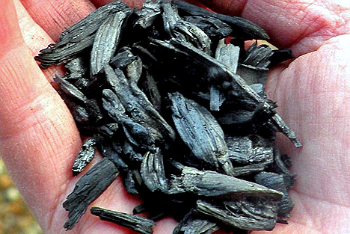
This is the promise of biochar — the carbon-rich remains of “burning” organic matter via an oxygen-free process. According to the International Biochar Initiative (IBI), biochar “has four value streams: waste reduction, energy production, soil fertilization, and carbon sequestration.” This has implications for both developing and developed economies — and, most importantly, the interrelated problems of global warming and food security.
Based on the work of researchers in the Amazon who discovered the startling properties of terra preta, land that had been improved hundreds and, in some cases, thousands of years ago, soil scientists have been pursuing a way to replicate the success of the Amazonian Indians in producing spectacular fertility in the midst of the relatively infertile rainforest.
One of the key components of terra preta is charcoal. Modern biochar, however, isn’t derived from the same process that agricultural societies have been using for millenia to produce charcoal. Instead, biochar is a product of the breaking down of biomass by a controlled thermal degradation — not burning. The most prevalent method of producing biochar is through pyrolysis.
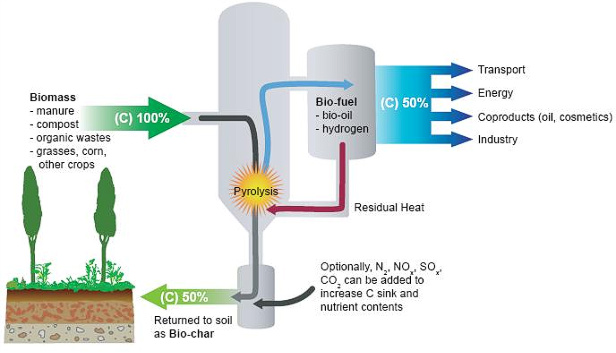
The first step in biochar production is providing feedstock. This can be agricultural waste that would otherwise sit in the field to decompose or be burned, in both cases generating greenhouse gases. Other sources are forest debris or waste products like the enormous fraction of municipal solid waste comprised of grass cuttings and leaves. The feedstock is placed into a pyrolysis chamber — a nearly airtight device that intensifies heat but limits exposure to oxygen to avoid burning. The chamber can be a small unit processing as little as a few pounds of biomass for a family’s cooking and gardening needs, or a large one with a capacity of as much as a 100 tons per day.
Since pyrolysis is performed with little or no oxygen present, it produces no combustion byproducts such as black carbon (soot), carbon monoxide or carbon dioxide. Instead, gases such as hydrogen and biofuels are produced, which can be used to provide the necessary heat for the pyrolysis process with some left over for other uses.
Here’s a look at the overall process:
 Courtesy Johannes Lehmann, Cornell University
The remaining solid material — the biochar — can be used as a soil additive that, according to most of the research to date, has a remarkable ability to enhance agricultural or horticultural productivity.
One key international governmental organization, the United Nations Convention to Combat Desertification (UNCCD), believes “the role of the soil in capturing and storing carbon dioxide is often one missing information layer in taking into consideration the importance of the land in mitigating climate change.”
The UNCCD, along with the IBI, pushed hard to include biochar in the draft negotiating text for the upcoming Copenhagen climate talks. This means that biochar and other methods of employing agriculture to mitigate carbon emissions may well lead to the issuing of offset credits for these methods. This is the big prize that could lead to the massive deployment of biochar production worldwide.
Biochar has been embraced by worthies such as Chris Goodall and James Lovelock. Tim Flannery, in his foreword to Biochar for Environmental Management, says: “The biochar approach provides a uniquely powerful solution, for it allows us to address food security, the fuel crisis and the climate problem, and all in an immensely practical manner. With its careful evaluation of every aspect of biochar, this book represents a cornerstone of our future global sustainability.”
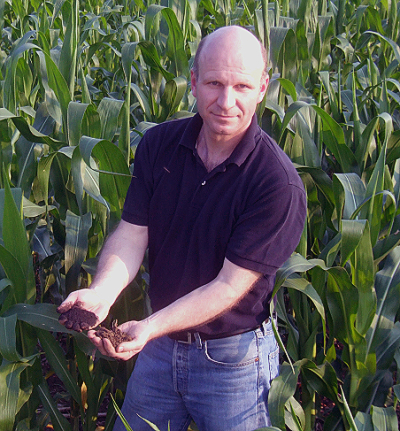 Cornell’s Johannes Lehmann is studying how various types of biochar can boost soil fertility and sequester carbon.Courtesy LehmannDr. Johannes Lehmann — co-editor of Biochar for Environmental Management, chairman of the IBI, and a professor at Cornell University — is one of the driving forces behind the growing recognition of biochar’s value. Like any good scientist, however, he’s conservative in his prognostications. His current work focuses on generating and evaluating research on biochar production and use. His group at Cornell, for instance, is evaluating scores of different chars from around the world.
Lehmann does not endorse growing biomass on a massive scale as biochar feedstock — something George Monbiot accused biochar boosters of advocating in a somewhat infamous Guardian column from March.
“It doesn’t make any sense to grow biomass on land specifically and solely for the purpose of generating energy or biochar or a combination,” Lehmann said. “It makes the most sense to talk about agricultural waste.”
Lehmann considers forest debris and yard waste to be prime candidates for biochar production. But he is circumspect about which wastes might be most cost-effective. Collecting corn stover from fields for the purpose of generating char and energy might be ineffective, but the massive amounts of waste generated by sugar cane production could work very well. Similarly, if money and effort must be expended to collect forest debris for biochar production, then it might not be worthwhile. However, it could be cost-effective if the debris is being collected anyway for fire prevention.
Biomass is often left on the ground to decompose, creating huge amounts of greenhouse gas emissions, or is burned in the fields or in forest fires, creating carbon dioxide. Biomass, usually scrub wood or animal dung, is also burned in open cooking fires throughout the developing world, a practice that has drastic dire health impacts for the people routinely exposed to the smoke, mostly women and children. It also generates black carbon (or soot), increasingly being identified as a powerful driver of climate change second only to carbon dioxide.
Among the many projects in which Lehmann is involved is comprehensive research and development on pyrolyzing cookstoves that produce both clean heat and biochar for use by farmers. “You can dramatically expand your feedstock options when you switch from burning to charring,” he said. What matters in all of this, Lehmann emphasizes, is looking carefully at the costs and benefits in each situation, performing “whole systems analysis, from cradle to grave.”
Biochar could get a big boost in the United States if the Waxman-Markey bill is passed. The legislation would allow agricultural and forestry projects to qualify as carbon offsets, a move that sparked outcry from some environmental groups concerned that Congress would prevent regulators from measuring the full carbon footprint of U.S. farming practices.
Nevertheless, offsets retain considerable support in Congress. Sen. Tom Harkin (D-Iowa), chairman of the Senate Agriculture Committee, is a biochar booster. “As part of the overall effort to lessen the effects of global warming, biochar is an exciting method for sequestering carbon,” he said in a statement for this article. “It is a truly innovative option not only because it sequesters carbon, but also because it improves soil condition and reduces the amount of water and fertilizer required on farms.”
William Hohenstein, the director of USDA’s Office of Global Climate Change, sees biochar in the context of a comprehensive policy construct, along with conservation tillage, tree planting, and other mitigation methods. He envisions the inclusion of these methods in a system of offsets, both domestically and internationally. The Agricultural Research Service, meanwhile, concluded in a recent report that the costs of processing crop residue into biochar and incorporating it into farmland soils could be offset by giving farmers the ability to sell credits for the carbon sequestered by the biochar.
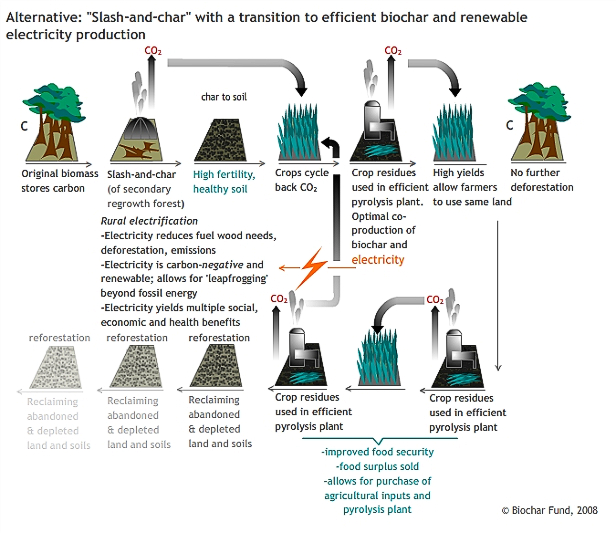
A chart via Biochar Fund showing how biochar production can be used for electricity generation:
 Courtesy Biochar Fund
Video: Cornell’s Lehmann is featured in this video on biochar produced for an Australian audience:
A pyrolysis cooking stove that can generate biochar as a fuel residue:
A message from
Your support keeps our climate news free.
Grist is the only award-winning newsroom focused on exploring equitable solutions to climate change. It’s vital reporting made entirely possible by loyal readers like you.
At Grist, we don’t believe in paywalls. Instead, we rely on our readers to pitch in what they can so that we can continue bringing you our solution-based climate news. Donate today to keep our site free.