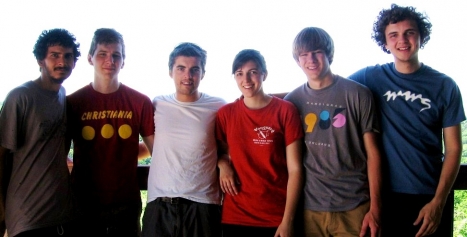
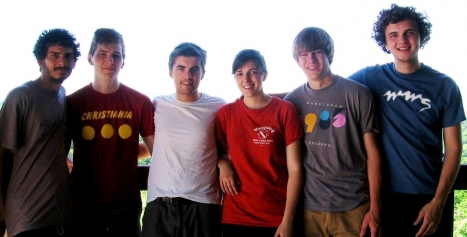
 Timothy DenHerder-Thomas (left) and fellow “solutionaries.”Photo: Summer of Solutions blogFossils like Washington Post columnist George Will may think that “the Mall does not reverberate with youthful clamors about carbon.” But that’s because a growing number of young people are engaged in less-visible efforts at the grassroots level. It’s not their parents’ activism — with all the marching, chanting, and sign-waving that entails — but by focusing on the work on the ground, some young activists are achieving the kind of change that can’t come from political rallies alone.
Timothy DenHerder-Thomas, just a few months shy of graduating from Macalester College in St. Paul, Minn., with an environmental science degree, is busy coordinating the second Summer of Solutions, a project that he and fellow student activists in the Twin Cities began last year. Now expanded to nine cities across the United States, S.O.S. gets young activists working on sustainability projects in local communities. Many of these projects are centered around energy efficiency and home weatherization, green jobs education, and community gardening, and all have the goal of becoming self-sustaining.
“We saw that lots of people usually sort of drop off the scene during the summer because they go get a different job or that sort of thing,” said Matt Kazinka, a junior at Macalester and another coordinator of the program. “We decided we wanted to make an intentional space for us to work on some projects that we had already started.”
Kazinka, DenHerder-Thomas, and some of their peers came up with the idea for S.O.S. and created a nonprofit called Grand Aspirations to support their work. So far all of their funding has come from small-scale, local grants and individual contributions, DenHerder-Thomas said, just enough to provide cost-of-living stipends to those working on S.O.S. projects full-time during the summer. In some cities, like Omaha, S.O.S. participants live and work together, but levels of involvement across the country vary, with many students finding time to donate to S.O.S. between other projects and jobs. DenHerder-Thomas estimates that, including part-time volunteers and some older folks, up to 150 people across the country are involved, mostly in communities where they either grew up or now attend school.
“A huge idea behind the organization is that people in different locations know better what will work in their area, in their local community,” said Abbie Plouff, another part of the national coordination team. A student at Hamline University in St. Paul, she joined the organization this year.
Although work is tailored locally, S.O.S. wants successful projects to be replicable. “The projects and programs that we set up via Summer of Solutions, be they in the Twin Cities, or in Austin, Texas, or in Corvallis, Ore., can also work as models that other communities can then hook into and look at and use,” Plouff said.
As part of a movement in which small-scale efforts can feel like mere drops in the bucket, these students have a refreshing clarity of vision when it comes to their role in problem-solving. They don’t expect to change the world by taking shorter showers. But they also don’t underestimate the potential of smaller projects to grow into big changes.
“The vision and purpose behind Summer of Solutions is that it’s very much connecting the local and the global,” said DenHerder-Thomas. “It’s linking people on the ground, in their communities, with models and ways of thinking that can change the way the whole thing works … We’re going to try this here, and other people around the country are going to do similar things, and then we’re going to talk, and figure out how to make it into a larger solution.”
A new kind of activism
DenHerder-Thomas, Kazinka, and Plouff think of their work as “solutionary” — taken out of the negative context of what’s wrong and put into the positive context of what can be done about it. That means, as Kazinka eagerly pointed out, that “it’s really, really fun.”
“It feels real,” he said. “It feels like you’re making an impact, because you are.”
The type of work these “solutionaries” (as they call themselves) do can be hard to pin down, DenHerder-Thomas said, maybe because youth today are starting to see a range of progressive issues as more integrated than they’ve traditionally been imagined. “We definitely feel that the work we’re doing is environmental,” he said. “But it’s also about economic recovery, and it’s also about energy security, and it’s also about creating social justice in the midst of a recession.”
DenHerder-Thomas, Kazinka, and Plouff all trace their involvement in the environmental movement to the discovery of its intersections with other progressive causes. “You can work for social justice through working for environmental justice,” Plouff said. “Environmentalism ended up being my home because it’s the most holistic thing that I could think of to work on.”
DenHerder-Thomas grew up in a low-income community in Jersey City, aware from an early age that there was something dysfunctional about the way his world, with its “poverty and pollution and intolerance and cultural fragmentation,” was structured. “It was never really defined as environmental to me until later, because I never really had exposure toward things that would more typically be called nature,” he said. But a few years ago, just before he went off to college, the pieces started to come together. “Communities all over the planet are really being depleted, and a lot of their economic and social systems being corroded, by the way we do development, which is based on the way we use energy,” he said. He began to see clean energy solutions as “ways to revamp our economy around social justice.”
Kazinka had the same realization when he saw Van Jones speak at Power Shift 2007, a youth climate summit he attended. “Seeing how he framed the green economy as an opportunity to create social justice and economic opportunity through environmentalism … really was just a moment where it all came together for me,” he said. “All these things that I’ve been interested in are one.”
Summer of Solutions lives as an example of how environmentalism has moved beyond the domain of tree-hugging hippies and nature enthusiasts, and why, as a result, pigeonholing a new wave of young environmentalists as such is no longer an effective opposition tool. To that end, Plouff said she’s very conscious of avoiding “traditional in-your-face activism,” instead focusing on meeting people in the middle, and listening to what they have to say.
“Listening is really huge,” she said, “because people want to know that you care and that you’re not just kind of filing [away] the information that they’re giving you, or just completely disregarding it. So trying to cultivate deep relationships with people even if they don’t agree with you in a conversation — I think that’s really important.”
For example, Plouff explained, when fighting a coal plant, “know who you’re talking to,” and emphasize to community members worried about job losses that renewable energy resources can not only replace the coal jobs lost, but create additional ones.
As for the future of their work, the solutionaries are more realistic than optimistic, but always hopeful.
“Transition will happen. That isn’t really optional,” said DenHerder-Thomas. “If you have an unsustainable society, that means it will not be sustained. It won’t continue in its current form. Something will change … The question is always, How bad is it going to get in the meantime?”
Summer of Solutions just hopes to help positive change come before things get too much worse.