 Image: Tom Twigg/Grist
UPDATED: 11 Aug 2009
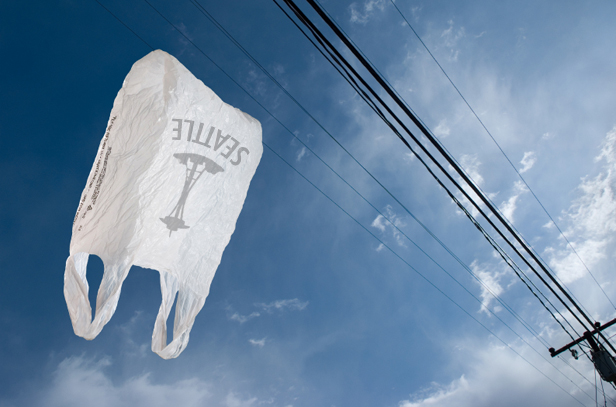
When the Seattle City Council voted last summer to impose a 20-cent fee on paper and plastic bags, the Progressive Bag Affiliates (PBA) of the American Chemistry Council immediately sprang to action to block the move. The fee would have taken effect January 1, 2009, but the Coalition to Stop the Seattle Bag Tax (funded by PBA, the Washington Food Industry, and 7-Eleven) collected enough voter signatures to put the measure on the August primary ballot.
Referendum 1, as it’s now known, would require consumers to pay 20 cents for every disposable bag (paper or plastic) they get from grocery, drug, and convenience stores. Small businesses — those with under $1 million in annual revenue — would retain the entire 20-cent fee. Other businesses would get to keep five cents, with the rest going to Seattle Public Utilities to pay for implementation and oversight of the program, and to provide free reusable bags to low-income families, soup kitchens, and homeless shelters.
Voters will cast their ballots on Aug. 18. Some polls have shown people closely split over the issue. A more recent poll [PDF] found the “no” side leading 55 percent to 41 percent; Democrats and young voters were more inclined to support the ballot measure, while Republicans, Independents, men, and minorities were inclined to oppose it.
The “yes” camp
The pro-bag-fee side has raised around $64,000 so far — a tiny fraction of the million-plus dollars raised by the “no” side. The main organization supporting the measure is the Seattle Green Bag Campaign. Notable endorsements have come from The Seattle Times, The Stranger, Mayor Greg Nickels, five Seattle City Council members, the 43rd and 46th District Democrats, PCC Natural Markets, Central Co-op’s Madison Market, and a host of environmental groups, including the National Wildlife Federation, People for Puget Sound, and the UW Sierra Student Coalition. The campaign has also received support from Orin Smith, former president and CEO of Starbucks, and Reusablebags.com.
The fee was introduced as a simple way to change Seattleites’ shopping habits, encouraging the use of reusable bags without banning disposable ones outright. Supporters point to Ireland’s successful PlasTax measure, which, by imposing a similar fee, saw plastic bag use reduced by over 90 percent only a few weeks after it took effect. Plastic bags can take up to 1,000 years to decompose, and paper bags, while more easily recyclable, require far more energy and toxic chemicals to produce. A study by Seattle Public Utilities indicated that Referendum 1 could cut disposable-bag-related greenhouse-gas emissions by about 4,000 tons per year (the equivalent of taking 665 cars off the road). In 2002, Bangladesh became the first country to ban plastic bags, and dozens of other nations, from Botswana to Denmark to South Korea, have restrictions on disposable bags. Bag-fee supporters hope to make Seattle a model for other American cities on this issue, the same way the city set a precedent by introducing residential curbside recycling in 1988.
The “no” camp
Opposition to the measure has been largely driven by the Coalition to Stop the Seattle Bag Tax, which lists its members on its website. Most of its funding — about $1.4 million so far — comes from the American Chemistry Council, whose members include Dow Chemical, ExxonMobil, and major plastic-bag producers. Coalitions such as the Korean American Grocers Association, Washington Association of Neighborhood Stores, and the Independent Business Association have also come out against Referendum 1.
Mayoral candidate Jan Drago opposes the bag fee, as do Seattle City Council candidates Jordan Royer and Sally Bagshaw. The Central Area Motivation Program has spoken out against the fee because it believes it will unfairly affect low-income people, and Real Change, Seattle’s weekly activist paper sold by the homeless, recommended a “no” vote. A group of economists called the Northwest Economic Policy Seminar conducted an analysis [PDF] of the proposed fee and then published a letter to the Seattle City Council voicing their opposition.
Because the American Chemistry Council represents makers of plastics, many in the “yes” camp have come to see the effort to pass the referendum as a fight against big oil. But some in the “no” camp say they oppose the measure because it’s costly and unnecessary in a city where 90 percent of citizens claim to already reuse their disposable bags. “We don’t have a serious plastic bag litter problem,” said Peter Nickerson in the Northwest Economic Policy Seminar’s letter to the city council. Opponents have also said that the measure includes too many exemptions and loopholes to really be effective.
Opponents tend to refer to the measure as a “tax,” not a fee, and by definition it could probably go either way, although the fact that revenues go specifically to bag-elimination efforts (instead of into a general fund) puts it more in the fee category.
The Seattle Times plans to publish its endorsement on Referendum 1 on Aug. 8. [UPDATE: The Times endorsed the referendum.] No endorsements yet from the Seattle Post-Intelligencer or the Seattle Weekly.