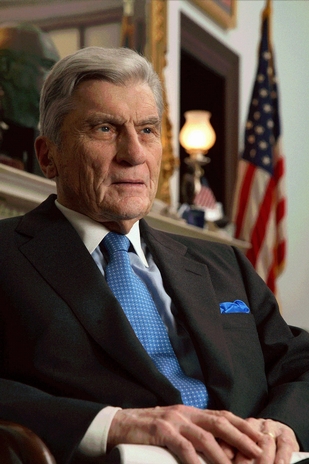
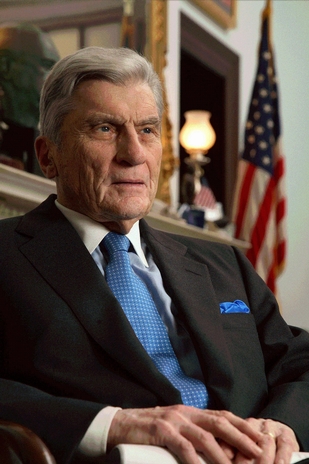
 Former Sen. John WarnerMore senators and citizens might support a climate bill if it emphasized the national security challenges presented by climate change, former Virginia Sen. John Warner (R) argued on Tuesday.
At a hearing of the Senate Foreign Relations Committee, Warner joined former high-ranking military personnel and military analysts to stress that climate change poses national security threats, including the possibility of increased conflicts over scarce resources. The witnesses echoed previous reports from U.S. intelligence officials that have warned climate change could make the world a more dangerous place.
Warner, a veteran who served as secretary of the Navy from 1972 to 1974, cosponsored the Climate Security Act last year with Sen. Joe Lieberman; the bill failed to pass the Senate.
At Tuesday’s hearing, Warner said it was crucial to work with other nations on climate policy. “If the American public perceives that we’re going alone, and other nations aren’t bearing part of the burden or costs, the American public could pull the plug on this legislation,” he said.
But Warner stressed that Congress can’t delay. “This is the time Congress has to forcibly lead,” he said. “We can’t follow the public. We’ve got to lead the public.”
Retired Navy Vice Admiral Lee F. Gunn, president of the American Security Project, also urged swift action. “It’s not simply about saving polar bears and preserving the beauty of glaciers,” said Gunn. “It’s about national security.”
Gunn emphasized that even if there is some uncertainty about the impacts of climate change, there is a need to act. “Threats and risks never present themselves with 100 percent certainty,” he said. “By the time they present themselves with that kind of certainty, something bad will have already happened on the battlefield.”
Gunn and two other hearing witnesses — retired Navy Vice Admiral Dennis McGinn of the Center for Naval Analyses Advisory Board and Sharon Burke, vice president of the Center for a New American Security — said climate change could put a strain on the U.S. armed forces, pushing them into more military interventions and humanitarian missions.
Climate change could act as a “threat multiplier” in already unstable countries, they said. Depletion of resources like water could lead to more conflict and more failed states, and failed states could become havens for extremists, potentially increasing the risk of terrorism (see: Somalia).
Burke warned that reliance on foreign energy supplies is also a threat to national security. Even if dependence on foreign oil decreases, the U.S. could become reliant on lithium for lithium-ion batteries in electric cars if proper planning isn’t done, she cautioned. And since the Department of Defense is among the largest consumers of energy in the country, the issue should be of particular importance.
Sen. John Kerry (D-Mass.), chair of the Foreign Relations Committee, told reporters after the hearing that he is “confident” there will be a national security component to the climate bill that is taking shape in the Senate, though he couldn’t yet say what the component would look like. He said he is working closely with Environment and Public Works Committee Chair Barbara Boxer (D-Calif.) to author an overall climate package, and will be a cosponsor of the legislation.
Kerry said he believed he could get bipartisan support for including national security more explicitly in the climate bill. Yet only two of his Republican colleagues — Dick Lugar (Ind.) and Bob Corker (Tenn.) — were present at the hearing. Both Lugar and Corker have expressed a desire to address climate change, but have raised concerns about Democratic proposals and are considered swing votes on a climate bill this year.
During the hearing, Kerry spoke forcibly about national security threats posed by climate change. “Just as 9/11 taught us the painful lesson that oceans could not protect us from terror, today we are deluding ourselves if we believe that climate change will stop at our borders,” he said.
“The future has a way of humbling those who try to predict it too precisely,” he continued. “But we do know, from scientists and security experts, that the threat is very real. If we fail to connect the dots — if we fail to take action — the simple, indisputable reality is that we will find ourselves living not only in a ravaged environment, but also in a more dangerous world.”