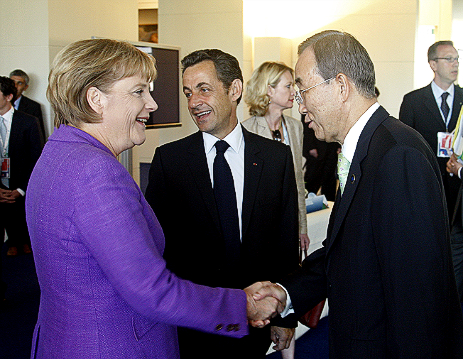
 Secretary-General Ban Ki-moon (right) greets Germany’s Angela Merkel and France’s Nicolas Sarkozy at the G8 summit in L’Aquila, Italy.UN Photo/Mark GartenUnlike some of his predecessors, U.N. Secretary-General Ban Ki-Moon seems to be a brave man, for he has had the courage to chide his most powerful paymasters for failing to do enough to combat climate change.
What’s more, he did so last week just as the leaders were congratulating themselves for what they had achieved when they met in L’Aquila, Italy. British Prime Minister Gordon Brown called it an “historic agreement.” German Chancellor Angela Merkel said it was a “clear step forwards,” and President Barack Obama reported: “We have made a good start.”
But the UN chief was unimpressed. “The policies they have stated so far are not enough,” he said. “We must work according to the science. This is politically and morally imperative.”
Others were more outspoken. “A massive opportunity has been missed here,” said Paul Cook, director of the British aid charity, Tearfund. And Guruswamy Ananthapadmanabhan, Greenpeace International’s Program Director, denounced “a disgusting abdication of leadership and responsibility.”
Most of the media followed suit. Reuters reported “disappointments.” The Christian Science Monitor spoke of a “a failure to find common ground.” And the New York Times said “things fell apart.”
Yet another interpretation is possible. There is an argument to be made that, while the leaders failed to take action commensurate with the scale and speed of the climate crisis, they still achieved more than had been expected, established some common ground and made a meaningful deal at December’s vital negotiating meeting in Copenhagen more possible, not less.
L’Aquila, in fact, got two summits for the (admittedly expensive) price of one. The first was the annual G8 summit of the world’s most powerful countries; the second a special climate summit of major industrialized and developing countries, convened by President Obama under the aegis of the Major Economies Forum on Energy and Climate.
Both meetings — in identical words — endorsed a maximum permissible global temperature rise of two degrees centigrade above pre-industrial levels. This may not seem much — after all, scientists have been saying for years that the world should not heat up beyond this to give it a fighting chance of avoiding catastrophic climate change. But the United States was resisting that level until a few weeks ago, as were the leading developing countries just days before.
This is a genuine, if long overdue, advance, and it sets an important vital benchmark needed for setting meaningful targets. There was some progress in this area too, with G8 countries accepting, again for the first time, that their emissions should be cut by 80 percent by 2050, a precondition to developing countries agreeing a global 50 percent by then.
The developing country leaders refused to endorse that global target, but they did accept that they should do more than merely reduce the rate of growth of their emissions, agreeing that they should “peak” (and so start coming down in absolute terms) “as soon as possible.” Yet again, this is the first time this has happened, and represents a significant shift in attitudes.
There were also some signs of movement on the thorniest issue of all — funds to help developing countries fight climate change and adapt to its consequences. President Obama, who chaired the climate summit (participants were keen to avoid it being led by the prime minister of the host country, the climate-skeptical Silvio Berlusconi) gave the floor to Gordon Brown to outline his proposal for a $100 billion a year fund. The leaders agreed to instruct their finance ministers to study the idea and report back the G20 summit in Pittsburgh in late September, just what Britain’s leader wanted.
Of course, there is much to criticize. The financial proposal remains just that, even though it is the first to be put on the table. The 80 percent reduction target did not have a firm base year, vaguely stipulating “1990 or more recent years” in deference to the United States and Japan. It would have been much better to have achieved a global target. And above all, there was no target for 2020; so far, rich countries have only offered about a third of the 25-40 percent cuts needed.
Ban Ki-Moon was right than what was agreed was far from enough. But the summits were not the disaster some have depicted. Yvo de Boer, the blunt head of the climate treaty secretariat, said the outcome “hasn’t given me a huge rush of adrenalin,” but represented “a careful, but useful step towards Copenhagen.” That seems about right.
A senior source added that the meetings also “established a new sense of collective purpose and momentum among the leaders about reaching agreement in Copenhagen.” If so, that could be the most important result of all. But it needs to lead to greater action — and do so fast.