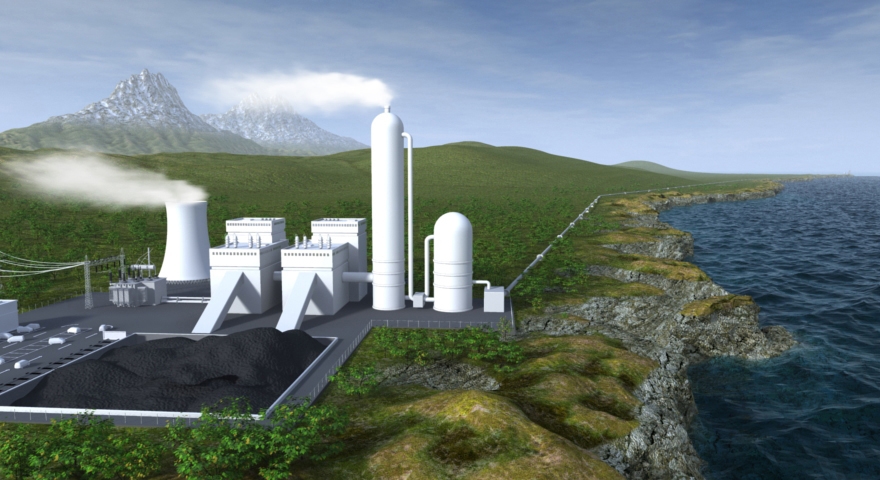
 Artist’s rendering of a power plant with CCS technology.Image: Prosjektlab/BellonaIt is conventional wisdom among People Who Matter that burning coal is going to continue, even accelerate, no matter what kind of legislation is passed or international agreements are forged. That’s why carbon capture and sequestration (CCS) — technology that buries power-plant carbon dioxide emissions underground — is widely seen as the bright, shining hope for maintaining a livable climate: it’s the only way to burn coal without frying the planet.
Or it would be, if it were proven to work on a large scale.
The American Clean Energy & Security Act recently passed by the House contains billions of dollars in subsidies for developing CCS technology, and effectively delays any serious domestic greenhouse-gas reductions for 10 to 15 years — by which time, it is hoped, CCS might be able to be scaled up to wide use.
But does CCS technology actually exist? Is it practical? Affordable? Who’s working on it? Despite the flurry of chatter about CCS, these basic questions usually go unanswered.
That’s why I turned to Sarah Forbes, who leads the CCS program at the World Resources Institute. WRI recently finished a collaborative project with over 80 stakeholders, including both environmental groups and coal companies, to develop “Guidelines for Carbon Dioxide Capture, Transport, and Storage.” Through that process Forbes has learned not only the technical ins and outs of CCS, but the various business, regulatory, and social issues that will have to be worked out before CCS can become a reality.
Q. When people hear about CCS, they generally think about underground caves or abandoned mining shafts. Are there other ways of doing it?
A. We do geological storage underground. If I were to hold up a sample of the rock, it looks like a piece of sandstone, but if you look at it with a microscope you would see that there are spaces in between the grains, in the rock. The CO2 gets injected and trapped in these little pore spaces in the rock, and then also dissolves into the fluid that’s underground in that formation.
That’s usually what you think of for underground geological storage; it’s not necessarily inside of a cave, it’s inside of a rock. Technically it’s called “separate-phase CO2.” It still has the properties of CO2, it’s still gaseous, but it behaves like a liquid. That storage reservoir has to have a cap rock above it that the CO2 can’t get through.
You have to have the right geology; this isn’t something you can just do anywhere.
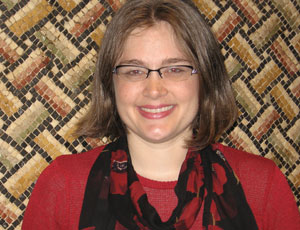 Sarah Forbes, CCS expert at the World Resources Institute.Q. Has anybody done a survey of the U.S. to determine how much potential space there is for CCS?
A. They have. The problem is that you can only learn so much from a grand national assessment. You can get a pretty good idea of what sites would probably be good, but until you go to a site, drill a hole, bring a core up, and study the geology, you’re not going to know if it’s going to work.
That’s one of the things that came out of the economic stimulus package, some funding for geological studies for CCS sites that look promising. Funding that type of work, getting a handful of sites that are proven geologically, is an important next step.
Q. Based on the national estimates, do we have the kind of capacity we need to bury a large fraction of our CO2?
A. We have lots of capacity. The last time I looked it was beyond the realm of how much you would think we would need.
It is important to test that; it’s an order-of-magnitude estimate, and really, we won’t know until we’ve looked at the geology at a specific site.
Q. The Waxman-Markey climate bill recently passed by the House assumes that CCS can do a lot over the coming decades to reduce CO2 emissions. Do you think CCS can carry that weight?
A. We haven’t demonstrated technology at that scale yet. I worry about that. I worry that the [Energy Information Administration] predicts that CSS is going to be 20 percent of the solution to climate change (a 50 percent global reduction in emissions by 2050).
I do think the provisions in the Waxman-Markey bill allow for that demonstration to happen. And they incentivize some early deployment. But we shouldn’t count our chickens before they hatch.
Q. What’s the largest existing CCS demonstration project?
A. We have done CCS at the scale of about a million tons per year in several places. The largest and longest-lived project is off the coast of Norway, in the North Sea, usually referred to as the Sleipner project. It’s operated by Statoil.
What we haven’t done is integrated electricity production combined with carbon capture and storage.
Q. You say there are projects that sequester a million tons of CO2 a year. How many tons a year does an average coal plant produce? How close is that to the kind of scale we need?
A. It’s about a quarter of the scale. It depends on the specifications of your coal plant, but I think of the average coal plant as 4 million tons per year. Some are more and some are less.
Q. Lots of the early work in CCS has been around injecting CO2 into oil wells to help extract more oil, known as enhanced oil recovery (EOR). How big of a role is that going to play?
A. Some early opportunities for EOR can and should be explored. It’s not CCS, though, unless you’re storing the CO2 and monitoring it over the long time frame.
Q. Are any EOR projects doing that?
A. The Weyburn project, which takes CO2 from the Dakota gasification plant in North Dakota and takes it up to the Weyburn oil field, has had a strong research project associated with it that’s been tracking the CO2 — using that as a platform to study CCS via EOR.
Standard industry practices leave about a third of the CO2 underground.
Q. A huge piece of the climate puzzle is reducing emissions from existing, old-fashioned pulverized coal plants. How different is that, technologically and economically, from doing CCS with new coal-gasification plants, also known as IGCC?
A. There are economic and technical differences. Technically, on an existing coal plant it’s called post-combustion capture. Post-combustion capture has a bigger energy penalty because the CO2 is dilute and it’s at lower pressures compared to IGCC, where the CO2 is not quite as dilute and at higher pressures. So there are some inherent advantages to capture from an IGCC power plant. And people are pushing for IGCC for some of the other environmental benefits associated with a gasification system compared with a pulverization system.
Q. But is CCS going to be economically realistic for an existing coal plant?
A. CCS is going to cost. In order to think about CCS, we need a long-term, stable carbon price. CCS has been proven at pilot scales, but it hasn’t yet been demonstrated, so in order to get it over that, it probably needs more than just a carbon price. That’s why you see some of the complementary policies — they helped demonstration and deployment.
Q. Have there been demonstrations of CCS on existing pulverized coal plants?
A. In Europe right now there’s a power plant in France that has undergone a retrofit for oxygen combustion. It’s up and running, and they’re doing some CCS associated with that project. In the U.S. we have some very small-scale what I call slipstreams — less than 10 percent of the CO2 from the plant being captured. There’s a plant in Maryland that’s capturing the CO2 and selling it to the beverage industry. We’re doing some capture with existing power plants in the U.S., but not much.
Q. A big MIT study found that adding CCS to a new coal plant imposes 40 percent additional cost. Is that about gasification plants?
A. I believe the 40 percent number is with a brand-new traditional coal plant. The cost of IGCC is less than that.
Although we don’t yet know how much it’s going to cost. We haven’t demonstrated it; there are great uncertainties. When you look at the studies, there’s a range of costs, and it’s a really big range.
MIT just came out with another report (PDF) about post-combustion capture. It calls for the [Department of Energy] to step up their program doing demonstrations with CCS on existing power plants. The report says new plants will be better candidates for retrofitting compared with 35-year-old plants. The 35-year-old plants have been able to make substantial reductions in emissions by doing more traditional energy-efficiency upgrades like boiler retrofits or using biomass.
Q. You had a wide array of stakeholders involved in the process of coming up with recommendations for CCS. You’ve said there was a lot of consensus up until the issue of post-project stewardship — taking care of the stuff after it’s in the ground — when there were more disagreements. What are those disagreements?
A. There were stakeholders who felt that they couldn’t even do one demonstration without some sort of government liability protection. They felt: you have to protect everything. Other stakeholders felt very strongly that if we could draft good guidelines and rules that show how to do CCS responsibly, there shouldn’t be a need for liability protection. By not having liability protection, it puts the onus on industry to be responsible operators of these projects.
There are many stakeholders who fell somewhere in between those two and felt that in the operational phases it is appropriate for industry to use traditional mechanisms to have financial assurance and insurance, but that there was a role in the longer-term for some criteria for proving non-endangerment. Most stakeholders felt that after they reached non-endangerment, if they could prove the seven things we listed as criteria, at that point the liability would transfer to another entity. What that entity is, whether it’s the government, a quasi public-private partnership, strictly a private entity … there is not agreement on.
Q. It’s reminiscent of the debates over nuclear waste and Superfund, both of which are highly controversial. This seems like a big minefield. Do you see a way to avoid those same disputes, controversies, and inaction?
A. In CCS it is really essential to balance what we know and what we don’t know. We know enough to do these demonstrations, but we don’t have all the answers. One of the things I think we could get agreement around would be some liability protection for the first demonstrations. [Sen. Jeff] Bingaman [D-N.M.] has a bill [recently passed by the Senate Energy and Natural Resources Committee] that does just that, provides liability protection for the first ten demonstrations. It provides that every three years, EPA has to report to Congress and revisit the regulations.
Acknowledging what we don’t know, and not locking in decisions when we haven’t gone through the demonstration stage, is important. That type of approach is needed in the Waxman-Markey bill.
Q. Is there any point at which you can determine that buried CO2 doesn’t need to be monitored any more, and just walk away?
A. In the European directive, which is their environmental regulatory framework for CCS, they require the operator to provide 30 years of funding for monitoring. I don’t know the technical basis for that, but I do know that most geologists feel that it may, at some point, be okay to quit monitoring. The problem is that, because geology is so diverse, that number of years is not going to be the same for every project.
Q. What happens after 30 years? What would make it safe?
A. A mineralization process will happen, but estimates are that that’s hundreds of years, if not longer, before the CO2 is eventually converted into solid minerals. I would be more comfortable with monitoring over the long term. Whose responsibility that is … we need to think about stewardship, and about maintaining records and registries for sites over the long term.
Q. Do the powers that be in China seem interested in pursuing CCS on a large-scale basis?
A. China is moving forward with CCS. We’re working with Xinghua University in China; we have a steering committee that includes Chinese industry CCS experts and some of the folks who were instrumental in developing our guidelines. We’re working together on guidelines for CCS in China. China is building IGCC plants; they have plans to do CCS tests. They have an aggressive research program for CCS, and foreign governments have sponsored a number of projects related to CCS in China.
I went to China for the first time last December and I was blown away. They’re doing much more than I had dreamed possible.
Q. China has hundreds of old-fashioned pulverized coal plants. The argument is that they’re not going to stop burning coal because it’s cheap. But attaching a CCS facility onto a pulverized coal plant is one of the most expensive options. If they won’t do large-scale renewables, why would they do this? If they are willing to do something more expensive, why this and not renewables and efficiency?
A. I hope and believe that they are moving forward on renewables. I guess I see it as: if we’re going to continue using coal, this is our one chance to solve climate change. It should not replace investment in energy efficiency or investment in renewables, not here, not in China, not anywhere.
Q. What mechanisms are available to deal with NIMBY issues?
A. First of all, we have monitoring technologies that should prevent the CO2 from reaching the surface. There are mitigation technologies that you can use to stop a leak before it gets that far. Let’s hope that’s not the problem.
I do think NIMBY issues are important, and that’s why we’re working right now on some guidelines for community engagement — guidelines that deal with what a community needs to know about a project that may be in their backyard, and how industry provides them with that information.
Q. Do you think a coal plant that captures and buries its CO2 deserves the name “clean coal”?
A. Coal isn’t clean. I don’t call it clean coal.
Q. If you’re taking a 30 or 40 percent energy hit by using CCS technology, it means you have to burn more coal …
A. You have to burn more coal to make less energy.
Q. Which means more mining, more toxic ash.
A. I’ve heard people argue that if you take it on a macroeconomic scale, if you force CCS, ultimately you will have some plants shut down. On a national scale, you may not see the 40 percent increases in coal that you see on a plant-by-plant basis. That’s what some of the models show.
This is a good chance to think about China, because this is a complexity for China and CCS. China last year had their 11th CCS plant come into place. And they’re increasing the efficiency of their coal fleet. They shut down plants all over the country that met certain criteria. It’s an example of a different type of policy framework for power.
A message from
Your support keeps our climate news free.
Grist is the only award-winning newsroom focused on exploring equitable solutions to climate change. It’s vital reporting made entirely possible by loyal readers like you.
At Grist, we don’t believe in paywalls. Instead, we rely on our readers to pitch in what they can so that we can continue bringing you our solution-based climate news. Donate today to keep our site free.