Steel Yourself

Ask Umbra on paperback writers 10

Send your question to Umbra!

Q. Hi Umbra,

I’m in the book business, and there are many who try and make sure books never make it to landfills and are donated to worthy causes. However, I have been wondering for some time about the environmental impact of such authors as Danielle Steel, Nora Roberts, and Tom Clancy, whose books quickly become worthless, and how they feel about their environmental impact, and what if anything they are doing to improve the clearcutting they might be causing? Just a thought.

Joe Hoppe
Austin, Tex.

A. Dearest Joe,

Is this misplaced blame? They are in the book business, you are also in the book business. They write books, you sell or collect or ship or edit or in some other way earn your living off of books. Like it or not, you and Danielle Steel have a mutual interest in the success of and continued circulation of books. And you also share a mutual responsibility for urging the book industry to be more eco-minded.
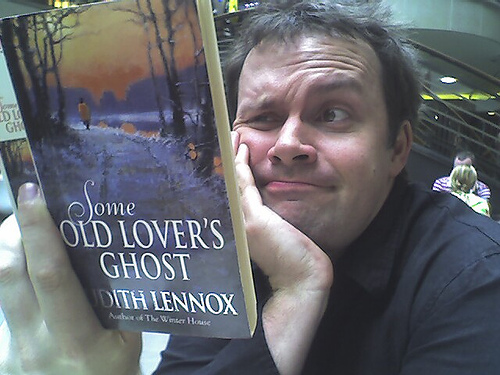
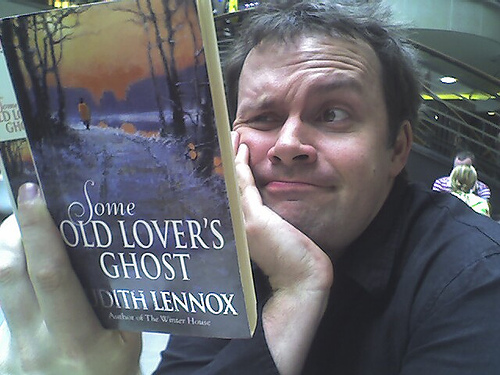
romance novel readerYour plots are delicious, but your eco-impacts suspicious.justin via flickrI looked into the authors you mentioned whose books “quickly become worthless.” All three have engaged in various philanthropic causes, mostly involving children’s health. I don’t see any obvious messages about clearcutting coming from them, although Nora Roberts has done a bit of donating to Defenders of Wildlife. And Tom Clancy wrote Rainbow Six, involving terrorist environmentalists! From the Wikipedia summary: “After living in sealed redoubts ... and protected by the secret ‘B’ vaccine, they will come out to rebuild the world in an environmentally friendly way.”

Sounds exciting! What may be more exciting, in light of your question, is some of the progress the book industry is making. The industry, like all others, contributes to global warming and other environmental problems. Glancing over at our friend the Carnegie Mellon EIO-LCA database, we find that for every million wholesale dollars of book printing, 717 MT of CO2 equivalent are produced. We also know that 30 million trees are used to make books sold in the U.S. each year.

So what are some of the steps publishers are taking? Random House, which publishes Steel’s novels, has committed to increasing its use of recycled paper from 3 percent to 30 percent by 2010. Penguin, which publishes Clancy’s and Roberts’ work, has an even more substantial-seeming green effort, which includes using FSC-certified paper, publishing work by environmental-minded authors, partnering with various green groups, and taking concrete steps to green its in-house business. Then, of course, we have electronic publishing, which is taking the trees out of the equation; as I have written before, e-books may be the greener option—and your authors have made their work available in that format.

That is good news. But more to the point, I do not share your concern about the obsolescence of popular literature. I’d particularly like to direct you away from the idea that bestselling mainstream books quickly become “worthless.” There is a reason that Steel and her ilk have sold millions and millions of books: People like to read them. Not just once, but again and again. My small window into vacation homes, library book sales, airplane and bus reading, shows that it is these very books that are repeatedly proving their worth. Perhaps not monetarily—and maybe this is where your gripe comes in—but certainly as reading material. It’s the intellectual stuff that weighs down the table at a yard sale.

I say not to worry. Unlike many other manufactured objects—cell phones spring to mind—books are endlessly reused. Paperbacks have two great benefits: they are easily recyclable alongside old phonebooks. And they are highly portable. After all, no one is going to take their leatherbound copy of The Mill on the Floss to the beach.

Relaxedly,
Umbra
 

Yours is to wonder why, hers is to answer (or try). Send your green-living questions to Umbra.

Umbra Fisk is Grist Research Associate II, Hardcover and Periodicals Unit, floors 2B-4B.

Advertisement
Advertisement
  1. Orng Crush Posted 6:46 am
    08 Jul 2009

    Amen.  Popular literature is so important to keeping our nation literate, even if many intellectuals think it is "garbage."
  2. Islandia Posted 11:21 am
    08 Jul 2009

    Here in Brooklyn, NY we're not allowed to recycle books. I have sometimes gone to the trouble of actually tearing out all the pages of books I was throwing out in order to recycle the paper!
    1. kobie03 Posted 10:13 am
      10 Jul 2009

      you can recycle books. Check out bookcrossing.com. you register a book get an BCID bookcrossong ID number write  it in the book on a label you can print from bookcrossing, leave it in a public place for someone to pick up and your book goes travelling to new readers. I've read books that have been travelling 4-6 years to new readers. I've recycled hundreds of books this way and have fun doing it.
      1. Raffizack Posted 7:37 am
        11 Jul 2009

        Hey fellow crosser!Thanks for mentioning bookcrossing a second time, this great thing couldn't mentioned as often as it should be :-)
  3. CarlyBee Posted 1:04 pm
    08 Jul 2009

    While switching to recycled paper is nice, to be honest, the real waste within the publishing industry is due to extremely antiquated business models, wherein they purposefully over-produce books, over-ship them, and then at the end of the first few months of sales, when the expected top-seller has made it way from the New Books table to to bargain table out front of Borders, the store then sends back all the unwanted copies (save a few which go into the fiction stacks) and gets a refund from the book publisher. Can you imagine this happening in any other industry?All of those books then get remaindered (their covers are torn off) and some get resold on black markets (though I've never actually seen a book with a fake cover, only read the warning about them in book flaps), but most just end up in warehouses. Even if they do get recycled... what of the carbon footprint their circular journey has taken? No wonder profits are dwindling.All of this serves as a bigger argument for more On-Demand publishing and the Kindle and other non-conventional ways of delivering those juicy (or vapid, depending on your taste) tales... and none of this really puts the blame on the author, only the medium their stories get sold as. The day will come when you can walk into a book-store and order a book off a screen and watch as a the machine prints you a single copy of that book, an actual bound BOOK book instantly. One printed on recycled paper, one that hasn't had to be schlepped in diesel trucks across the country, one that won't be remaindered, because you ordered exactly how many copies you needed... obviously this is still a ways out, but it's cool to know someone has been thinking of a way to fix the book business problem (and it's a big problem).
  4. bailsout Posted 5:20 pm
    08 Jul 2009

    There are some appropriate ways for the philanthropists to donate. Let's stop donating to children's health but instead, to the reduction of child production. If we sterilized ourselves to the edge of extinction, would we be missed?  Yes, like the sound that a falling tree makes in a tropical forest with no one to acknowledge. More healthy children means a less healthy ecosystem. When  will we realize the price that it costs to civilze?
  5. rjnagle Posted 12:40 pm
    09 Jul 2009

    Umbra, this is a great article (as usual).  By some coincidence, I was working on an article on the same subject! (with ample  credit given to your own articles).My main beef is with governmental climate change reports. They are big cumbersome things; most people would prefer to see the information on a webpage.  
    1. Raffizack Posted 8:44 am
      10 Jul 2009

      Bookcrossing is an excellent way to keep books moving and prevent them to get dusty in shelfes.

      After registering a copy of a book at http://www.bookcrossing.com it's set free to find a new reader and maybe rise the karma of the previous reader.

      You don't think it works? It does, some 750.000 bookcrossers all over the world registered over 5.5 million books since April 2001.

      Make the whole world a library and see You at bookcrossing...


      Raffizack
  6. jessicainny Posted 8:39 am
    14 Jul 2009

    I'll continue to read paperbacks in good old fashioned book form (as opposed to e-books) so long as there are services like paperbackswap.com that allow users to exchange read books.  I'm able to find all sorts of amazing books that way -- even vegan cookbooks! -- while ensuring my once-read castoffs get a new life.
  7. raz Posted 11:43 am
    14 Jul 2009

    Regarding the carbon footprint of the book industry - I'm not familiar with Carnegie Mellon EIO-LCA database you mentioned, but according to the 'Environmental
    Trends and Climate Impacts: Findings from the U.S. Book Industry
    ', which was published on March 2008 by The
    Green Press Initiative
    (GPI) and The
    Book Industry Study Group
    (BISG). the industry's carbon footprint of 12.4
    million metric tons or 8.85 lbs. of carbon dioxide per a book
    (2006 figures).Also, this report found out that the source of the paper is responsilbe for the biggest part of the industry's carbon footprint - forest and forest
    harvest impacts are responsible for 62.7% share of total carbon emissions.
    Second is paper production at the mills with 22.4% share.You can read more on this report at http://www.ecolibris.net/book_industry_footprint.asp

Add a Comment

You are not logged in. Thus, you cannot post a comment. If you have an account, log in. If you don't have an account, well, by all means go make one! Meet you back here in five.

Hello, Visitor!    Why not register?

Advertisement