De Rothschild hopes his catamaran made of plastic bottles will draw attention to the need to develop solutions to increase the recycling and reuse of plastic.Courtesy Adventure EcologySan Francisco’s waterfront is but a Disney-fied ghost of its former life as a maritime hub. But amid the chi-chi cafés along The Embarcadero and the tourist trap faux crab shacks on Fisherman’s Wharf, some actual boat building is going on.
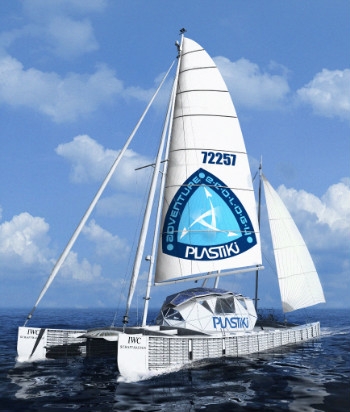
Peer through the window of a battered green door at Pier 29 ½ and you’ll see—but not hear—the form of a rather quirky catamaran quietly taking shape. That’s because it’s being built almost entirely of recyclable plastic that has been melted and molded to form hulls and bulkheads. Plastic bottles—the universal symbol of a disposable consumer culture poisoning the planet—form the pontoons and keep the boat afloat.
The Plastiki is the latest project of British environmentalist and polar adventurer David de Rothschild, the 31-year-old scion of the famous banking family. De Rothschild and his crew of five plan to set sail later this year for Sydney on a three-month voyage across the sometimes treacherous Pacific to draw attention to a host of environmental problems, from rising sea levels and coral bleaching to the Eastern Pacific Garbage Patch, a swirling mass of plastic trash twice the size of Texas.
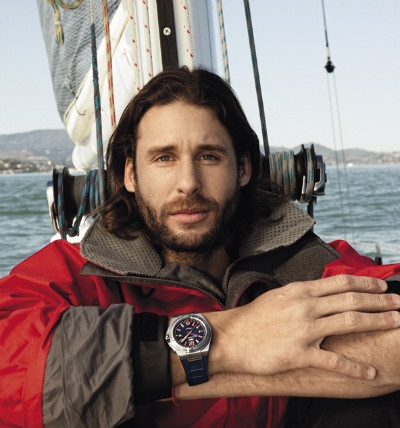
Standing 6-feet-4-inches tall with shoulder-length brown hair and piercing eyes, de Rothschild is a media magnet—a gaggle of reporters and television cameras recently gathered for the opening of the Plastiki Mission Control Center on Pier 45 as throngs of souvenir-hunting tourists passed by a window covered in a curtain of green plastic bottles.
But the pretty-boy messenger has an unconventional message. “For a very long time, plastic has been vilified as one of those materials we say that we have to ban,” says de Rothschild, standing next to Plastiki’s equally telegenic skipper, 29-year-old ocean-racing veteran Jo Royle. “We’re looking at the Plastiki not to vilify the material but to understand it. A big part of this project is to use technology to innovate new plastics, innovate new uses. We have to move from Planet 1.0 to Planet 2.0.”
In other words, don’t outlaw plastic, but develop technological solutions to reuse, recycle and reduce. (Only 20 percent of those ubiquitous plastic water bottles are recycled, according to de Rothschild.)
The Plastiki—an homage to the Kon-Tiki, the balsa raft that took Thor Heyerdahl from South America to Polynesia in 1947—itself is Exhibit A.
When de Rothschild’s crew at Adventure Ecology—his enviro organization—found that pontoons of plastic bottles would make the craft uncontrollable, they scoured the world for material to add structural rigidity. The answer: self-reinforcing polyethylene terephthalate (PET). PET is the stuff plastic bottles are made of but, srPET is a cloth-like material that contains plastic fibers that give it fiberglass-like strength. The cloth is heated and fused to PET foam to make panels for bulkheads and hulls. It’s all 100 percent recycled and recyclable plastic.
“You start to realize this stuff is super lightweight and super strong—this is a surfboard right here or a skateboard,” de Rothschild tells me, holding up a piece of srPET. “It’s a new type of material we are engineering. That helps us not only to achieve our project but has the ability to change an industry. Not just the naval industry but many other industries.”
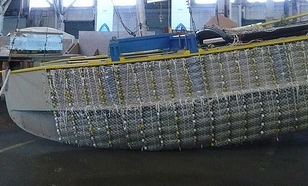
Look closely and you can see the plastic bottles that will make the Plastiki’s two pontoons float.Photo courtesy ekornblut via Flickr.“Imagine if you start changing business models,” he adds, standing on a floor made of recycled Nike athletic shoes. “What if I as a company own your surfboard and you own the graphics that cover it. So every time your board gets damaged, you bring back to us and we’ll give you a new recycled board and you buy new graphics. So you never really are having to generate new waste.”
De Rothschild, who comes across as charming and self-effacing, declined to say what the mission will cost, citing confidentiality agreements with Plastiki’s sponsors, but he indicated that it’s in the mid seven figures.
The launch date for the mission was been delayed twice as the team works to solve the challenge of building an all-plastic boat that can withstand a transoceanic voyage. De Rothschild will only say the Plastiki will sail out of San Francisco later in the year (presumably before the Pacific cyclone season begins). He says he expects the hulls and cabin to be completed by the end of July.
Hewlett-Packard is equipping the Plastiki with computer and communications technology and has made the engineers and researchers at its HP Labs available to the Adventure Ecology team.
“They’ve allowed us the ability to throw crazy questions at them,” says de Rothschild. “We’ll say, ‘How do we convert appliances for the boat and how do we create energy saving devices for the boat?’ and they come back and say, ‘We’ve been developing this and this’—I’m not allowed to say what. They have this amazing thin-film solar technology they’re working on which I hope we can try to include in the boat.”
The Plastiki will feature stationary bicycles that will be used to generate electricity, a small wind turbine and “biodigestible composting” toilets.
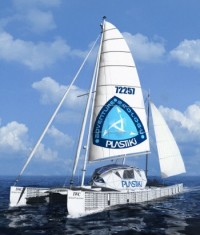
An artist’s rendering of the Plastiki.Courtesy Adventure Ecology“As you can imagine, electrical equipment and the washing machine-like environment we’ll be living in don’t mix too well,” says Royle, the Plastiki skipper, pointing to an HP laptop computer. “This EliteBook will be used to run most of our onboard systems and not only is it 90 percent recyclable and fits in with our message about the Plastiki, it has been designed to withstand all the crashes of life in the field.”
The catamaran’s crew will be living in a geodesic dome-like cabin and blogging and vlogging about the mission, sharing the environmental data they collect. Each crewmember will also be wearing a gadget that will monitor heart rate and other biometric data that will then be broadcast to the Web. At Plastiki Mission Control, people can use HP touchscreen computers to follow the Plastiki’s progress, learn about environmental issues and interact with the crew.
“My favorite demography is between 13 to 17 years old,” de Rothschild says. “It’s an age where kids start to make decisions, start to form their opinions. They say, ‘I can do that, I can get out there.’”
So will de Rothschild be Twittering?
“I will. I’m Twittering now.”
The Plastiki mission’s Twitter handle is @Plastiki.
Comments
View as Flat
Steven Earl Salmony Posted 6:45 am
07 Jul 2009
Imagine for a moment that we are looking at an ocean wave, watching it move toward the shore where it crashes finally at our feet. The wave is moving toward us; however, at the same time, there are many molecules in the wave that are moving in the opposite direction, against the tide. If we observe that the propagation of the human species worldwide is like the wave and the reproduction numbers of individuals in certain locales are like the molecules, it may be inaccurate for the latter to be looked at as if it tells us something meaningful about the former.
Abundant research indicates that most countries in Western Europe, among many other countries globally, have recently shown a decline in their rates of human population growth. These geographically localized data need not blind us to the fact that the absolute global human population numbers are skyrocketing. The world’s human population is like the wave; the individual or localized reproduction numbers are like the molecules.
Perhaps a "scope of observation" problem is presented to everyone who wants to adequately understand the dynamics of human population numbers.
Choosing a scope of observation is a forced choice, like choosing to look at either the forest or the trees, at either the propagation numbers of the human species (the wave data) or localized reproduction numbers (the molecular data). Data regarding the propagation of absolute global human population numbers is the former while individual or localized reproduction data are the latter.
From this vantage point, the global challenge before humanity could be a species propagation problem. Take note that global propagation numbers do not vary with the reproduction data. That is to say, global human propagation data and the evidence of reproduction numbers of individuals in many places, appear to be pointing in different directions. The propagation data are represented by the wave; the reproduction data are represented by the molecules moving against the tide.
In the year 1900 world’s human population was approximately 1.2 to 1.6 billion people. With the explosive growth of the global human population over the 20th century in mind (despite two world wars, ubiquitous local conflicts, famine, pestilence, disease, poverty, and other events resulting in great loss of life), what might the world look like in so short a period of time as 41 years from now? How many people will be on the planet at that time? The UN Population has recently made its annual re-determination that the world’s human population will reach 9.2 billion people around 2050, and then somehow level off. No explanation is given for how this leveling-off process is to occur.
We can see that the fully anticipated growth of absolute global human population numbers is about 8 billion people for the 150 year period between 1900 and 2050.
Whatever the number of human beings on Earth at the end of the 21st century, the size of the human population on Earth could have potentially adverse impacts on the number of the world’s surviving species, on the rate of dissipation of Earth’s resources, and on the basic characteristics of global ecosystems.
For too long a time human population growth has been comfortably viewed by politicians, economists and demographers as somehow outside the course of nature. The potential causes of global human population growth have seemed to them so complex, obscure, or numerous that a strategy to address the problems posed by the unbridled growth of the human species has been assumed to be unknowable. Their preternatural, insufficiently scientific grasp of human population dynamics has lead to widely varied forecasts of global population growth. Some forecasting data indicate the end to human population growth soon. Other data suggest the rapid and continuous increase of human numbers through Century XXI and beyond.
Recent scientific evidence appears to indicate that the governing dynamics of absolute global human population numbers are indeed knowable, as a natural phenomenon. According to unchallenged scientific research, the population dynamics of human organisms is essentially common to, not different from, the population dynamics of other organisms.
To suggest, as many politicians, economists and demographers have been doing, that understanding the dynamics of human population numbers does not matter, that the human population problem is not about numbers, or that human population dynamics have so dizzying an array of variables as not to be suitable for scientific investigation, seems not quite right.
If I may continue by introducing an extension of my perspective.
According to the research of Russell Hopfenberg,Ph.D., and David Pimementel, Ph.D., global population growth of the human species is a rapidly cycling positive feedback loop in which food availability drives population growth and this recent, astounding growth in absolute global human numbers gives rise to the misperception or mistaken impression that food production needs to be increased even more.
Data indicate that the world’s human population grows by approximately two percent per year. All segments of it grow by about 2%. Every year there are more people with brown eyes and more people with blue ones; more people who are tall and more short people. It also means that there are more people growing up well fed and more people growing up hungry. The hungry segment of the global population goes up just like the well-fed segment of the population. We may or may not be reducing hunger by increasing food production; however, we are most certainly producing more and more hungry people.
Hopfenberg’s and Pimentel's evidence suggests that the magnificently successful efforts of humankind to increase food production in order to feed a growing population has resulted and continue to result in even greater human population numbers.
The perceived need to increase food production to feed a growing population is a widely shared and consensually validated misperception, a denial both of the physical reality and the space-time dimension. If people are starving at a given moment of time, increasing food production cannot help them. Are these starving people supposed to be waiting for sowing, growing and reaping to be completed? Are they supposed to wait for surpluses to reach them? Without food they would die. In such circumstances, increasing food production for people who are starving is like tossing parachutes to people who have already fallen out of the airplane. The produced food arrives too late; however, this does not mean human starvation is inevitable.
Consider that human population dynamics are not biologically different from the population dynamics of other species. Human organisms, other species and even microorganisms have essentially similar population dynamics. We do not find hoards of starving roaches, birds, squirrels, alligators, or chimpanzees in the absence of food as we do in many "civilized" human communities today because these non-human species are not annually increasing their food production capabilities.
Please take note that among tribal peoples in remote original habitats, we do not find people starving. Like non-human species, “primitive” human beings live within the carrying capacity of their environment. History is replete with examples of early humans and more remote ancestors not increasing their food production annually, but rather living successfully off the land for thousands upon thousands of years as hunters and gatherers of food.
Prior to the agricultural revolution and the production of more food than was needed for immediate survival, human numbers supposedly could not grow beyond their environment’s physical capacity to sustain them because global human population growth or decline is primarily determined by food availability. Looked at from a global population perspective, more food equals more human organisms; less food equals less human organisms; and, in one and all cases, no food equals no humans.
Thank you.Steven Earl SalmonyAWAREness Campaign on The Human Population, established 2001http://sustainabilityscience.org/content.html?contentid=1176
Permalink
Delay And Deny Posted 9:30 am
07 Jul 2009
Permalink
Tyler Durden Posted 10:37 pm
07 Jul 2009
understand it. A big part of this project is to use technology to
innovate new plastics, innovate new uses."Too bad. Plastic is very environmentally destructive, from its creation to its disposal. The idea that the only thing wrong with plastic is that instead of reusing it people throw it away is as fallacious as the idea that nuclear power will be good for the Earth because switching to it from coal will reduce greenhouse gas emissions (which, BTW is not even true). In order to create plastic you have to drill and refine oil, two very destructive processes. Once created, all plastics constantly "out-gas," polluting the air.2. What's unusual about this boat is that its hulls are being made of recycled plastic, not that it's being made of plastic. Boats used to be made of wood, but as of 30-40 years ago they're almost all made of plastic; it's called fiberglass and seems to be very similar to the srPET material that these people are developing, judging by their description. (There are a few boats made of ferrocement and steel, but they're pretty rare.)Sailing Issues1. They're called "hulls," not "pontoons." You don't want people to think you're a landlubber, do you?2. If they're going to avoid the hurricane season in the South Pacific, they'd better hurry. The correct time to leave from SF for Australia would be May or June. I definitely wouldn't leave any later than early September, and even that's taking a significant chance.3. Sorry to kill anyone's sailing fantasies, but all modern sailboats have diesel engines, with literally a handful of extremely rare exceptions. What will provide the auxiliary power for this boat? A company named Lagoon has been selling hybrid boats for a few years. They have electric engines instead of diesel ones and a diesel generator for when the batteries need charging. This is a much less environmentally harmful alternative.4. Re No. 3, what will be Mr. de Rothschild's and his skipper's commitment to only motoring when absolutely necessary. Motoring with electric engines uses more electricity than anything else on a boat, which in turn causes the diesel generator to come on, consuming fuel and polluting the air and water. Many modern so-called sailors motor at least half the time, because they refuse to wait out calms and/or don't want or know how to sail upwind properly.
Permalink
Moondancermom Posted 9:28 am
08 Jul 2009
Permalink
windermere Posted 10:38 am
08 Jul 2009
Permalink
Moondancermom Posted 10:46 am
08 Jul 2009
Permalink
rational exuberance Posted 11:36 am
08 Jul 2009
Permalink
rational exuberance Posted 4:07 pm
08 Jul 2009
Permalink
grygy Posted 5:41 pm
14 Jul 2009
Permalink