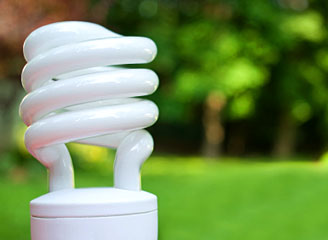
 President Barack Obama doesn’t think he can solve global warming by changing his f**king light bulbs, but he’s going to do it anyway. More importantly, he’s going to change the light-bulb industry.
Obama unveiled new energy-efficiency standards for lighting and appliances on Monday — the latest in a string of energy-focused announcements and events for the president. On Friday, he praised the House for passing the landmark American Clean Energy and Security Act. On Saturday, he focused his weekly address on the bill and the importance of clean energy — a last-minute change, as the address had been intended to focus on health care. And on Sunday, he sat down with a group of reporters for a lengthy interview about the climate bill and energy in general, emphasizing that he thinks the clean-energy market is poised for explosive growth.
On Monday, with Energy Secretary Steven Chu at his side, Obama said the Department of Energy is at work on new standards for fluorescent and incandescent lighting. And in the meantime, he’s changing the light bulbs in the White House.
“Now I know light bulbs may not seem sexy, but this simple action holds enormous promise because 7 percent of all the energy consumed in America is used to light our homes and our businesses,” Obama said.
The president estimated that the new lighting standards would cut 594 million tons of carbon dioxide emissions between 2012 and 2042 and save American energy users $1 billion to $4 billion each year over that period — conserving enough energy to eliminate the need for as many as 14 new coal-fired power plants.
Obama also announced that the Department of Energy has outlined tougher efficiency standards for household appliances, responding to a request from the White House in February to speed up the delivery of new rules, and he noted major federal investments in energy efficiency for buildings.
“One of the fastest, easiest, and cheapest ways to make our economy stronger and cleaner is to make our economy more energy efficient,” said Obama. “By bringing more energy-efficient technologies to American homes and businesses, we won’t just significantly reduce our energy demand; we’ll put more money back in the pockets of hardworking Americans.”
Obama highlighted the gains that California has made in efficiency since the 1970s, which have put the state’s energy usage 40 percent below the national average. In the process, he said, the state has created 1.5 million jobs in energy efficiency. Obama predicted that the new federal standards will have similar effects — creating jobs, reducing emissions, and saving money.
The president also announced that $346 million from the economic stimulus bill will be invested in efficiency for commercial and residential buildings, which account for 40 percent of domestic energy use and 40 percent of domestic CO2 emissions. Of that money, $100 million will be invested in advanced building systems research, $70 million in residential buildings, $53.5 million for commercial buildings, and $72.5 million for buildings and appliance market transformation.
Obama took the opportunity to again praise the House’s passage of the climate and energy bill on Friday, a move he said will help make “clean energy the profitable kind of energy.” He praised legislators who voted for the bill for being “willing to place America’s progress ahead of the usual Washington politics.”
For more, read Obama’s full remarks.
Here are President Obama’s full remarks:
THE PRESIDENT: Good afternoon, everybody. Since taking — excuse me — since taking office, my administration has mounted a sustained response to a historic economic crisis. But even as we take decisive action to repair the damage to our economy, we’re also working to build a new foundation for sustained and lasting economic growth.
And we know this won’t be easy, but this is a moment where we’ve been called upon to cast off the old ways of doing business, and act boldly to reclaim America’s future. Nowhere is this more important than in building a new, clean energy economy, ending our dependence on foreign oil, and limiting the dangerous pollutants that threaten our health and the health of our planet.
And that’s precisely what we’ve begun to do. Thanks to broad coalitions ranging from business to labor; investors to entrepreneurs; Democrats and Republicans from coal states and coastal states; and all who are willing to take on this challenge — we’ve come together to achieve more in the past few months to create a new, clean energy economy than we have in decades.
We began with historic investments in the Recovery Act and the federal budget that will help create hundreds of thousands of jobs doing the work of doubling our country’s supply of renewable energy. We’re talking about jobs building wind turbines and solar panels; jobs developing next-generation solutions for next-generation cars; jobs upgrading our outdated power grid so it can carry clean, renewable energy from the far-flung areas that harness it to the big cities that use it.
And thanks to a remarkable partnership between automakers, autoworkers, environmental advocates, and states, we created incentives for companies to develop cleaner, more efficient vehicles — and for Americans to drive them. We set in motion a new national policy aimed at both increasing gas mileage and decreasing greenhouse gas pollution for all new cars and trucks sold in the United States. And as a result, we’ll save 1.8 billion barrels of oil over the lifetime of the vehicles sold in the next five years — the projected equivalent of taking 58 million cars off the road for an entire year.
And we know that even as we seek solutions to our energy problems at home, the solution to global climate change requires American leadership abroad. That’s why I’ve appointed a global climate envoy to help lead our reengagement with the international community as we find sustainable ways to transition to a global low-carbon economy.
And, now, just last Friday, the House of Representatives came together to pass an extraordinary piece of legislation that will finally open the door to decreasing our dependence on foreign oil, preventing the worst consequences of climate change, and making clean energy the profitable kind of energy. Thanks to members of Congress who were willing to place America’s progress before the usual Washington politics, this bill will create new businesses, new industries, and millions of new jobs, all without imposing untenable new burdens on the American people or America’s businesses. In the months to come, the Senate will take up its version of the energy bill, and I am confident that they too will choose to move this country forward.
So we’ve gotten a lot done on the energy front over the last six months. But even as we’re changing the ways we’re producing energy, we’re also changing the ways we use energy. In fact, one of the fastest, easiest, and cheapest ways to make our economy stronger and cleaner is to make our economy more energy efficient. And that’s something that Secretary Chu is working every single day to work through.
We know the benefits. In the late 1970s, the state of California enacted tougher energy-efficiency policies. Over the next three decades, those policies helped create almost 1.5 million jobs. And today, Californians consume 40 percent less energy per person than the national average — which, over time, has prevented the need to build at least 24 new power plants. Think about that. California — producing jobs, their economy keeping pace with the rest of the country, and yet they have been able to maintain their energy usage at a much lower level than the rest of the country.
So that’s why we took significant steps in the Recovery Act to invest in energy efficiency measures — from modernizing federal buildings to helping American families make upgrades to their homes — steps that will create jobs and save taxpayers and consumers money. And that’s why I’ve asked Secretary Chu to lead a new effort at the Department of Energy focusing on implementing more aggressive efficiency standards for common household appliances — like refrigerators and ovens — which will spark innovation, save consumers money, and reduce energy demand.
So today, we’re announcing additional actions to promote energy efficiency across America; actions that will create jobs in the short run and save money and reduce dangerous emissions in the long run.
The first step we’re taking sets new efficiency standards on fluorescent and incandescent lighting. Now I know light bulbs may not seem sexy, but this simple action holds enormous promise because 7 percent of all the energy consumed in America is used to light our homes and our businesses. Between 2012 and 2042, these new standards will save consumers up to $4 billion a year, conserve enough electricity to power every home in America for 10 months, reduce emissions equal to the amount produced by 166 million cars each year, and eliminate the need for as many as 14 coal-fired power plants.
And by the way, we’re going to start here at the White House. Secretary Chu has already started to take a look at our light bulbs, and we’re going to see what we need to replace them with energy-efficient light bulbs.
And if we want to make our economy run more efficiently, we’ve also got to make our homes and businesses run more efficiently. And that’s why we’re also speeding up a $346 million investment under the Recovery Act to expand and accelerate the development, deployment, and use of energy-efficient technologies in residential and commercial buildings, which consume almost 40 percent of the energy we use and contribute to almost 40 percent of the carbon pollution we produce.
We’re talking about technologies that are available right now or will soon be available — from lighting to windows, heating to cooling, smart sensors and controls. By adopting these technologies in our homes and businesses, we can make our buildings up to 80 percent more energy efficient — or with additions like solar panels on the roof or geothermal power from underground, even transform them into zero-energy buildings that actually produce as much energy as they consume.
Now, progress like this might seem far-fetched. But the fact is we’re not lacking for ideas and innovation. All we lack are the smart policies and the political will to help us put our ingenuity to work. And when we put aside the posturing and the politics; when we put aside attacks that are based less on evidence than on ideology; then a simple choice emerges.
We can remain the world’s leading importer of oil, or we can become the world’s leading exporter of clean energy. We can allow climate change to wreak unnatural havoc, or we can create jobs utilizing low-carbon technologies to prevent its worst effects. We can cede the race for the 21st century, or we can embrace the reality that our competitors already have: The nation that leads the world in creating a new clean energy economy will be the nation that leads the 21st century global economy.
That’s our choice: between a slow decline and renewed prosperity; between the past and the future.
The American people have made their choice. They expect us to move forward right now at this moment of great challenge, and stake our claim on the future — a stronger, cleaner, and more prosperous future where we meet our obligations to our citizens, our children, and to God’s creation — and where the United States of America leads once again.
That’s the future we’re aiming for. I’ve got a great Secretary of Energy who’s helping us achieve it. I want to thank again the House of Representatives for doing the right thing on Friday, and we are absolutely confident that we’re going to be able to make more progress in the weeks and months to come.
Thanks, guys.