News of a compromise foretold

How bad is the Peterson-Waxman deal on climate legislation? 7

Big tractorBig Ag gets its way.

[See update below.]

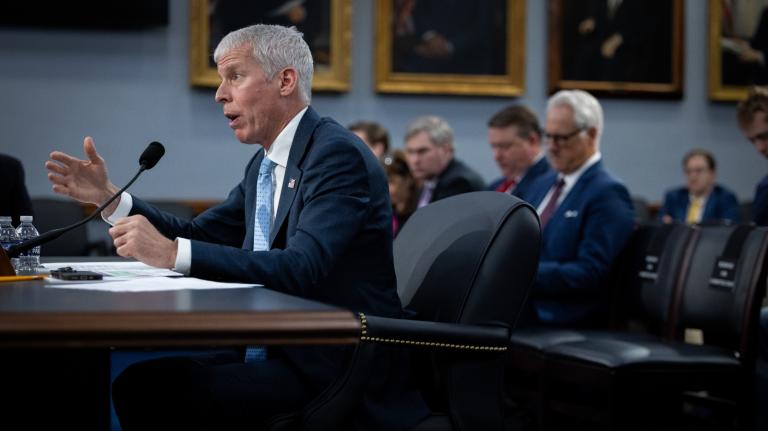
Surprising no one—but disappointing many—House energy chief Henry Waxman (D-Calif.) has caved in to the demands of the the agribusiness industry over the climate bill.

In reality, he had little choice if he wanted his legislation to get through the House. For more than a month, House Ag Committee Chairman Collin Peterson (D-Minn.)—an unabashed proponent of agribusiness interests—has thundered and roared about how no climate bill could get through the House without containing his agenda.

He had the votes to back up his bluster—26 Democrats on his committee, plus another 20 to 25 rural reps who shared his concerns. Without Peterson’s support, Waxman-Markey was a dead letter. There’s no guarantee that Peterson can now deliver enough of those rural votes to push the bill through. But with Peterson’s support sewn up, the legislation has a reasonable chance of surviving Friday’s vote.

“Not all of my House ag people will vote for it, but there will be a good majority,” Peterson told The New York Times.  “I think the votes are going to be there.”

The question for greens now is, just how bad is this compromise? How much does it undercut the legislation’s underlying goal of slashing greenhouse gas emissions and stabilizing the climate?

The compromise has two major planks:  1) the EPA will be forbidden for five years from assessing the indirect land-use effects of ethanol, a topic that sends the ethanol-besotted Peterson into literal fits of rage; and 2) the USDA, not the EPA, will administer the market for ag-related offsets under the bill’s cap-and-trade scheme.

The ethanol bit is a travesty, to be sure—no serious person with knowledge of the topic denies that diverting ever-growing amounts of U.S. corn into biofuel inspires farmers in other places, including ecologically precious rainforest regions, to put more land under the plow. But here’s the key: As I wrote at the time of their release,  the EPA’s proposed land-use rules didn’t really change much on the ground. The 2007 Energy Act had already grandfathered in 15 billion gallons of corn-based ethanol—and producers only churned out 9 billion gallons in 2008. That means that despite Peterson’s fulminations, the EPA’s proposed rules would do nothing to impede a stunning 66 percent leap in ethanol production over 2008 levels, indirect land use be damned. So repealing it won’t change much on the ground.

So in real-world terms, the compromise hinges on the offset piece. And here, too, we have a travesty—and this one could have real effect. It’s impossible to get much of an idea yet of just how bad things are—Waxman has yet to release specific language about ag offsets. But the compromise raises serious questions. The EPA will still have some role in the process; we don’t no yet what that role will be. But its authority on judging ag offsets will evidently be secondary to that of the USDA.

[UPDATE: Grist’s Kate Sheppard has just spoken to an Energy and Commerce Committee staffer who said that we can expect precise language on the ag compromise to emerge tonight, and that the USDA will “write rules for the domestic [ag] offset program” while the EPA will writes rules for all other offsets, including foreign agricultural offsets.]

No one disputes that the USDA, with its extensive network of offices in rural areas nationwide, should have a role in administering ag offsets. But the idea that the agency should perform the lifecycle analyses needed to determine what really constitutes a carbon offset is ridiculous.

Meredith Niles, coordinator of the Cool Foods campaign for the Center for Food Safety, put it to me like this: “the USDA’s mission statement is to promote U.S. agriculture. The EPA’s is to protect the environment. It makes no sense for the USDA to run such a critical environmental program.” In other words, the USDA has a bit of a conflict of interest here: an agency who’s very DNA compels it to promote industrial agriculture is being asked to curb its excesses.

Of course, the USDA already does perform an environmental-protection role—it administers the various conservation programs set forth in the Farm Bill. And here, it’s record is spotty at best. In September 2007, the Environmental Working Group released a paper highly critical of the USDA’s conservation efforts, sourced largely by critical reports from the Government Accountability Office and other federal agencies. The EWG study concluded that the USDA’s efforts to curb soil erosion through conservation programs has largely failed. The authors put it bluntly:

Due to lax standards and implementation problems, the conservation compliance program is missing cost-effective opportunities to make further, substantial reductions in soil erosion on U.S. cropland.

The idea that the USDA has a conflict of interest in administering environmental programs makes me think of its recent performance around swine flu. Despite much compelling evidence that the deadly strain emerged from U.S. factory hog farms, USDA chief Tom Vilsack rushed to the defense of the pork industry. And why not? As currently structurd, his job is to promote U.S. farm interests, not protect public health.
 

Grist food editor Tom Philpott farms and cooks at Maverick Farms, a sustainable-agriculture nonprofit and small farm in the Blue Ridge Mountains of North Carolina. Follow my Twitter feed; contact me at tphilpott[at]grist[dot]org.

Advertisement
Advertisement
  1. neosapiens Posted 1:21 pm
    24 Jun 2009

    It just means that there will be another big fight another day.  Ultimately, the truth will come out. 
  2. Michael Wagner Posted 2:35 pm
    24 Jun 2009

    <!--[if gte mso 9]><xml> Normal 0 false false false MicrosoftInternetExplorer4 </xml><![endif]--><!--[if gte mso 9]><xml> </xml><![endif]--><!--[if !mso]> <style>
    st1\:*{behavior:url(#ieooui) }
    </style>
  3. ecoplasm Posted 10:30 pm
    24 Jun 2009

    A bit unfair to say Waxman 'caved'.  He's actually a masterful politician.  Do you want climate change legislation or not?Anyway, the House and the Senate already voted to authorize the USDA to develop a carbon offsets program, including a registry -- signed into law last year -- it's called the 2008 Farm Bill (Sec. 1245). Waxman only agreed to include this type of program in his cap-and-trade system as a mechanism to provide compliance offsets from agriculture and forestry. Lisa Jackson (EPA) already publicly ceded this part of the offsets program to the USDA last week (I think she's trying to keep her new job; wish her luck).By the way, by design, an offsets program is not a regulatory program but an incentives program.  To be sure, if it is to provide compliance offsets then there has to be a high bar for eligibility, quantification and issuance of credits, but the goal of offsets programs is to incentivize emission reductions in difficult to regulate sectors, not to regulate them.  EPA, as a regulatory agency, may not be the best choice if we're honestly trying to reduce GHG emissions in these sectors as quickly and practically as possible, especially in ag, where it has almost no boots on the ground and barely speaks the language.  EPA is better suited to regulate the large emitters.  And despite the high hopes of some, the EPA is probably not the best vehicle for ruling the earth.Hooray for climate legislation and Hooray for Waxman!  It will only get better as we can all finally get to work on reducing global warming. 
  4. Meredith Niles's avatar

    Meredith Niles Posted 5:53 am
    25 Jun 2009

    Ecoplasm- agree with you that Waxman is a brilliant politician.  We all know that he has had a difficult time trying to develop something comprehensive and still environmentally beneficial.  I actually think the best system would be a dual relationship between EPA and USDA.  For sure USDA has the excellent reputation with farmers, extension agents and other valuable assets to the farm community to be able to implement and follow an offsets program.  But I think it would be ideal to have the EPA sitting at the table with USDA to help determine the life cycle analysis' necessary to figure out which types of offset programs would work.  In my eyes, both agencies, as well as others with vested interests including Departments of Commerce, Labor, etc. should also have a seat at the table.  We'll see how that develops...
    1. ecoplasm Posted 9:58 am
      25 Jun 2009

      Meridith, I hope so to.  EPA's Climate Change office has a very good working relationship with folks at USDA, and relies on them heavily for national GHG inventory work and modeling in the ag and forestry sector.  Many of the early offset program design concepts for Kyoto came out of this EPA group. However, given the long-simmering bad blood at other levels and especially with respective consitutuents, perhaps something akin to a Rwanda-style unity and reconciliation effort would be necessary for an ideal working relationship between these two agencies to be possible.I'm not so sure about the maturity of EPA's life cycle analysis capabilities, however.  A great hueristic tool, LCA, but EPA's recent oopsy in the ethanol debate was largely the result of a borrowed Berkeley approach and I've heard that even the EPA economists would be hard pressed to call it anything more than a work in progress. EPA's LCA Waste and Recycling Model (WARM) developed in what used to be called the Solid Waste Division has gotten nothing but rotten tomatoes from the Climate Change office, and is also literally a work in progress (again).  In fact, the biggest cart-tip Lisa Jackson has experienced so far, in which she apparently lost a few political apples, was due to a political decision to rush ethanol LCA into the rulemaking process - probably well before it was ready.I think there is already some good experience accumulated both nationally and internationally for applying LCA, when appropriate, to offset program leakage evaluations.  Most of it, however, has been outside of the EPA (remember that in the 'dark days' until the Obama admin they lacked both funding and political will to spend much time on this - it's hard to get good at something you're not allowed to do).  
  5. Michael Wagner Posted 4:22 pm
    25 Jun 2009

    The Greenhouse Effect is mature science...--however the idea of offseting emissions is without merit...Right--mankind is responsible for fantastic amounts of GHG emissions--somehow I don't see planting a tree as any kind of solution here... (when the tree dies it rots in the sun and releases much of the carbon back...)A close examination here undoubtedly will uncover a money trail...!!!
  6. Michael Wagner Posted 4:28 pm
    06 Jul 2009

    <!--[if gte mso 9]><xml> Normal 0 false false false MicrosoftInternetExplorer4 </xml><![endif]--><!--[if gte mso 9]><xml> </xml><![endif]--><!--[if !mso]> <style>
    st1\:*{behavior:url(#ieooui) }
    </style>

Add a Comment

You are not logged in. Thus, you cannot post a comment. If you have an account, log in. If you don't have an account, well, by all means go make one! Meet you back here in five.

Hello, Visitor!    Why not register?

Advertisement