Halfway through the second debate of last fall’s presidential campaign, moderator Tom Brokaw asked the candidates what their top priority would be if elected. McCain hemmed and hawed, but Obama answered in plain language: energy is “priority No. 1” and health care “priority No. 2.”
Fast forward. In an NYT Magazine piece this weekend on the legislative strategy driving Obama’s presidency, Sen. Max Baucus recalls a flight on Air Force One in which Obama “just turned to me and said, ‘This is my No. 1 issue.'” That issue? Health care.
What a difference a little time in office makes.
This Reuters story says that health care and climate are jockeying for legislative position, but in reality, the jockeying seems over: health care won. The question now is, can a climate bill still pass when most of the attention and passion of the political left are focused elsewhere?
I spent the weekend chatting with a diverse range of energy-literate experts and insiders — congressional staff, think tankers, NGO reps, energy company execs — and this question came up repeatedly. While the discussions were off the record, I can report a broad conclusion: it’s hard to say. Really hard.
I had people tell me with great confidence that there are 60 votes in the Senate for cloture on the climate bill (to overcome the threat of filibuster) and 51 for the bill itself. Others told me there are procedural tricks (strip stuff out and add it back in via conference committee) that can get the bill through the Senate in any case.
Other people (definitely the larger faction) accepted what one called “the worst kept secret in DC”: that there’s “no way” the Senate is passing a climate bill this year. There just aren’t 60 votes.
The truth is, nobody really knows. The situation is extraordinarily fluid, and as always in politics, it’s likely presently unforeseeable circumstances that will make the difference. With that boring and very unbloggy point on the table, let’s look at a few dynamics that are shaping the course of events.
Republicans aren’t involved
Republicans have settled on a strategy of blanket opposition to both the health care and climate legislation. This obviously isn’t in the best interests of the country; it’s not even obviously in the narrow self-interest of many Republicans. Nonetheless, a combination of increasing ideological rigidity, lack of new ideas, and sheer cussed habit has taken the Right completely out of these debates, except as rock-throwers and gear-grinders. They’ve decided that Democratic successes on either of these major initiatives could fuel further electoral losses, and that’s their worst fear.
It didn’t have to be this way, and many people I talked to evinced genuine surprise at how it’s turned out. The climate bill strategy, for instance, got rolling in December, way back pre-Obama stimulus plan. It was designed around the assumption that in the wake of Obama’s historic win and efforts to reach out across the aisle, a few Republicans could be peeled off.
That didn’t work out. And it can’t be overstated how much unified Republican opposition is shaping things. The debate is entirely between Democrats, entirely along regional lines, and “moderate” Democrats (i.e. those hailing from carbon-intensive districts) have been accorded enormous power. Witness Boucher’s triumphs in the House.
In the Senate, there are maybe two Republican yes votes — the last moderates standing, Olympia Snowe and Susan Collins from Maine. That means to get cloture, Dems can lose no more than two votes from their own caucus. Meanwhile, there are far more than two senators on the fence (at best) or likely nos (at worst): Mary Landrieu (Louisiana), Evan Bayh (Indiana), Ben Nelson (Nebraska), Blanche Lincoln and Mark Pryor (Arkansas), and several others.
Health care is primed and ready
Democrats have been pushing for universal health care for, hell, over a half century now, and time after time it’s gone down to defeat, most recently with the HillaryCare fiasco of 1993. At this point, however, the gathering crisis is undeniable, solid coalitions have been assembled, and policy options are well-understood. Politically speaking, the issue is mature.
The same can’t be said of climate. It was swept under the rug during Bush, so it’s only now, with viable legislation on the table, that the political world is grappling with it in earnest. One party still denies the problem; coalitions are shifting, uncertain, and poorly matched to traditional divisions; policy options are complex and controversial; grassroots support and messaging are nascent at best. There’s a level of ignorance about the issue in Congress (and among staffers, governors, etc.), even on the Left, that I suspect would stun and horrify most Grist readers.
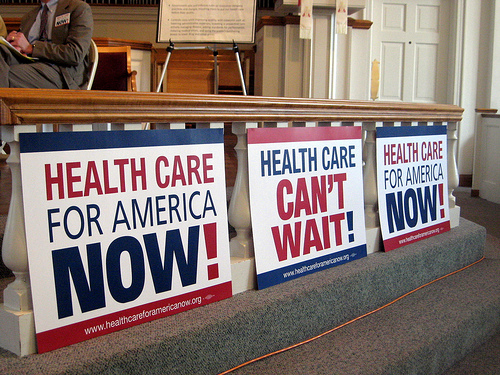
Partly as a consequence of its maturity — and partly due to its more personal, visceral, immediate character — health care generates a passion among Democrats that climate simply doesn’t. That’s true for politicians, thought leaders, and grassroots types alike. (At the climate panel during the America’s Future Now conference last week, on which I spoke, all of 15 people showed up. Throughout the conference, climate occasionally appear on The List — “we need to do X, Y, and Z!” — but it rarely came to the fore and even more rarely generated any real audience response.)
Congressional leaders get this. Pelosi is willing to give her members a hard deadline for passing a health care bill (end of July). On climate, however, she wants committee chairs to finish with the bill by June 19, but won’t offer a deadline for passing the bill on the House floor. Senate Democrats are willing to push health care via the reconciliation process — which prevents the legislation from being filibustered in the Senate — but are unwilling to do the same with climate legislation. That means climate needs 60 votes, which makes it a much, much heavier lift.
Wildcards: Obama and momentum
Health care is the passion and central focus of the Obama administration (particularly budget director Peter Orszag). Whereas Obama’s been fairly quiet on the development of the climate bill (aside from one behind-the-scenes meeting with members of the House E&C Committee, which from everything I hear actually made a huge difference), he’s now decided to put his face and enormous popularity behind health care, with, the New York Times reports, “speeches, town-hall-style meetings and much deeper engagement with lawmakers.”
Does he have the time, attention, and political capital do the same for climate? That’s the $64 million question. Everyone I talked to agreed: only Obama can make the difference in the Senate.
You can see it going two ways. If the fight over health care turns nasty and extends well into the fall, it could consume all the attention from Obama, legislators, and the press. Lawmakers will be loathe to undertake another contentious battle at the same time. In particular, watch Max Baucus (Montana), chairman of the Finance Committee: he’s not going to let focus be divided with a health care victory finally in reach under his watch.
Alternatively, it could be that Obama’s public advocacy will juice public opinion and put the wind behind lawmakers’ backs, as he did on the stimulus bill. Rahm Emanuel will do the necessary arm-twisting and reconciliation will sail through. Emboldened by their success (and no longer feeling defensive and parochial), Dem senators and Obama, riding an extraordinary historical wave, will use the momentum to take up climate. “Moderate” Dems will have the fear of God put into them by active, public pressure from Obama and will drop their usual “we can only accept this bill if it’s 20 percent weaker” shtick. Wavering Dems, even those unwilling to vote for the bill, will grudgingly vote for cloture and open debate. And voi la.
Think of it this way: the two trains, health care and climate, are lined up at the station. The one’s got to get through before the other can. But if the first gets through, it might just be a little easier to roll the second through before the station shuts down. That’s about the best hope the poor little climate train has.