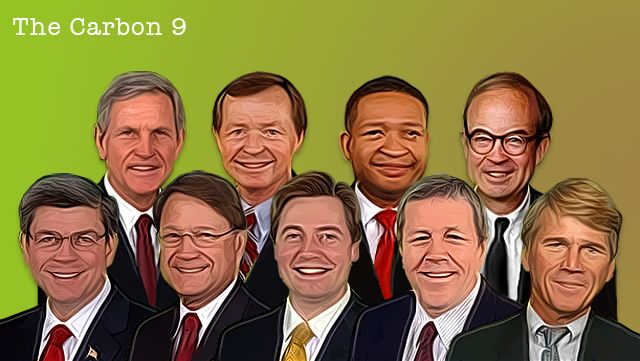
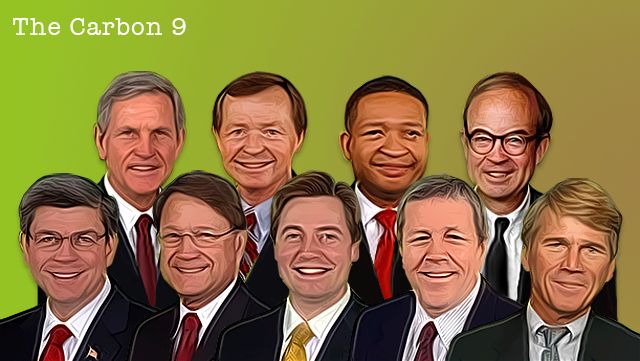
 The House Democrats who could determine the fate of the American Clean Energy & Security Act: (rear, from left) Baron Hill, Earl Pomeroy, Artur Davis, Rick Boucher; (front, from left) Mike Ross, Charlie Melancon, Jason Altmire, John Tanner, and Gene Taylor.Photo illustration by Tom Twigg / Grist
Imagine the 435 members of the U.S. House of Representatives standing in a single line, from the most likely to support climate change legislation to the least likely. At the far “green” end, i.e. most inclined to vote for greenhouse gas restrictions, you’d find Seattle Democrat Jim McDermott. At the far “brown” end, Texas Republican/libertarian Ron Paul.
Predictably, most Republicans would stand nearer to Paul’s end. Most Democrats would stand closer to McDermott. In the exact center, according to recent work by two economists, are nine lawmakers. And if the Waxman-Markey climate bill receives a full House vote, any one of them could provide the 218th “yes” — the decisive vote that passes the bill.
Let’s call them the Carbon Nine: Jason Altmire (Pennsylvania), Rick Boucher (Virginia), Artur Davis (Alabama), Baron Hill (Indiana), Charlie Melancon (Louisiana), Earl Pomeroy (North Dakota), Mike Ross (Arkansas), John Tanner (Tennessee), and Gene Taylor (Mississippi).
They’re all Democrats and all men. The nine mostly rural districts they represent are among the country’s most economically reliant on fossil fuels; their districts’ per-capita carbon emissions are, on average, more than three times higher than the national median. (This doesn’t mean people in those districts use more power than average folk, only that the industries located in those districts are carbon-intensive.) In the 2008 presidential election, voters in each of these districts but Davis’ went for Republican John McCain.
The “issues” sections of the Carbon Nine’s official congressional websites tend to call for energy independence and expanded domestic production but rarely mention climate change. Seven of the nine are members of the Blue Dog Coalition, a group of Democrats that emphasizes fiscal conservatism; Hill and Melancon are co-chairs of the group.
Four of the nine sit on the Energy and Commerce Committee, which passed the bill last Thursday, with two (Boucher and Hill) voting for it, and two (Melancon and Ross) voting against. The other Carbon Nine members say they are undecided, voicing concerns that the bill would slow economic recovery and transfer money from Southern and Midwestern states to coastal ones.
“I’d like to have a bill I could vote for,” said Melancon, who represents a southern Louisiana district where oil and natural gas drilling and refining are the chief economic drivers. “I need to be able to go home and say I protected the interests and the jobs of the people in my state and my district. So this can’t be an extreme piece of legislation. It needs to moderate our movement forward.”
Three others seem set on opposing the bill. Altmire recently said, “I think cap-and-trade is bad policy.” Taylor called cap-and-trade “a Ponzi scheme.” Last week, Davis and the rest of Alabama’s congressional delegation sent a letter (PDF) to Energy Committee leaders warning that the bill would “stifle any attempt at reviving our economy and getting back on the path to economic growth, making it nearly impossible for new industries to move into the U.S.”
Turning pols into statistics
The identities of the Carbon Nine were culled from a yet-unpublished paper by economists Matthew Kahn of the UCLA Institute of the Environment and Michael Cragg of the Brattle Group consultancy, “Carbon Geography: The Political Economy of Congressional Support for Legislation Intended to Mitigate Greenhouse Gas Production” (PDF). The list—in Appendix One, if you’d like to see it—relies on regional carbon emissions data from the Vulcan Project of Purdue University’s Department of Earth and Atmospheric Sciences. Kahn and Cragg assigned scores to members of the 110th Congress based on three key climate votes drawn from the League of Conservation Voters 2007 Voter Scorecard [PDF]. The two authors gave weight to household income levels (richer voters show more support for regulation) and ideology (same with liberal voters), and combined these scores with the Vulcan carbon data to produce the ranking.
“These geographical facts suggest that the Obama Administration and the Waxman Committee will face distributional challenges in building a majority voting coalition [for a climate agreement],” they write.
There are limits to the authors’ method. First, Kahn and Cragg ranked members of the 110th Congress (Jan. 2007 to Jan. 2009), so lawmakers first elected in 2008 are not included. Second, they used county-by-county data, so districts within the same high-population counties are scored identically, and counties that include multiple districts were counted in all of those districts.
“I doubt [the county data] is going to make a difference in the main punch-line of the paper,” said Kevin Gurney, an assistant professor of earth and atmospheric sciences at Purdue University who started the Vulcan Project.
Also, 22 other House Democrats come very close to the middle (see a list of them) and could well play a swing vote role if and when Waxman-Markey goes before the full House.
Dan Weiss, director of climate strategy at the Center for American Progress and a Grist contributor of late, cautioned against giving the ranking too much weight with so many factors still unknown—what other House committees will do with the bill, when it will receive a vote, how President Obama will try to influence lawmakers.
“This analysis tries to lay scientific assessment over what is essential an art,” said Weiss. “The methodology is valuable for thinking about who are the targets, or the votes up for grabs, but it is not very useful as a predictor.”
The Coasts vs. the Heartland
The Kahn-Cragg ranking highlights the geographical divide between relatively cleaner congressional districts on the East and West coasts and the more carbon-intensive areas represented by the Carbon Nine and lawmakers like them—those who must be convinced a climate bill will not unfairly burden their districts.
“The proposed [renewable energy] mandate would unfairly penalize southern states, like Alabama, simply because of our geography,” Davis, who is running for governor in 2010, wrote with his fellow Alabama legislators. “While other states have the ability to make electricity from wind and solar power, Alabama lacks the natural resources to meet these mandates due to cloud coverage and little wind.”
Indeed, the paper’s authors warn that “conservative, poor, rural areas will face a higher carbon bill under a cap and trade system than rich, urban areas.” They did not factor the other elements of the Waxman-Markey bill designed to even out this disparity, such as energy-efficiency and low-income relief measures. But the nine House members have the same concern.
“Everybody should have some skin in the game,” Melancon said in an interview last week, before voting against the bill. “Everybody needs to sacrifice. This bill should not be picking winners and losers, and I see some of that in there, so I have concerns.”
He outlined his policy concerns in a committee statement, advocating for increasing domestic production of fossil fuels, making domestic offsets more available, relaxing the definition of biomass under the bill’s renewable standard, and increasing funding for wetlands restoration for his coastal district.
“I’m concerned about the [climate] long-term, but if people aren’t working, you can’t pay for any of this stuff,” he said. “No matter how you frame this thing, you’ve got to make it so that it doesn’t collapse the economy. It doesn’t do us any good to clean up if nobody has any jobs.”
He also said he’s heard a lot more about the bill from business interests in his district than from constituents. “Right now, I don’t know that the private citizens are that well engaged,” he said.
They’ll have a little time to become engaged, as several other House committees may demand a review of the bill before it gets a floor vote. For lawmakers on the fence, that could be time to exercise their influence. Boucher has already demonstrated the deal-brokering power that comes with a swing vote, playing the lead negotiating role for undecided coal-state Democrats on the Energy Committee. He was able to get authors Henry Waxman (D-Calif.) and Ed Markey (D-Mass.) to lower the bill’s targets for emissions and said he would continue seeking even lower targets, stating that his vote for the bill in committee does not guarantee he would support it on the House floor.
Others are waiting to reveal their positions. Ethan Rabin, press secretary for Taylor, said the Mississippi congressman hadn’t had enough time to review the 932-page bill and decide where he stands.
“He’s pretty much right down the middle,” Rabin said.
Summary of the Carbon Nine’s positions on the Waxman-Markey climate bill
(See also the positions of 22 other House members within three percent of Kahn and Cragg’s “center” of the House on climate.)
- Jason Altmire (Pennsylvania): Seems to oppose; calls cap-and-trade “bad policy.”
- Rick Boucher (Virginia): Voted for it in committee but says he will keep pushing for lower targets.
- Artur Davis (Alabama): Seems to oppose; said it would penalize Alabama and that Congress should address health care first.
- Baron Hill (Indiana): Voted for it in committee.
- Charlie Melancon (Louisiana): Voted against it in committee.
- Earl Pomeroy (North Dakota): Undecided. Says science requires action on climate change but he will support a bill only if it protects North Dakota interests.
- Mike Ross (Arkansas): Voted against it in committee.
- John Tanner (Tennessee): Undecided, according to his press secretary.
- Gene Taylor (Mississippi): Seems to oppose; called cap-and-trade “a Ponzi scheme.”