Send your question to Umbra!
Q. Dear Umbra,
Nice column on elevators. Since most elevators are counterbalanced, there is much less energy use involved than most people would expect. It’s nice to see the addition of hybrid technology to recapture the braking energy, though. On the other hand, those ESCALATORS ….. ! I have seen a “smart” escalator in Europe that only operates when there is someone around to use it, rather than going and going all day even when there’s no one around. I wish they would make it to the States.
BTW, since you are a writer and obviously not “in the dark,” shouldn’t you be called “Penumbra”?
Peter
Boston, Mass.
A. Dearest Peter,
While I appreciate your wordplay, a penumbra obscures things. Hopefully that is not my role. Though I’m not sure I have a ton of light to shed on the world of escalators. Other than, of course, advising all readers against installing escalators inside their homes.
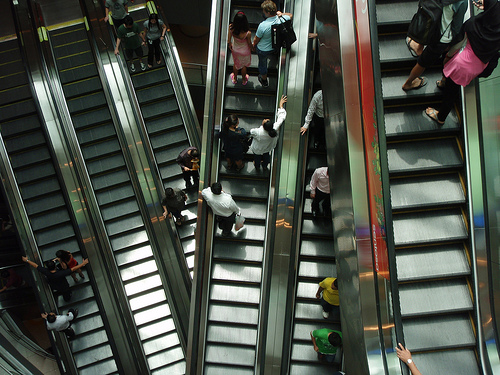 Better escalate than never?Eric and Deanna Pesik via flickrLet’s start with some good news: The “smart” escalators you have seen, which are also known as intermittent escalators and are in wide use in both Europe and Asia, are indeed beginning to make it to the States. New York City got a special permit to start using them last summer, and installed 35 test units in various subway stations. When no one is riding, these escalators move at 15 feet per minute; a few seconds after a rider steps on the bottom stair, the speed increases to 100 feet per minute.
You might like some germane energy-use stats. A 2004 report from Congress tells us that the 30,000 escalators in the U.S. use enough energy to power 375,000 homes (i.e., 2.6 billion KwH). The cost to continuously run these escalators is an estimated $260 million a year. The use of intermittent escalators can save 40 to 50 percent of this energy, as well as reducing wear and tear on escalator parts. As a result of its findings, Congress required that any new escalator “acquired for installation in a Federal building shall be an intermittent escalator.” There you are — your wish will potentially be coming true in federal buildings as well as in the bowels of the Big Apple.
As for the rest of us: It makes sense to use the stairs instead of the escalator, whenever the choice is presented. Firstly, it is good for us to make physical efforts up staircases (unless prohibited by preexisting health conditions). Secondly, logic says it must take slightly more energy for the internal gears of an escalator to move each additional riding person. Thirdly, an unused escalator is a strange, ghostly phenomenon, and leaving it behind us as we pass through a building can only make us feel happy.
Strangely,
Umbra