
Poop + Marketing = Biosolids

Sludge, farmer’s friend or toxic slime? 18

sewer pipesShould what we put down our sewers ultimately wind up back on our plates?Marc Samsom via Flickr

Urine, feces, menstrual blood, hair, fingernails, vomit, dead skin cells. Industrial chemicals, pharmaceuticals, soaps, shampoos, solvents, pesticides, household cleansers, hospital waste.

Sewage sludge, the viscous brown gunk left over when wastewater is treated, is more than just poop: it’s an odiferous smoothie of everything we pour down the drain. There are pathogens; there are heavy metals. PCBs, dioxins, DDT, asbestos, polio, parasitic worms, radioactive material—all have been found in sludge. Despite pretreatment programs that prevent some of the most noxious stuff from entering the public sewers, sludge can include so many toxins that the Clean Water Act lists it as a “pollutant.”  

So it’s a little surprising where it ends up: Today more than half of America’s sewage sludge is spread on land as fertilizer.

Granted, this isn’t a new idea. For most of human history, our crap has ended up back on land—and it wasn’t until the past century, which brought flush toilets and public sewers to mainstream America, that using excrement as fertilizer started sounding at all strange. Sure, this system was driven partially by convenience, but it also made ecological sense: our urine and feces contain the same nutrients that plants need. Spreading it on land closes the nutrient loop; it avoids the need for chemical fertilizers. Eat, shit, fertilize, and eat again. For thousands of years, this arrangement worked just fine.

Or, rather, almost fine. As human populations grew and concentrated, health problems like cholera outbreaks inspired a push for flush toilets and public sewer systems. This led to huge improvements in public health, but resulted in a new problem: sewers mixed domestic sewage with industrial waste and spewed it untreated into rivers and lakes. The next step was sewage treatment plants, which separated liquids from solids, but in solving one issue they created yet another: the cleaner they made the water, the dirtier the leftover sludge. Adding to the challenge, as the population of the United States grew, so did the amount of sludge: we’re currently generating more than 7 million dry tons a year and counting—and we have no intention of cutting back.

Meanwhile, as a mycelium of sewer pipes spreads underneath our cities to whisk our waste away from us, Americans became increasingly squeamish about dealing with excrement. We’re now a nation of “fecaphobes,” obsessed with toilet humor but unaware and uninterested in what happens to our actual crap. We don’t want to think about it; we don’t want to deal with it. We want to flush the toilet and forget.

**
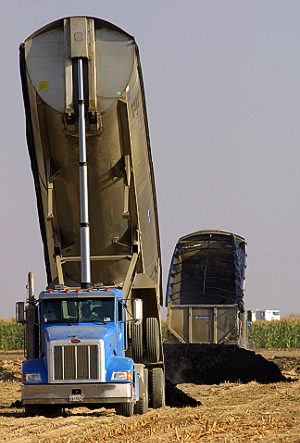
sludge as fertilizerSludge from Los Angeles is dumped at Green Acres, a Los Angeles-owned farm in Kern County, California.Courtesy Bakersfield CalifornianThe Office of Water doesn’t have the privilege of forgetting about sludge—it’s the Environmental Protection Agency department responsible for dealing with America’s sewage. In the 1990s its job got even harder: sewers and wastewater treatment facilities mandated by the 1972 Clean Water Act more than doubled the amount of sludge America produced each year, and the 1988 Ocean Dumping Act eliminated the option of getting rid of it at sea. The OW had been encouraging land application on a limited scale since the 1970s.  Now, faced with limited options and a never-ending supply, it evaluated its remaining possibilities—landfilling, incineration, or land application—and settled on the cheapest option available: promoting sludge as fertilizer.

To make this palatable to the American people—or, at least, to prevent them from thinking about it too hard—the word “sludge” had to go. So the sewage industry’s main trade and lobbying organization, the Water Environment Federation, stepped in. (WEF and OW often work closely together.) It organized a “Name Change Taskforce” and sponsored a contest to come up with a different term for sludge. Rebranding was an area in which WEF had experience—originally founded in 1928 as the brown-sounding “Federation of Sewage Works Associations,” it had recently gone through its fourth name change, and had begun referring to its members, who included sewage plant operators and waste management corporations, as “water quality professionals.”

The renaming contest received over 250 entries, many of which suggested that even water quality professionals still enjoy a good poop joke. Submissions included “bioslurp,” “black gold,” “sca-doo,” “hu-doo,” “geoslime,” and “the end product”; one person proposed rebranding sludge as “R.O.S.E.” (“Recycling Of Solids Environmentally”). Critics asked whether a rose by any other name would still smell as bad, and in 1991 WEF settled on “biosolids,” a term that Sheldon Rampton, co-author of Toxic Sludge Is Good For You, suggests “must have been chosen precisely because it evokes absolutely nothing in the minds of people who hear it.”

Of course, from the wastewater treatment industry’s perspective, that was the point: they didn’t want any visuals. Armed with an empty word, their next goal was to make “biosolid” suggest something positive. So in 1992, OW and WEF joined in a “cooperative agreement” called the Biosolids National Public Acceptance Campaign and hired a public relations and lobbying firm called Powell Tate to produce a report on how to improve the public image of sludge.

The resulting campaign—“Biosolids 2000”—didn’t answer important questions, like why people living near biosolids application sites complained of health problems, or why current federal legislation still permits every business, institution and industry in the country to dump 15 kilograms (33 pounds) of untreated hazardous waste into the sewer system each month, no reporting required. It also failed to prevent 2000 and 2002 reports from EPA’s own Office of Inspector General from stating that “EPA cannot assure the public that current land application practices are protective of human health and the environment.”

And yet partially because of OW and WEF’s PR efforts, partially because of our willful ignorance, the effort to rebrand sludge as biosolids has largely been successful. Although some is still incinerated or buried in landfills, today more than 50 percent of America’s sewage sludge is spread on land.

***
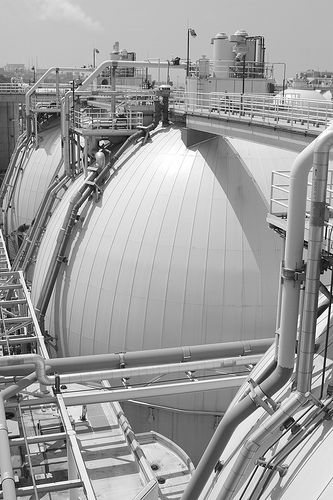
Hyperion Treatment Plant in Los AngelesBiosolid digesters at the Hyperion Treatment Plant in Los Angeles.Courtesy Brian RaimondiDiane Gilbert, a spokesperson for biosolids at the Hyperion Wastewater Treatment Plant in Los Angeles, is a water quality professional of the sort endorsed by the Powell Tate report. Her enthusiasm seems genuine, but like other biosolids spokespeople I interviewed, she is also a master at following the guidelines articulated in biosolids media training guides. [Sample tip: “If the reporter asks rapid fire (multiple questions), choose the easiest.”]

Enthusiastic and bubbly, Gilbert grew up in Louisiana and has been at Hyperion since 1987. But Gilbert’s involvement with sewage sludge started even earlier; with a father who worked at a wastewater treatment plant and used sludge to fertilize the family’s garden, she considers herself a poster child for land application. “I’ve been eating food fertilized with biosolids for as long as I can remember,” she told me, after I’d returned from a tour of the plant. (Tip: “Encourage the reporter to meet you at a working location.”) “So if anyone should be affected by biosolids, it should clearly be me.”

I’d come to Hyperion because I wanted to learn more about this mysterious brown substance—how it was made, how it was monitored, and how worried we should be. Eager to dispel my concerns about land application, Gilbert had originally wanted to take me to Green Acres, the 5,000-acre city-owned farm just outside of Bakersfield, where Los Angeles ships most of its treated sludge to grow various grass crops to be fed to dairy cows. (Tip: “Location visuals help enhance and give credibility to your message.”)

Unfortunately, lawyers got in the way. Green Acres is in Kern County, and residents there don’t like the idea of being the recipients of Los Angeles’ crap. So, like an increasing number of communities across America, Kern County passed a ban on the land application of sewage sludge. Los Angeles responded by suing the county, and since the lawsuit is still pending, lawyers have gotten cagey about letting reporters visit the farm.

Instead Gilbert and I grabbed sandwiches and headed for a darkened conference room at Hyperion, where Gilbert popped in a promotional movie about Green Acres. With a synthesized soundtrack reminiscent of the theme song for Doogie Howser, M.D., the movie opened with a picture of a field of wheat, its title superimposed in yellow bubbly script.

“Imagine turning arid soil that can only grow tumbleweeds and sage brush into nutrient-rich soil that can grow crops for livestock,” said a male narrator, blessed with the voice of a 1950s public service announcer. “Imagine doing this without saturating the soil with chemicals.”

He continued, smoothly substituting euphemisms for That Which Must Not Be Named: “Now imagine tons of treated primarily organic material from wastewater treatment plants being used to change the soil through its own nitrogen, phosphate, phosphorous and other natural ingredients.”

The movie was titled, appropriately enough, “Imagine.” But instead of being a paean for peace, it invited me to imagine a world in which all of our “beneficial,” “nutrient-rich” biosolids were put to use as fertilizer—and followed a script that could have come directly from the Powell Tate report. I took a bite of my sandwich as the narrator dispelled concerns about using sewage sludge as a soil amendment. “There will always be skeptics who question the use of biosolids,” he announced, “just like there were skeptics who didn’t believe that people could fly—until the Wright Brothers proved them wrong.”

***

Among many others, these skeptics include two unrelated Georgia dairy farmers, Andy McElmurray and Bill Boyce. Starting in 1979 and 1986 respectively, both began using free sludge as fertilizer on their farms, a practice the city of Augusta assured them was safe. But starting in the 1990s, problems arose: hundreds of the men’s cows died, McElmurray discovered his land was contaminated with aluminum, which he attributed to the sludge, and a 1999 test found that milk from some of Boyce’s surviving cows contained thallium—an element once used as rat poison—at 120 times the concentration EPA allows in drinking water.

Both farmers filed lawsuits against the city and in March 2008, U.S. District Judge Anthony Alaimo issued a 45-page ruling on one of McElmurray’s lawsuits that found that “senior EPA officials took extraordinary steps to quash scientific dissent, and any questioning of the EPA’s biosolids program.”

And that’s just the cows. Today, 16 years after the official federal sludge rules came into effect in 1993, EPA still doesn’t have a system in place to monitor or investigate sludge-related health complaints. But in 2002, a team of researchers produced the first peer-reviewed article (whose findings were recently backed up in a separate study) to both document health complaints from people who’d been exposed to sludge and explain how this exposure might have made them sick.

The long list of health problems reported by the study’s 48 participants includes asthma, fevers, nausea, vomiting, skin rashes, coughs, burning eyes and throats, sinusitis, and diarrhea. Two subjects died from Staphylococcus aureus infections acquired shortly after being exposed to freshly applied biosolids. (Interestingly, while EPA’s Office of Water—the department responsible for writing the sludge rules—denies that these deaths were at all connected to biosolids exposure, EPA’s office of Research and Development approved the paper for publication and supported its conclusions.) When the researchers compared their subjects’ rate of staph infections to that of hospital patients, considered “a recognized risk group for S. Aureus,” the infection rate of the study’s subjects was approximately 25 times higher.

According to EPA paperwork, the lead author of this study, David Lewis, Ph.D., resigned from EPA in 2003.  Lewis, however, says he was essentially fired for speaking out on sludge—and his former lab director backs him up. She wrote in a 2008 statement that Lewis’s termination was “involuntary” and that Lewis “was an excellent researcher and an asset to EPA science.”

Motivated by stories like these, several passionate groups—like Citizens for Sludge-Free Land, Sludge Victims and Riles (Resource Institute for Low Entropy Systems)—have dedicated themselves to fighting the land application of sludge. They run websites; they lobby politicians to try to change the rules. But as for the rest of Americans, the subject of sludge is still not something we dwell on.

Unfortunately, as arguments and lawsuits against land application pile up—not to mention the sludge itself—our days of blissful ignorance might be limited. I’d come to Hyperion not just because it had occurred to me that we should be thinking about what happens to our sewage, but because I could see a day in the not-so-distant future when we’d be forced to.

Given the inconsistency and toxicity of the ingredients in sludge, the loopholes in its regulations and the mounting criticisms against its use, I kept reaching the same conclusion: despite the Office of Water’s insistence on the safety of spreading sludge on land, we should be looking for alternatives. The United States will never stop producing shit. But there must be a better way to deal with it.

Tomorrow: Businesses try to figure out how to turn poop into gold.

Catherine Price is a contributing editor at Popular Science whose work has appeared in the New York Times, The Best American Science Writing and Slate, among many other publications. The research for this article was funded through a Middlebury Fellowship in Environmental Reporting.

Advertisement
Advertisement
  1. Paula Crossfield Posted 7:43 am
    05 May 2009

    Great piece! I think this is something we forget about for obvious reasons, but thanks for bringing it back under our eyes. Is it legal to use sludge/biosolids on organic fields?
    Looking forward to your next piece!Paula
  2. CowsEatGrass's avatar

    CowsEatGrass Posted 10:10 am
    05 May 2009

    Sewage sludge is prohibited for any use on Certified Organic Farms.  It is one of the basic "Nos" along with GMOs and radiation.
  3. atreyger Posted 11:53 am
    05 May 2009

    So what do we do with it?
    1. CowsEatGrass's avatar

      CowsEatGrass Posted 12:09 pm
      05 May 2009

      Treat it with wetlands.Use it to fertilize non-food crops or ornamentals.Segregating the really nasty stuff from the human waste would also go a long way toward managine this waste stream, but that's quite a challenge....
  4. eleanordowling's avatar

    eleanordowling Posted 1:09 pm
    05 May 2009

    Great article! I think it's fascinating that they held a contest just to change the name--amazing the stereotypes that are evoked by mere words...and in order to create change we first have to revamp the way we TALK about it. Crazy.This article really put "biosolids" into perspective for me. I live in a city and to just imagine where the bizillion pounds of crap go each time my street flushes the toilet...it's really insane. Maybe the days of outhouses weren't so bad--it was going right back into the earth immediately.
  5. delvebelow Posted 3:37 pm
    05 May 2009

    This would be a great way to make biodiesels a more viable option.  If biosolids could turn relatively inactive dirt into fertile (if a little toxic) soil, then switchgrass, sugar cane, rapeseed, and other plants suitable for biodiesel production could be grown where plants destined for the table should not be cultivated.  And our edible cornfields would be going to dinner plates instead of factories.
  6. Grizzabella Posted 6:32 pm
    05 May 2009

    Excellent article.  Well-researched and thoughtful.  There are new technologies coming on line that may prove to be the answer to this problem.  For now, just putting it in places other than where food is grown is not the answer.  The numerous harmful constituents in sludge still harm the environment, wildlife, and our waterways and ground water supplies.  It should not be spread, period.  But it can be burned anarobically to produce energy with a usable ceramic sand as residue.  These technologies are just being tried in this country, but are certainly showing promise.Thank you for making people aware of this problem.  From one who lives in one of the areas getting spread with biosolids, I am indeed quite grateful.
  7. keblack789 Posted 8:54 pm
    05 May 2009

    I grew up on a working dairy farm.  We never concidered putting human waste on our fields.  We didn't grow human food, just crops for our cows but we only used cow manure and fish waste on our fields.  This article was informative and scary.colon cleanse information
  8. PermieWriter's avatar

    PermieWriter Posted 11:39 am
    06 May 2009

    Have you read "Toxic Sludge is Good for You"? Great book about how the PR industry works with a special focus on this special product.Sounds like the poop isn't the problem, it's the industrial detritus. If people wouldn't treat the sewage system like a hazardous waste disposal, the problems would be manageable.
  9. KMD Posted 11:32 am
    07 May 2009

    This is the sort of article from Grist that frustrates me.  Though the author makes an attempt to get the other side of the story, her bias shines through.  She neglects to report that they did the most extensive study they have ever done on anything before they set biosolids regulations.  They set regulations for a farmer and his family who applies biosolids and whose entire diet is made up of biosolids-fertilized crops, and then they added a margin of safety on top of that for unknowns.  She also doesn't mention that industrial influent into wastewater treatment plants is highly regulated; they are not allowed to put whatever they want down the drain.  They must treat to remove toxic contaminants like mercury before their effluent is released into municipal sewers.  The author also made no effort to find other farmers that are using biosolids.  Kern County is the exception to the norm.  How about heading to King County, Washington and talking to the farmers using biosolids in Eastern Washington?Incineration might seem a great way to get rid of biosolids, but it just creates yet another problem: greenhouse gas emissions and high energy costs.  Land application at least gets farmers to stop using chemical fertilizers.You are welcome to be uncomfortable with the concept of biosolids recycling, but as Ms. Price notes, we are a society of fecaphobes.  Our society is happy to criticize those of us in the industry who are doing the best we can to deal with the situation we are given, but society is also completely unwilling to consider their own personal impacts on the environment.  How many hair products does each of us use?  What are the ingredients in the hand soap you use?  Did you know the average senior citizen takes 40 different kinds of medication?  Do we really need all these things, and are there better choices we can use?  We as a society are also unwilling to pay to treat the waste we produce to remove the contaminants we gleefully add to the water.  How many people are willing to pay an extra $100 a month or more on their sewer bill to clean wastewater to pristine levels?  
  10. AAG2 Posted 12:55 pm
    07 May 2009

    In response to KMD:Price's exellent series on sewage sludge is thoroughly researched, accurate, and not at all biased.  KMD, on the other hand,  made several inaccurate statements. First, the "thorough study" that "they" (EPA's Office of Water) did to "prove" that sludge is safe,  was pretty much debunked in 2002, when a National Academy of Sciences panel concluded that the science and risk assessment upon which the sludge rule was based, were outdated or non-existent.Second, although there are limits on some hazardous materials that industries  can  dump into sewers, many more pollutants are not regulated and discharged into waste waster treatment plants.   Often noone knows what was dumped until AFTER the pollutants end up in land applied  sludge.  Last summer sludge containing high levels of cancer-causing  PCBs was spread on parks  in Milwaukee, causing some playgrounds to turn into superfund sites. The poisoned material   had to be scraped up and transported at great expense to out-of-state specially designated hazardous waste landfills.  And Lawrence County, Alabama, is currently coping with wells and ponds ( and milk?) all contaminated by run-off from land repeatedly treated with  sewage sludge containing perfluorooctanoic acid (C8). C8 is only one of the many thousands of unregulated  chemical compounds found in  sludge which can legally be  spread on our fields, farms, and forests.
    1. KMD Posted 1:39 pm
      07 May 2009

      I don't see how you can call her article thoroughly researched when she made no attempt to talk to farmers outside of Kern County, and only talked to ONE treatment plant person. You are welcome to continue to criticize biosolids management practices, but the truth still stands that someone has to do something about our society's waste, and wastewater treatment managers are doing the best they can with what they've got.  When our society finally gets its head out of the sand, we'll get some change.  But the fault should not be laid on the wastewater industry.  We have met the enemy, and it is us.
  11. AAG2 Posted 2:27 pm
    07 May 2009

    Look, KMD, those of us opposed to using sludge as fertilizer do not criticize workers at wastewater treatment plants. They do an essential and often dangerous job: cleaning up the sewage, removing as many pollutants as possible ( which all end up in sludge) so that the relatively clean water can then be returned to the environment.  Nor do we criticize farmers who choose to use this stuff, after having been told in fancy brochures that using this contaminated waste is safe, beneficial, and sustainable ( it's none of the above).Our concern is that for decades EPA, the agency that is supposed to protect our health and the environment, has worked closely with the industry it is supposed to regulate to promote this practice and has worked with sludge lobbying groups to mislead the public, the media, legislators, and farmers about the short-term and long-term risks.Price explored some of the alternatives.  Even putting sludge in a well-managed, double lined landfill where the resultant methane can be used as a renewable source of energy is better than putting it on our agricultural land.
  12. Biodiversivist's avatar

    Biodiversivist Posted 12:11 pm
    08 May 2009

    A guy who once worked for Seattle's sewage department told me about their attempt to spread sludge on forest land. At a public meeting a citizen asked him about hepititis. He told the citizen that hepititis had never been detected in the sludge. What he didn't tell the citizen is that they had never attempted to look for it.You can't trust strangers. Verify.
  13. wordbarter Posted 2:37 pm
    11 May 2009

    I find this article deeply frustrating and a bit reactionary.  Sure, contaminated biosolids could be hazardous, and it's fun to mock a government agency for holding a contest to rename poop, but I don't understand the author's intent with this article.  What is the actual problem that needs to be solved?  Clarifying the issue might go a long way towards findings solutions.I'll lay out my thoughts here:Compost is great for farms and fields.  Raw poop, from whatever animal, generally is not.  So, you process the poop (by aging or solarizing or whatever process you want) to turn it into usable compost.  A complete composting process will kill all the pathogens (bacteria and viruses).  From this angle, the best thing we could do with human waste is compost it and use it as fertilizer.  We then partially close the loop on the solar-powered nutrient cycle of life and death that has worked on earth for eons.The problem with bio-solids from modern humans is all the stuff that isn't poop or pee.  It's the industrial waste that finds its way into the sewer system, for whatever reason.  It's the leftover drugs we flush down the toilet.   It might even be un-metabolized drugs we're taking.  This stuff is not destroyed by any composting process, and so it can accumulate on farms where biosolids are applied. There are two categories of solution to this problem, which still allow agricultural re-use of biosolids: get the bad stuff out of the waste stream (super hard) or make sure it never gets in (very hard).  I don't have an easy solution, but I just wanted to point out what I think this article failed to make clear: Your poop is not the problem.  It's all the other crap that gets into the sewer system that's the problem.   
    1. MEC Posted 7:07 am
      14 May 2009

      I was also frustrated with the presentation of this article, especially since the first ten words (seven items) of the article:  "Urine, feces, menstrual blood, hair, fingernails, vomit, dead skin cells."  are precisely what makes biosolids a good thing.  These are the things that provide the nutrients for plants and build organic matter in soils.  It's that latter part of the same sentence...industrial chemicals, pesticides, etc. that complicates the issue, but the author fails to make that distinction.  What I find most interesting is that we are fine with using many of those chemicals on our bodies or household surfaces every day and even willing to ingest the pharmaceuticals as pills to keep us healthier--all at much higher concentrations than what is found in biosolids.  Many of the industiral chemicals are pretreated before releasing into the sewer system.  As far as I know, regulated industries pay permit fees to cover extra costs of testing so they are not getting a free ride for disposal like one of the posters mentioned.  Plus, many treatment plants rely on a balance of good bacteria in their system to clean wastewater and having a large dose of a toxic substance come through can upset the whole wastewater treatment plant so it's in their best interest to make sure industries are following the pretreatment laws.  While separating out these chemicals would make using biosolids less controversial, I bet there would still be people opposed to them just on the fact that they contain the first seven words of the article. A well researched and non-biased article would have more fully presented both sides of the story.  It should have at least mentioned the benefits that users and generators of biosolids quote....improved crop yields, less reliance on chemical fertilizers, carbon sequestration in the soil, improved organic matter in the soil, etc.  and let the reader know that these benefits do not come without risks, but what doesn't come without risks?  Walking across the street has its risks.  What the Grist readers, wastewater treatment professionals, members of the EPA have to decide is whether the "potential" risks of land application of biosolids offset the proven benefits and are worse than other alternatives.  Based on the current reaserch many scientists feel that the "potential" risks are so small that land application is safe. So, there are no easy answers whenever you talk about any environmental issue.  If someone suggests that there are then they either don't fully understand the issues or are simplifying things so much that there arguement is worthless.   
  14. AAG2 Posted 6:09 pm
    11 May 2009

    Wordbarter: you are so right!  It's all that other crap. And it's in there for a very good reason; industries, businesses, and institutions are getting a free ride to get rid of their liquid hazardous waste by legally dumping it into sewers.   Neither Congress, nor the EPA, nor industries have any intention of  changing  this. Under the current system there is no way we can prevent toxics from entering sewers and no way we can remove toxics from sludge. The only way would be to separate the two waste streams, which  would mean ripping out the entire sewage system and rebuilding it differently. But the billions of dollars that Congress has allocated for wastewater management is simply going into building  new sewage treatment plants or to up-grade existing ones. None of those funds are being used to separate industrial waste from poop. So for the foreseeable future we are stuck with more and more toxics- containing  sludge. And we better find something else to do with this contaminated waste than use it as fertilzier on our remaining agricultural land.
  15. AAG2 Posted 11:21 am
    14 May 2009

    Response to MEC: Low Risk? POTENTIAL
    problems?   You must be kidding!  Tell that to the hundreds and hundreds of
    people working and living adjacent to sludge spreading sites who have
    experienced serious health problems ( For a partial list,  visit sludgenews.org; for a more complete
    list, visit sludgevictims.com) POTENTIAL  problems  Tell that to the
    relatives of  people who lost their children  to sludge exposure, Joanne Marshall, the
    Behuns, the Pennocks. Tell that to residents of one small VA town where half
    the people suffered symptoms, some very serious, after biosolids was spread on surrounding
    farmland. Tell that to the two Augusta GA farmers whose plight was covered in
    Price’s story. Benefits?  Yes, the
    nitrogen and water in sludge will temporarily increase yields.  Yet repeated sludging of the same site will
    eventually reduce yields and degrade the land, affect wells, and built up in
    the food chain, especially in the  milk
    of dairy cows that graze on pastures that have been treated with biosolids. Pretreatment?  Price
    points out that “pretreatment prevents some of the most noxious industrial
    chemicals from entering sewers.”  However since 1000 new chemical compounds enter commerce every year, and
    EPA hasn’t even finished testing for some that have been around for twenty
    years and have been banned in other countries, sludge, especially sludge
    generated  in industrialized urban
    centers ( where most biosolids originates) is an ever increasingly toxic soup
    of unknowns. Even under the best of circumstances, pretreatment is a joke ( Cf.
    one EPA study concluded that 70% of the regulated industries were in non
    compliance of pretreatment regulations). “Improved crop yields, less reliance on chemical
    fertilizers, carbon sequestration, improved organic matter in soil” are worthy
    goals.  These goals can all be achieved
    by using organic farming practices, composts made from clean feed stocks,
    integrated pest management, crop rotation, and other sustainable and beneficial
    ways to grow the nation’s food.  Fertilizing
    our land with a complex and unpredictable mix, contaminated with  thousands of  chemical compounds, some of which are persistent and highly
    toxic,  makes no sense.

Add a Comment

You are not logged in. Thus, you cannot post a comment. If you have an account, log in. If you don't have an account, well, by all means go make one! Meet you back here in five.

Hello, Visitor!    Why not register?

Series Intro
Sludge, farmer's friend or toxic slime? 18
Regulating biosolids 0
Businesses struggle to profit from sewage sludge 7
For some eco-pioneers, solving the sludge problem means getting their hands dirty 7
Advertisement