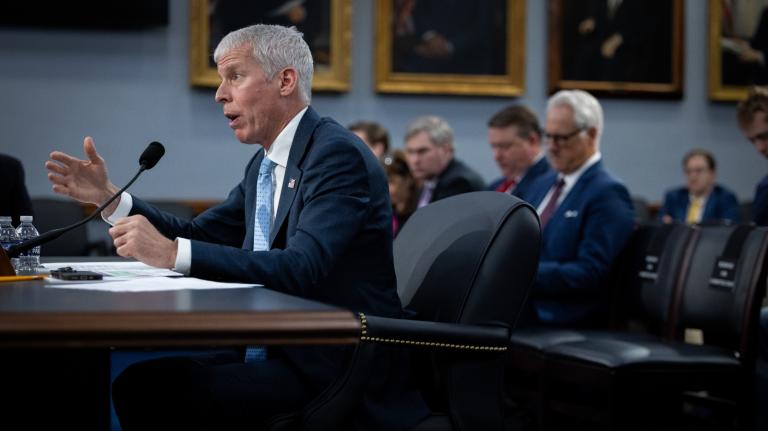
Rep. Chris Van Hollen (D-Md.) thinks he’s got the key to passing a climate bill this year: send every American a rebate.
It’s not a bribe, but a dividend — and one he thinks will help grow support for legislation to cap carbon.
Van Hollen, an up-and-coming Democratic leader and chair of the Democratic Congressional Campaign Committee, has introduced a cap-and-dividend bill — a type of cap-and-trade bill that would take all of the proceeds from selling pollution permits to industries and return that money directly to “every American with a Social Security number” in the form of a monthly check.
The momentum in the House is behind a different cap-and-trade bill sponsored by Reps. Henry Waxman (D-Calif.) and Ed Markey (D-Mass.), but that’s fine with Van Hollen. He just hopes that the key component of his legislation — returning money to Americans — can be incorporated into whatever climate bill moves forward.
“We don’t see this as in conflict with many of the other ideas out there,” Van Hollen told Grist during a recent interview in his House office. “The Waxman-Markey bill left open the whole question of what to do with the revenue generated by the sale of permits. Our proposal is, let’s return 100 percent of the revenue generated from the permits to consumers.”
A climate bill will be a tough sell — especially in the Senate — but if citizens get a direct financial benefit from it, Van Hollen argues, they’ll be much more likely to support it — and to support the legislators who vote for it.
Rep. Chris Van Hollen“You need to get something that will be politically supported on an ongoing basis. You don’t want somebody coming through three years from now and undoing something,” said Van Hollen. “If you want sustainable clean energy, you need sustainable political support for clean energy, and you need sustainable support among the American people.”
“I think by doing this simple, fair thing of returning an equal amount to every consumer, you help generate support for that effort,” he continued. “Everyone feels like they’re a part of that process, everyone has a stake in the success of the enterprise.”
The House Energy and Commerce Committee held a round of hearings on the Waxman-Markey bill last week, and will start serious debate on it next week. In the meantime, Van Hollen is working to convince House leaders to incorporate his approach.
Break it down
A cap-and-trade bill would put a limit on the amount of carbon dioxide emitted in the U.S. and then offer a gradually declining number of pollution permits to industrial emitters, which they can buy or sell amongst themselves. The point is to make polluting more expensive so there’s incentive to pollute less, which would inevitably drive up energy costs.
Electricity generators, distributors, and other energy-intensive industries are pushing hard for most or all emission permits to be handed to them free of cost, at least initially, to help them adjust to the new regime. They say this will allow them to keep consumer energy costs from rising too much.
But many others believe permits should be auctioned off to the highest bidders, and the proceeds from auction put to good use. Van Hollen wants all of the proceeds handed directly to Americans, to help defray rising costs — whether from home utility bills, gasoline, or food or other goods that would become more expensive to produce and transport if energy costs went up.
President Obama has called for 100 percent auction, on the campaign trail and in his first budget proposal. His plan would return roughly 83 percent of auction revenues to Americans through an annual tax rebate, with the rest of the money — he estimates $15 billion per year — to be used for clean-energy investments. But in recent weeks his advisers have suggested they can be flexible on this issue.
Van Hollen says he can see political reasons for giving away some pollution permits, but he argues that 100 percent auction would be the most economically efficient. “When you start providing some [permits] for free, what it does indirectly is drive up the costs of the permits you’re selling other people within the system,” he said. “It’s like a balloon — if you squeeze it in one place, the costs will simply flow elsewhere.”
The dividend fan club
Van Hollen’s dividend approach has a growing cadre of enthusiastic supporters.
In February, Peter Barnes, arguably the country’s leading proponent of cap-and-dividend, called Van Hollen’s bill “beautiful” and promised that he and other advocates of the method would “push it as hard as we can.”
Mike Tidwell, founder and director of the Chesapeake Climate Action Network, spoke in support of the Van Hollen bill to reporters a few weeks ago, saying it “offers the best mechanism” to address climate change and has the best chance of passing. “We’re concerned about having the best carbon cap possible,” said Tidwell. “You have to deal with the political issue — can you get the votes to pass it?”
Michael Noble, executive director of Fresh Energy, a Minnesota energy and environmental organization, argued that the cap-and-dividend idea is superior because of its simplicity. “If we don’t have a bill that we can explain to Grandma, I don’t know how we can sell it at the door,” said Noble. “I am very enamored with the simplicity of Van Hollen’s bill.”
Robert Greenstein, executive director of the Center for Budget and Policy Priorities, a think tank that focuses on policy impacts on low-income Americans, testified in favor of dividends during last week’s climate-bill hearings. He argued average Americans would benefit more from direct payments than from the government giving emission credits to utilities so they’ll keep their prices lower. “Relief that only focuses on home electricity and gas bills leaves a major hole,” Greenstein told the Energy and Commerce Committee. In a recent report, his group found that rebating 55 percent of auction revenue could compensate the majority of low- and middle-income individuals, leaving another 45 percent for other purposes, like research and development of renewable energy, energy-efficiency measures, adaptation, and green-job training.
Van Hollen says that even if not all auction revenue is returned to citizens, refunding some of it will help make a bill more palatable.
“I don’t think anybody should be drawing any real lines in the sand right now, other than that we’ve got to accomplish this objective of passing a climate bill,” said Van Hollen. “We’re working hard in the House. Obviously the concern right now is that the Senate won’t move, but that’s a topic of a whole other conversation.”
Van Hollen suggested earlier this week that House leaders might actually wait to bring a climate bill to a floor vote until the Senate gives signs of being willing to act too. On Wednesday, however, he told National Journal, “We are not waiting for the Senate.”
Bank on it
Van Hollen is also promoting a separate bill he introduced last month, the Green Bank Act of 2009, which would create a national Green Bank to fund clean-energy and efficiency projects. The bank would be an independent, tax-exempt corporation of the federal government, and would issue $10 billion in “green bonds” through the Department of Treasury each year.
During testimony last week, Al Gore praised this proposal, calling it a “very imaginative, very excellent idea.”
Van Hollen hopes the bank bill can be passed this year, either as an add-on to a climate bill or as stand-alone legislation.
“It’s a way to put a down payment down that will generate huge dividends for the economy and clean energy in the future,” said Van Hollen. “There’s a lot of capitol on the sidelines right now that would flow into clean energy projects if there was better financing, better alternatives. So it would certainly help jumpstart the economy at the same time that we help boost clean energy projects.”