What he means when he says 'my friends'

McCain wants a climate policy that benefits the rich 13

I see John McCain is upset by the fact that Obama wants to auction 100% of cap-and-trade permits. He wants the vast bulk of the permits to be given away to businesses.

There are lots of complicated, obscure issues around carbon policy, but this is not one of them. Let’s be very very clear about what this means: McCain favors the interests of industry over the interests of consumers.

This is the giveaway quote: “At this time of economic hardship, it is beyond irresponsible to further raise costs of the operation of this country’s businesses.”

The alternative, of course, is to raise the cost of living for consumers. It’s a clear cut choice.

First, let’s clear up a common confusion. McCain says that auctioning permits will “allow for little or no transition into a low-carbon system.” That is straightforwardly false: the cap forces a low-carbon system. The cap does the environmental work. How the permits are allocated is not an environmental issue, it’s an economic issue. It’s about distribution—who pays.

Someone will pay. When the price of emitting CO2 rises, someone pays the increased costs. If costs are raised and no further action is taken, fossil energy providers and fossil-intensive manufacturers will pass along the increased costs—consumers will pay. Giving permits away will not prevent this—consumer costs will rise whether permits are auctioned or given away.

If the government auctions the permits, it raises revenue with which it can offset or erase the burden on consumers: through direct rebates, through investments in energy efficiency (which lower power bills), through investments in clean power that accelerate its availability.

If the government gives away the permits, businesses raise prices anyway, reap enormous windfall profits, and consumers bear the full burden. That’s what McCain wants.

I return again to this graph from the Congressional Budget Office:
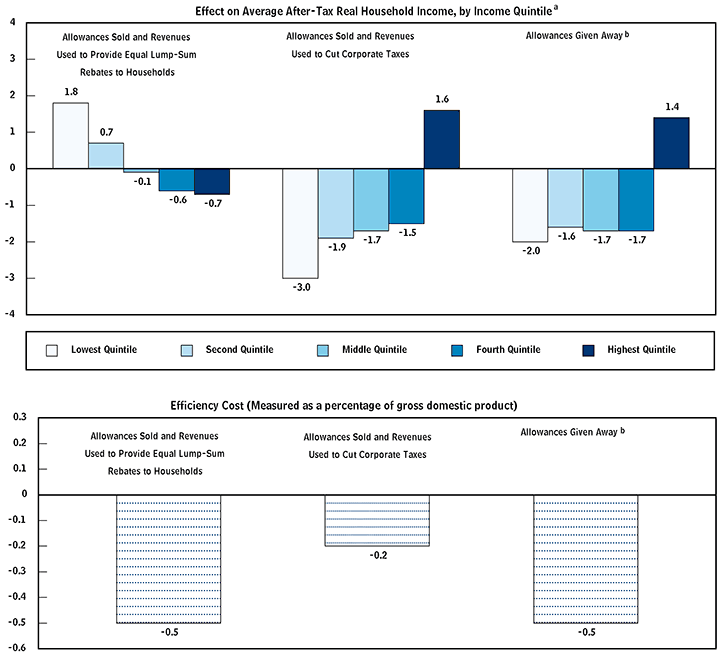
effect on average after-tax real household income, by income quintileFrom March 2009 CBO testimony to Congress

This charts the distributional consequences of auctioning vs. freely allocating permits. On the left, auctioning. On the far right, freely allocating. (For more, see this post.) As you can see, auctioning (and transferring the value to consumers) benefits the poor and working class, while putting most of the cost burden on upper income quintiles. Giving away permits puts the burden on the bottom four quintiles and overwhelmingly benefits the most wealthy.

That’s what McCain is advocating for: a system that primarily benefits the very wealthy.

Don’t be misled by all the rhetoric: This is a classic dispute between the left, which thinks economies prosper when more wealth is in the hands of the poor and middle class, and the right, which thinks economies prosper to the extent they benefit the rich.

David Roberts is staff writer for Grist. You can follow his Twitter feed at twitter.com/drgrist.

Advertisement
Advertisement
  1. PatCullen Posted 7:49 am
    27 Apr 2009

    i'm not sure mccain has anymore influence or power in this government. seeing as how the democrats rule it!
  2. Sean Casten's avatar

    Sean Casten Posted 7:49 am
    27 Apr 2009

    Is that really what the CBO chart says? It looks to me like that is simply comparing three different shitty policies; in all cases, we put a charge on CO2 and redistribute the proceeds to people who have nothing to do with lowering CO2.  Ergo, in all cases we raise the cost of energy.  Those charts seem to show that if you use the proceeds of a CO2 auction to provide a rebate to taxpayers, you get a less regressive impact than if you use the proceeds to cut corporate taxes, or give them away (potentially raising rates but also increasing profits to allowance-granted businesses.)  But that's only because of the way that the proceeds are being doled out, not an allowance vs. auction issue per se.Don't get me wrong - I'm totally in agreement with you that we are economically better off if everyone pays equally per ton of CO2 for the right to pollute.  But one can get that metric right and still screw up CO2 policy if you don't provide an equal incentive for CO2 sinks. Put bluntly, if we set out to create a CO2 policy that will both raise the costs of energy and lower CO2 emissions, the only thing we can guarantee is that it will raise energy prices - since we might simply shift CO2-intensive businesses to other countries that don't have CO2 policies of their own.  Addressing the regressivity issue therefore doesn't ensure that you have addressed the environmental issue.  Which is, after all, the goal of CO2 policy.  Presumably.
  3. Delay And Deny's avatar

    Delay And Deny Posted 9:02 am
    27 Apr 2009

    Instead of paying people not to use CO2, I would pay them to use Hydrogen!
    The more hydrogen they use, the more industry becomes pollution free. I would call these Hydrogen Bonus Points.It's better to reward good behavior, than punish bad behavior. 
    1. Sean Casten's avatar

      Sean Casten Posted 9:22 am
      27 Apr 2009

      Also, you could pay people to shoot rainbows out of their eyes.
      1. Delay And Deny's avatar

        Delay And Deny Posted 10:01 am
        27 Apr 2009

         "Sean Casten": Also, you could pay people to shoot rainbows out of their eyes. Something I would expect from a person who fantasizes that he is a "CEO"...yeah, keep telling the girls at the bar that one...  
  4. GreyFlcn Posted 9:35 am
    27 Apr 2009

    So lets say US Debt goes up instead.
    With the primary consequence being inflation.

    Is that regressive, or progressive?http://libertyminnesota.com/2009/03/inflation-the-ultimate-progressive-tax/
  5. davefordemocracy Posted 11:01 am
    27 Apr 2009

    Sean, I think you misread the graph. The set of bars on the left represents auctioning all the allowances and giving the proceeds to families. The set of bars on the right represents giving away all the allowances to greenhouse gas emitting corporations, which would produce no revenue, and thus no proceeds. So it's not a case of simply deciding where the proceeds go, and there is no "allowance vs. auction issue." Maybe you meant to call it auctioned allowances vs. free allowances.I also have to disagree that any of these plans "redistribute the proceeds to people who have nothing to do with lowering CO2." As a consumer of power, I have something to do with lowering CO2. If my electricity bill goes up, I'll use less energy, even if I'm getting that bonus from the government (the proceeds of a carbon auction). I'm going to also take issue with the original post, though I largely agree with it. What's the evidence that  "consumer costs will rise whether permits are auctioned or given away." It seems that you're saying utilities will raise their rates whether or not they're paying to emit. Maybe so, but logic says they would raise rates more if they had to pay for the carbon they emit and if they're required to emit less of it. I just don't think this is a self-evident statement. Maybe you're talking about the social costs of global warming?
    1. Sean Casten's avatar

      Sean Casten Posted 3:39 pm
      27 Apr 2009

      Dave,I see that on the graphs, but am pointing out a separate point.  You're right that the far right and far left can be labelled as free allowances vs. auctioned allowances.  But that's too simplistic - every carbon regime includes allowances; it's simply a matter of how they get doled out.  (even in 100% auction scenario, we don't tax all CO2 sources... like your exhaling, but also many small sources that aren't covered.)So the question underlying any effective CO2 plan comes down to (a) whether the allowances are fairly distributed through the economy and (b) how the proceeds from the CO2 payment are distributed. Re: the first, I suspect we'd agree that they ought to be distributed as evenly as possible.  If we're going to not tax exhalation, let's not tax it for everyone.  If we're going to charge for CO2 from power plants, let's charge every power plant.  What we shouldn't do in any situation is to stick free allowances in one industry and expensive allowances in the other.  (And this isn't because of some kind of social equity, but rather economic efficiency - if all tons of CO2 are priced equally, markets will allocate capital towards the most cost-effective means of control.  But if there are big sectoral differences, markets will inefficiently allocate capital to arbitrage the regulation.)Re: the second, all of the charts above are consistent, to the extent that they distribute proceeds to people who have nothing to do with the problem.  And I beg to differ with your comment that electricity users contribute.  To be sure, your demand for electricity caused a power plant to run somewhere.  But that's true whether you're in hydro-rich Idaho or coal-rich West Virginia.  As such, the carbon impact of your decision is hugely variable; to pay you a flat amount simply because you're a tax payer / citizen / politically-connected stooge / whatever other metric gets used causes the exact same economic inefficiency as pricing allowances differently.  The goal of carbon policy, after all is not to redistribute wealth willy-nilly, but to lower CO2 emissions.  Paying you $100 simply because that's the total auction proceeds divided by the US population doesn't do anything to lower CO2 emissions.  (Indeed, it might make it worse if you use that $100 to buy more CO2-intensive stuff.)  That's equally true if we use CO2 proceeds to reduce corporate taxes (chart 2) or to simply create a gift of higher profit margins to emitting sources (chart 3). Fixing that is surprisingly easy - simply do what a cap & trade is supposed to do.  Let sources & sinks trade bilaterally (rather than via a Beltway intermediary).  If a ton of CO2 release costs $20, then a ton of CO2 reduction ought to be paid $20.  Let the solar plant contract directly with the coal plant and that happens.  But if we instead force the coal plant to send money to DC and then to allocate from there, we get massive political distoritions, massive increases in energy costs and - to my initial point - no guarantee that we actually lower CO2 emissions (since at some point, the steel mills simply relocate to Burma rather than pay our high energy costs.)  This lose/lose outcome isn't because it's innately expensive to reduce CO2, but the result of bad policy.
      1. davefordemocracy Posted 4:25 pm
        27 Apr 2009

        So what you are proposing is a procedural decision to have the carbon trading market outside of Washington? I'm not sure what that gets you but I'll go with you on it.  Are there examples of carbon trading done right in your opinion? The RGGI or the carbon market in Chicago (the nameof which I can't remember) are both outside the Beltway and presumably face little to no interference from Congress.I'd also like to know more about how you would involve the carbon sinks. Solar plants are not carbon sinks. Carbon sinks store carbon. The Amazon Rainforest is a carbon sink and a carbon capture and sequestration plant would be a carbon sink if it were successful. Are you arguing for carbon offsets as cash for storing carbon, or are you arguing for compensating power plants that don't emit?
  6. LogicRules Posted 8:07 pm
    27 Apr 2009

    Instead of reading David Robert’s post, read the CBO report and get the whole story.
    David Roberts presents a one sided and biased account of cap and trade legislation. His statement that “McCain favors the interests of industry over the interests of consumers” is logically wrong. It is based, apparently, on the belief that taxes and business costs are somehow absorbed by electric utilities and have no impact on the consumer. He cherry-picks the report ”The Distributional Consequences of a Cap-and-Trade Program for CO2 Emissions” to support this view, ignoring all the negative impacts of selling rather than awarding the emissions credits.
    He also ignores the fact that case one, returning all the tax collected to households, is not under consideration as it would not raise money for Obama’s health plan.
    He also ignores the fact that the cost of everything we buy would increase (except in case 2, cutting corporate taxes).
    He also ignores another graph in the report that indicates the most beneficial case to society as a whole is case 2, cut corporate taxes.
    He quotes McCain as saying “At this time of economic hardship, it is beyond irresponsible to further raise costs of the operation of this country’s businesses”. Roberts then goes on to say “The alternative, of course, is to raise the cost of living for consumers. It’s a clear cut choice”. This is an intentionally misleading and illogical argument. A significant increase in the cost of doing business will be immediately passed on the consumer in the form of higher prices, and in addition some business will relocate to lower tax areas, thus putting people out of work. The report addresses this but Roberts ignores it. Roberts would have you believe that higher business costs would somehow be beneficial. This is disingenuous at best.
    Somewhere, the intent of cap and trade, that is, reducing CO2, has been lost and turned into a wealth redistribution and corporate punishment exercise. The goal should be to encourage business to expand, put more money in the hands of consumers, make business more competitive globally, and accomplish CO2 reductions at the least possible cost. Roberts goal of putting more money into the hands of those with the lowest incomes is laudable, but it should be primarily through gainful employment, not government handouts.
  7. Sean Casten's avatar

    Sean Casten Posted 6:18 am
    28 Apr 2009

    Dave,Good questions. 1) No, I'm not aware of any carbon market that does this right - all of them to date - RGGI, AB32, and even Kyoto - have a structure that is biased towards the most expensive approaches to CO2 reduction.  That's not cause for too much pessimism though, because there are plenty of examples of function markets elsewhere.  Like the grocery store.  If I have avocados and you want avocados, we can jointly agree on a price.  You're out $2.65 at the end of that transaction, but up one avocado.  I'm up $2.65 but out one avocado.  And if my competitors come along selling equally tasty avocados for $1.86, you'll likely buy from them and force me to drop my costs, drop my cost structure of find another business.  There is no reason that a carbon market couldn't work that way, such that those who reduce CO2 get paid a $/ton that is exactly equal to the $/ton being paid by those who release it.  And yet that doesn't exist in any of the regulated carbon markets to any precise degree, because of the distoritions caused by allocations and federal reallocation of proceeds.2) Your point about solar panels not being carbon sinks is right, but not quite relevant from a regulatory perspective.  Clearly a solar panel doesn't store carbon.  On the other hand, a solar panel, by virtue of it's operation does prevent some fossil-fired power plant from burning as much fuel as it otherwise would have, thereby slowing the rate of CO2 release into the atmosphere.  The dirtier the grid, the bigger the impact (and vice versa).  From an environmental perspective, that incremental slowdown in emissions rates is what matters.  (An acre of planted forest slows the rate of CO2 release to the atmosphere, but doesn't suddenly make us a net CO2 absorber.)  So from a regulatory perspective, both can be treated the same way, subject only to the use of a different set of metrics & M&V protocols.  In other words, given a solar array that reduces CO2 emissions by 10 tonnes per year and a forest plantation that absorbs 10 tonnes of CO2 per year, a proper regulatory regime would allow both to sell their CO2 "sink" to a CO2 source.  The only real distinction of note with the solar array in that case is that you need to properly re-evaluate the reduction each year to reflect any changes in the CO2-intensivity of the alternative source of supply.  But as I said, that is simply an M&V issue.
    We've been working DC on this (so far, without big success, but we keep pushing on.)  Here's the general framework, which essentially takes the environmental regulatory approach that has been taken by a number of states (TX, CT, and others) and applies it to CO2, but within a tradeable permit context.  Here's another framing, with a few more details & links to a much longer discussion of the principles of good CO2 policy. 
  8. Melissa L Posted 1:01 pm
    30 Apr 2009

    Using the Clean Air Act to regulate CO2 would impose enormous transaction costs on an already sputtering economy. Shopping malls, restaurants, retail stores, farms and all but the smallest of organizations would be subject to supervision due to the 250 tons per year regulatory mean in the act. The cost of obtaining and complying with the necessary air permits typically runs in the hundreds of thousands of dollars. Additionally, obtaining permits often requires a year or more. The EPA workload would increase at least tenfold just to process and track the a greater amount of permits. Payday loans can definitely be a life saver.
    1. Sean Casten's avatar

      Sean Casten Posted 1:15 pm
      30 Apr 2009

      I'm not sure that's right, Melissa.  Adding CO2 to the Clean Air Act would expose the conflicts within the Clean Air Act - most notably, in the sense that everything one is required to do to comply with the current CAA actually causes you to raise your CO2 emissions.  But that's no less true if CO2 is regulated elsewhere.  In that sense, it may actually be easier to regulate CO2 from within the CAA, to the extent that it forces the regulators to clean up all the conflicting language as a part of the enabling legislation, rather than waiting for lawsuits to resolve.  See here for more thoughts on that front.Note that these changes are way more substative (and regulatorily verbose) than the 250 ton/year regulatory limit.  Ergo, since we have to make massive changes to the CAA to accomodate CO2 regulation in any vehicle, it's a trivial matter to expand the 250 ton limit for CO2 to a more practicable level.

Add a Comment

You are not logged in. Thus, you cannot post a comment. If you have an account, log in. If you don't have an account, well, by all means go make one! Meet you back here in five.

Hello, Visitor!    Why not register?

Advertisement