Earth Day, to be observed for the 40th time on April 22, ranks just below motherhood and ahead of baseball and apple pie on the American cultural hit parade.
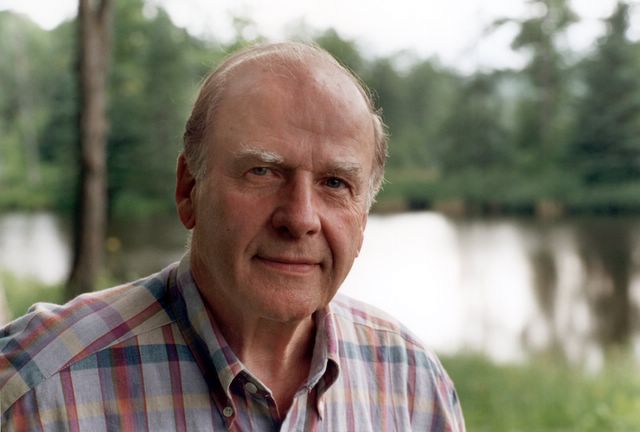
 Gaylord Nelson.Photo: Fritz AlbertWorldwide, organizers say a billion people will observe Earth Day this year, making it the largest secular civic event in the world. So why doesn’t it get more respect?
“Screw Earth Day,” says Grist. We should live every day like it’s Earth Day, not just be on our best environmental behavior once a year.
Wouldn’t that be nice?
In an ideal world, every day would be Earth Day and every person would be environmentally conscious every waking moment. Of course, an ideal world wouldn’t be experiencing global warming, either, but it is. We are a long way from environmental Utopia.
Gaylord Nelson, the Wisconsin senator and environmental visionary who founded Earth Day in 1970, wouldn’t be surprised by criticism. Even as the idea was widely accepted and 20 million people participated in the first observance, Earth Day came under fire from both the political right and left.
The arch-conservative John Birch Society claimed the April 22 event was nothing more than a thinly disguised attempt to honor the 100th anniversary of the birth of Vladimir Lenin. That gained some credence, until Nelson explained that millions of people, living and dead, share birthdays on any given day, and that people born on April 22 included St. Francis of Assisi, who some consider the first environmentalist; Queen Isabella; and, “most importantly, my Aunt Tillie.”
On the other end of the spectrum, critics said Earth Day and its environmental message was distracting from much more serious and pressing issues, like poverty, racism, and the Vietnam War. “The country is slipping into a wider war in Southeast Asia and we’re sitting here talking about litterbugs,” journalist I.F. Stone said.
But Nelson, an unabashed liberal, wasn’t just talking about litterbugs, as he made clear in his own Earth Day speech:
“Our goal is an environment of decency, quality and mutual respect for all human beings and all other creatures — an environment without ugliness, without poverty, without discrimination, without hunger and without war. Our goal is a decent environment in its deepest and broadest sense,” he said.
The first Earth Day, which was observed by 10 percent of the nation’s population, launched a new wave of environmentalism, prompted a decade of legislative action, and changed the way Americans think about the environment.
Nelson, whose idea had an impact that far surpassed his wildest expectations, would be the last to say there is no longer a need for Earth Day or a heightened environmental awareness.
“But isn’t Earth Day watered down?” critics ask. “What about the ‘greenwashing’ by corporations that put on a green front to look environmentally friendly while they continue to pollute the planet?”
Nelson was well aware that businesses and marketers were trying to claim the green mantle, and he was supportive of efforts to expose those actions. But he wrote in Beyond Earth Day, the book he co-authored in 2002, “Greenwashing is not all bad; in fact, it’s a generally positive development. It shows that even the bad guys want to look green to the public. It is a true public relations success, when even your worst opponents claim to share your environmental concerns.”
That’s certainly too soft a line for many critics of corporate America. But Nelson’s career was marked by his willingness to be inclusive, and many of his legislative achievements were attributed to his ability to keep disagreement on issues from becoming personal.
Although it may rub green activists the wrong way, Earth Day’s success derives from the fact that it has become institutionalized. Part of the genius is that it has, from the first observance in 1970, taken root in the schools, from elementary schools to universities. That has helped spawn environmental education and instill an awareness — Nelson called it an environmental ethic — in younger generations of Americans.
Later in life, Nelson liked to tell the story of a grade-school girl in Florida who told him about her mother bringing home a can of tuna that did not carry a “dolphin-safe” label, and how the youngster had insisted that mom return it and exchange it for one that was dolphin-safe. Grade school kids in the 1990s knew more and asked better questions about the environment than college students in the 1960s, because they had more exposure to the issue, he said.
So, why should we continue to observe Earth Day?
Nelson, who left the Senate in 1981, continued to go to his office at the Wilderness Society until shortly before his death in 2005. Why, he was asked, did he show up for work every morning at age 89?
“Our work’s not finished,” he said. “There’s a lot more to be done.”
If Earth Day can get a billion people to do something on April 22, whether it’s pick up a billion pieces of trash or open themselves to the environmental message, it is safe to say that Gaylord Nelson would be all for it.