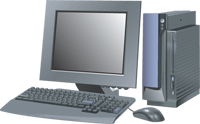
OK computer.
U.S. consumers are being cheated out of the chance to buy the greenest possible computers, according to the Silicon Valley Toxics Coalition and other environmental groups that have joined forces on the Computer TakeBack Campaign.
The campaign’s latest report card examined 28 computer manufacturers’ practices regarding hazardous materials, worker health and safety, and systems for taking back used products. CTBC found that fewer relatively eco-friendly computers are offered for sale in the U.S. than in countries with stronger environmental regulations, such as Japan and European Union nations, which have worked to eliminate hazardous materials from electronics and required companies to start take-back programs for old computers. (California and Massachusetts have banned the landfilling of cathode ray tube [CRT] monitors and TVs because of their lead content, and California will add a recycling fee to the cost of new computers and televisions starting July 2004, but thus far there’s been no federal action in the U.S. on these issues.)
A few weeks ago, the United Nations University released a 300-page report on the environmental impact of computers, from production through use and disposal. Not surprisingly, the authors concluded that reusing or upgrading a machine is better for the environment than buying a new one and recycling the old. The report also recommended that recycling incentives be increased for both consumers and producers and called for more study of the health impacts of computer manufacturing and disposal.
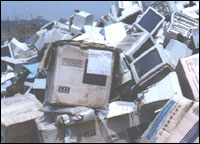
High-tech trash.
Photo: SVTC.
Toxins in computers include lead, brominated fire retardants (BFRs), polyvinyl chloride (PVC), and the heavy metals cadmium, chromium, and mercury. Manufacturing workers have suffered from hazardous exposures to some of these substances, including ethylene glycol ethers, which have been phased out of use because of links to miscarriages.
As 12 million PCs are landfilled annually in the U.S., such materials pose a threat to groundwater. And even machines that are kept out of the dump and sent to recycling centers aren’t necessarily being handled responsibly: To save money, many recyclers ship computers to China, India, and Pakistan, where unprotected workers dismantle them and face health risks.
SVTC is encouraging institutions that purchase large numbers of computers to press manufacturers for cleaner models. Ted Smith, executive director of SVTC, says, “We’re working with Health Care Without Harm to come up with procurement guidelines [for hospitals],” and his group is involved in similar projects with government and university officials. “I think that institutional purchasing guidelines are where a lot of the pressure for change is going to come from,” he says.
As for individuals, Smith recommends, “People should contact companies directly and ask them, ‘Do you make machines that are lead-free, flame-retardant-free, mercury-free, PVC-free?’ The more they hear from people, the more they will respond.”
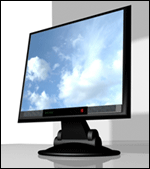
Flat chance.
Consumer tips:
- Avoid buying new computer equipment unnecessarily; whenever possible, upgrade your current machine.
- If you do need to purchase a computer, consider buying used: RefurbDepot.com sells refurbished computers and other electronics for somewhat less than the cost of new systems. Other purveyors of used computers include PCs Evolve and Computer Renaissance.
- If buying a new monitor, flat-panel screen models are an easy greener choice; they lack the five to eight pounds of lead found in conventional CRT monitors.
- Some U.S. computer brands are compliant with European Union regulations or eco-labels such as Germany’s Blue Angel, Norway’s Nordic Swan, or Sweden’s TCO. SVTC has more info on computer eco-labeling and brands that measure up to label standards.
- Look for Energy Star certified machines; they consume 70 percent less electricity than computers that lack power-management systems.
- Even after buying a new machine you might want to hang onto the old one instead of tossing it. Consider networking the two computers, or use the old computer to play MP3s or serve some other specialized function, such as acting as a Linux platform.
- Ask about consumer take-back programs like the Electronics Recycling Shared Responsibility Program, which includes Panasonic, Sharp, and Sony.
- Check out a list of responsible electronics recyclers compiled by the Basel Action Network. In general, be sure to avoid recyclers that use incineration (sometimes called “thermal recycling”) as well as ones that ship waste overseas for processing.
- If you live in California or Massachusetts, contact your local sanitation department for info on how to safely dispose of CRT monitors and TVs, as these two states have banned the landfilling of these items due to their lead content.
- Write your legislators to express support for bills like those in California and Massachusetts. During the past year, at least 20 states introduced legislation to address electronic waste.
- If you own stock in a computer company, consider submitting a stockholder resolution encouraging the company to take responsibility for its products at the end of their useful lives. Companies are increasingly responsive to measures like these. Find out more from the CTBC website.
The dish on a few computer companies that have started making progress:
| Company | Product | Green Aspects | Takeback or Recycling Program | Eco-Label |
|---|---|---|---|---|
| Fujitsu (Japan) | Fujitsu Siemens Scenic E600 Green PC ($1,170-$1,350) | E600 made from green materials. Company is eliminating lead solder from products. | None in U.S. | Swan (E.U.) |
| Canon (Japan) | i860 Desktop Photo Printer ($150) | i860 is very energy efficient, recycled plastic, BFR-free covers. Compny will eliminate lead, cadmium, hexavalent chromium, and mercury by Dec. 2004. | Working to enhance U.S. recycling systems. | Eco-Mark (Japan) |
| IBM (U.S.) | IBM 21″ CRT Monitor P275 ($750-$800) | Low-emissions. | Takeback program includes collection and recycling of old PCs for $29.99. | TCO |
| NEC (Japan) | Powermate Eco 900 ($1,500) | Powermate Eco uses lead-free solder; LCD display contains no boron. Other NEC products contain no mercury, PVC, or BFRs. | None in U.S. | Energy Star |
| Matsushita /Panasonic (Japan) | Toughbook laptops ($1,200 – $3,000) | Lead-free solder, reduced BFRs. | None in U.S. | |
| Sony (Japan) | VAIO R505G SuperSlim Pro notebook ($1,500-$2,000) | No BFRs, some lead-free solder. | Sony pays for recycling of all Sony products brought to collection points or special events. | |
| Apple (U.S.) | G5 Desktop ($1,700-$3,000), iBook G4 M9388 ($1,200-$1,500), and M9165 ($1,450-$1,700) | Does not contain PCBs or PCTs; PBB and PBDEs not found in plastic parts heavier than 25 grams. | Recycles batteries. | Energy Star; meets some criteria of TCO and BlueAngel labels. |