Chris Paine, the director of Who Killed the Electric Car?, looks a little embarrassed as he walks toward his waiting limo. “I should really have them drop us off a block away from the theater,” he says, laughing uneasily.
At least he’s carpooling.

Dean Devlin and Chris Paine at Sundance.
Photo: Fred Hayes/WireImage.
With him are Dean Devlin, one of the film’s executive producers (whose other projects include Independence Day, Godzilla, and The Patriot); former electric-vehicle sales rep Chelsea Sexton, who appears in the film; and Sexton’s husband, Bob, who helped launch Saturn before becoming the go-to technician for EV owners.
They have come to San Francisco for the city’s International Film Festival, after having premiered Who Killed at this year’s Sundance. So far, the local audience has responded strongly to the alternative-vehicle whodunit, since a large percentage of the country’s former electric-car owners — indoctrinated in the late ’90s during California’s short-lived pro-electric mandate — were from the Bay Area. Most of the rest lived in Los Angeles, allowing filmmakers to draw on the support of the Hollywood elite, both on-screen and off.
Roughly divided into two segments, Who Killed first addresses the broad history of the electric car, from its birth in the early days of the automobile through its sudden realization and untimely demise. Leased in limited quantities beginning in 1997, the EV was developed by auto companies to fulfill California’s mandate even as the companies sought to have the law repealed. When the requirement was altered to their liking in 2003, the cars were taken back and destroyed.
The passion and ire of the drivers left behind is touchingly captured in a funeral held for General Motors’ flagship electric car, the EV-1. This sets the stage for a dramatic unmasking. Who were the players behind the car’s death? Paine pinpoints many possible culprits, including consumers, corporations, and the government. Underneath its tongue-in-cheek premise, Who Killed is deadly serious — not just about the fate of the cars, but about some of the most essential questions America faces today.
For the most part, the media has portrayed EV enthusiasts as a likable, ragtag bunch who just won’t shut up, and that’s not too far off-base. They really, really loved their fast, sexy cars. But they are also reasonable, intelligent debaters who come off, more than anything, as justifiably angry. And what do you do if you’re mad about something and live in L.A.? Like, obviously, duh. You make a movie.
When did you start driving an electric car, and what were your first experiences?
Paine: My boyhood hero was Paul MacCready, who designed the bicycle-powered airplane and the solar-powered airplane that crossed the English Channel. I had heard that he was working on an electric car for General Motors, so I wrote and said I’d like to be a test driver. I didn’t get accepted, but when the car came out I immediately went and got one. It was amazing. I didn’t really like cars before, and suddenly I was a car lover. And I drove the thing for years — then GM said they were going to take it away. It was leased, so I said I’d buy it, and they said I couldn’t. Finally, I took it in for a repair one day, and they wouldn’t give me my car back.
We started getting the feeling that there was a lot more to the story than met the eye. We thought Frontline or 20/20, or Michael Moore, somebody would do it. Nobody did. So rather than have our [story] rewritten by the media, we decided we would dive in and try to tell the story the way it really happened.
Was there a moment when you said, no, really, we have to make this?
Paine: I guess the moment was when we put together the funeral. We thought, this is going to do it, the media is going to pay attention. We had all these engineers and politicians come and speak. The story that ran the next day was: EV drivers bid a fond farewell to a car they loved and get ready for the hydrogen car of the future. We were pissed! This was a great technology that was working well today.
I knew from making documentaries that you can spend years on a documentary and no one ever sees that. Dean, it turned out, had a similar experience. So [he got involved and] suddenly we had the resources to make a film that could achieve another level — not just be about a car, but about why America’s having a hard time getting out of the 20th century. What are the obstacles that keep making the status quo win?
Dean, the film is dedicated to your father, who had been outspoken about GM’s seeming unwillingness to promote the EV.
Devlin: That’s right. My father had one of the very first EV-1’s that were delivered. He was a huge enthusiast of the cars and the future he hoped they could bring. But he was suspicious from day one that the car companies had been forced to do this, and their hearts weren’t really in it … The advertising got worse and worse. My father was [complaining to the company]: why aren’t you saying that the car’s fast, why aren’t you saying it’s sexy? Why aren’t you showing the car?
He met with someone who worked in marketing at GM, and the guy opened a folder and said, what do you think of that ad? My father was like, it’s brilliant, this is exactly what you should be doing. And the guy said, every time we show them an ad like this, they say no, just say it’s electric, shrink the car as small as you can, and that’s it.
Paine: At GM-sponsored events they did treat us very well, at least in my experience. I’d have these birthday parties for the car, they’d send us jackets. Chelsea was our sales rep, and they made it a really nice experience. But then when none of our friends could get the cars and they started taking them away, we knew something was different.
Sexton: Well, it changed over time. When we started [as EV sales reps] we were made to read this book about the car. It described the 400 or so folks who’d been involved with it, and the 10 years of creation. It instilled this sense that the whole world is watching, if it succeeds or fails it’s on the shoulders of the 12 or 13 of you guys — but we also went out thinking, OK, but we have the biggest company in the free world behind us. And then there started being a disconnect here and there, and the advertising wasn’t so good, and we thought, growing pains. But then we had meeting after meeting [where] we were giving feedback from the front line, and exactly the opposite of our recommendations would happen.
It certainly wasn’t us against them. There are factions in GM; there are people who love that car to this day, and people who never wanted to see it happen. We became a little more subversive over time, until it got to the point where GM considered all of us and our waiting lists of people who wanted the car and all of that effort as a liability.
Paine: Chelsea has this great story that isn’t in the movie but might be a turning point. They had just delivered all these cars to meet a mandate requirement, and they got this letter. What did it say?
Sexton: We had just delivered the last car, and GM was simultaneously pleased and pissed. We got this nice letter from the brand manager and it was like thank you, kudos, and all that, and then it said, “You were a part of one of the best teams I’ve ever had the pleasure to work with.” It was two or three years before the actual end of the program.
How did the subjects you portray in a negative light feel about speaking with you?
Paine: When we talked to people about it, we told them, we’re making a story about our future as Americans. What are we doing as a nation, governmentally, politically, as individuals, to move forward? Our case study is the electric car.
We can give a lot of credit to the people who did speak with us, like Dave Barthmuss. He’s GM’s official spokesman and he’s supposed to talk to media, but on the other hand we had a lot of key interviews with GM cancel at the last moment, after we already had a crew in Detroit. It was very expensive. Alan Lloyd, from [the California Air Resources Board], was the secretary of Cal/EPA when we spoke to him. I think Alan feels like he did the right thing [by reworking the mandate to favor hydrogen vehicles over electric cars]. I respect Alan in terms of being willing to speak to us, and to stick to his stance, even though I think he was manipulated.
Devlin: It’s important to remember that this was happening not long after we had blackouts in California, where Enron had basically manipulated our markets and billions of dollars had left the state and the [government-organized partnership to promote hydrogen vehicles] was going to bring billions of dollars into the state. At the same time, our governor was being blamed for his role in the blackouts, and was about to lose his job.
Paine: They were under tremendous pressure. But the sad thing is, we can make the electric car even better now, and if the law were in place we could have 600,000 electric cars on the road in California.
There have been a couple of claims about EVs that aren’t really addressed in the film: that they didn’t comply with safety laws, or that the batteries would eventually stop holding their charge.
Sexton: There has been an incredible amount of negative information disseminated by the automakers. It’s important to note that while the automakers were not wild about doing this, they never would have put out an unsafe product. Certainly GM, so bent on being the first one out, had the attitude that if we’re going to do an electric car, we’re going to do the best electric car.
The reality is that, like other batteries, they do degrade over time. The batteries are replaceable, so after 10 years you might have to replace your battery.
I want to ask you about the structure of the film, because you start off with the whole story arc, then you go back and look at the “culprits.”
Paine: The story was 10,000 facts that were like puzzle pieces, so the initial structure was to create a puzzle and make the audience figure out the pieces for themselves. A murder mystery, with lots of clues. When Dean came in, he said, let’s really think about creating a chronology so people understand what the story is, then we can go into the puzzle.
Devlin: One interesting thing about the creative process was that all of us lived through this. All we have to do is see a picture of a crushed car and we’re going, oh god, I remember what that was like. So when we had the early cut, there was a certain assumption — well, everybody already knows all that, let’s get to the part people don’t know — and what we realized was that people didn’t know. Not only didn’t they know the story, they didn’t know the electric car existed. So the decision we made was, let’s take them on the journey we lived.
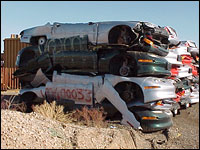
Crushed.
Paine: When GM was taking these cars and destroying them, when you turned in your car they would go over your entire car and say, there’s a scratch, you owe us $1,000 — then two weeks later, crush your car. The saddest thing is when the images of the cars came out on the internet and they wrote the VIN numbers on the sides, customers who had paid the penalties recognized, that’s my EV and I just paid $1,500 in penalties!
Sexton: We could tell from the VIN numbers who had it and how many miles were on it. We could look and say, that car only had 9,000 miles on it. EVs are rated to last several times longer than the average car. These motors are half-million-mile motors.
In your film, [battery] inventors Iris and Stan Ovshinsky seem to represent the kind of passionate innovation this country built itself on, versus the tradition of big business we are building today. Even though they’re high-tech, those guys are old-school.
Paine: The tradition of innovation and invention in this country is amazing, whether it’s Paul MacCready or Stan — the problem is that the vested interests that make their money the pre-invention way can make it very difficult for innovation to reach the market. That energy is still here, but it takes a collective push for it and people paying attention and saying no, this time the law is staying in place, this time we’re going to bring these things to market, and I’m going to buy one.
Devlin: One thing that people don’t get about this issue is that [driving an electric car] isn’t a sacrifice. People look at it as though, it’s the environment, so I’ll give up all these things. But it has zero impact on your lifestyle. You’re still going everywhere you would go. You’re still doing everything you would do. Maybe you’re saving time because you don’t have to go to the gas station. These were fast cars, too. And these were cars that were made 10 years ago. They could only improve.
Obviously you’re in favor of electric cars, and the next best thing may be plug-in hybrids — hybrids that can be charged at night and run on electricity before kicking over to gas. Chelsea, you’re an advocate of plug-ins through your organization Plug In America.
Devlin: So far, car companies are not really moving toward plug-in hybrids. We’re trying to shove them toward them. There’s been a lot of pressure, not just from activists. Mayors and governors across the country have signed petitions saying we need to do this. Our hope is that one of the things that comes out of this picture is that people say wait a minute, here is something car companies can do now. Instead of filling your tank every other week, it’s every other month.
Environmentally, these are issues that were kind of theoretical, but through things like Katrina, we are really starting to feel the effects of global warming. People know people who are dying overseas in wars that are fought at least in part for oil. Regardless of your political position, nobody wants people to die in a war for oil. We all breathe the same air. We are all paying the same high gas prices. These are the consequences of not embracing these types of technology. Would this solve all those problems? No. Would it make a big dent in them? It could. It really could.
What do Paine, Sexton, and EV developer Wally Rippel think about peak oil, ethanol, and shady PR tactics? Find out in Gristmill.