Coturri Winery in Sonoma County, Calif., could be a poster child for socially responsible business: The family-owned company farms organically, produces critically praised wines on a small scale, supports a local moratorium on genetically modified plants, and donates to nonprofit causes. But according to the Natural Capital Institute’s responsible-investing database, Coturri wouldn’t pass muster with at least 45 socially responsible funds, because these plans screen out companies that produce alcohol.

Big chairs to fill.
Many of the same funds hold shares in energy companies like BP, Chevron, ConocoPhillips, and Occidental Petroleum, whose business centers on feeding the world’s fossil-fuel habit. Other favorite holdings of socially responsible funds have mixed corporate citizenship records: Microsoft has been accused of antitrust violations, Wal-Mart undercuts local businesses and discourages employees from unionizing, and Merck faces multiple lawsuits charging that it marketed Vioxx knowing the painkiller was linked to heart attacks.
Few people would contend that corporate social responsibility is a bad idea in principle — although Nobel Prize-winning economist Milton Friedman argued in a widely cited 1970 essay that “The Social Responsibility of Business Is to Increase Its Profits.” In practice, however, as these examples suggest, CSR raises as many questions as it answers. Can shareholders and the public distinguish meaningful initiatives from public-relations ploys? Can voluntary actions ever make enough of a difference to substitute for regulation? How do you rate corporations that take progressive steps in some areas but lag in others? And does CSR improve companies’ financial performance?
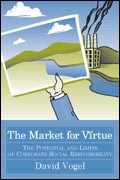
The Market for Virtue
by David Vogel, Brookings
Institution Press,
222 pgs., 2005.
In The Market for Virtue, University of California business professor David Vogel performs a reality check. Although many academics, executives, fund managers, and advocates believe socially responsible policies give corporations a competitive edge and increase profits, Vogel finds no clear-cut business case for virtue. In his view, reams of studies looking for a connection between doing well and doing good have measured corporate actions in too many different ways to draw broad conclusions about the results. He’s not out to torpedo the “real and substantive” concept of CSR, but he argues that the model needs some tough love.
While his analysis is generally balanced, Vogel does seem eager to point out ways in which CSR initiatives have fallen short: for example, he acknowledges that Forest Stewardship Council certification has become “a kind of global benchmark for forest-management policies,” but then spends several pages detailing the limits of FSC’s impact on tropical deforestation.
On the positive side, Vogel believes that CSR initiatives have led to higher wages and less use of child labor in developing countries. But he says it is harder to measure CSR’s environmental impact because there is less international agreement about what constitutes sustainability. He also notes that most corporate actions to protect the environment have taken place in the U.S. and Europe, and charges that the CSR movement has had relatively little to say about pollution in the developing world beyond some specific cases like forestry and oil and mineral production.
Vogel sees merit in production improvements and energy-efficiency gains at companies like Ford and BP, but notes that “when green strategies … rely on market demand for environmentally sensitive products, the limits of corporate environmental responsibility come into stark relief” — since consumers readily buy green products only when they confer benefits (like better flavor from organic food) that justify higher prices.
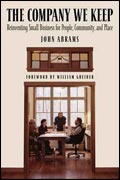
The Company We Keep
by John Abrams,
Chelsea Green,
313 pgs., 2005.
Ultimately, in Vogel’s view, CSR makes sense for some companies some of the time — niche firms such as Ben & Jerry’s that make it part of their identity, or larger companies like Nike that adopt policies in response to consumer boycotts and campaigns — but regulation is the only tool that impacts all companies all of the time. “If many companies believe that greenhouse-gas emissions should be reduced and that it is possible to do so efficiently — as they apparently do — then these same companies should support national legislation that forces all firms to reduce their greenhouse-gas emissions in an efficient and cost-effective manner,” Vogel writes. “Otherwise, self-regulation will remain largely ineffective.” Presenting this as an either-or choice oversimplifies the issue, since many CSR advocates also support strong regulations and mandatory targets, but this book raises serious questions about what we can expect from CSR alone.
If The Market for Virtue burns like a shot of bourbon going down, The Company We Keep by John Abrams is a cool chaser. Abrams’ construction business, South Mountain Company, has been building houses on Martha’s Vineyard for 30 years, and has developed a vision that would ace any CSR test. Abrams’ central message is simple: “[S]mall enterprises, if driven as much by principled practice as by profit, can produce workplace satisfaction, support good lives, and help shape strong communities.”
Abrams loosely structures the story of his employee-owned cooperative around the “cornerstones” of its business philosophy. They include supporting workplace democracy, choosing to grow very slowly, and celebrating the “spirit of craft.” The company works to integrate its homes with the landscape, and uses salvaged lumber, renewable energy, and green-building techniques to reduce projects’ environmental footprints. More broadly, Abrams and his colleagues are committed to fostering strong communities on Martha’s Vineyard by supporting efforts to build more affordable housing; as Abrams notes, the rush of wealth to the island in recent years has priced many middle-class workers, including town managers, out of the housing market.
The Company We Keep reads like a natural statement of real people’s views, not a public-relations effort. Abrams uses the term “bottom line” more loosely than the “triple bottom line” approach to CSR that aims to quantify corporations’ financial, social, and environmental performance — it’s a recognition that people want many things from their work, not an accounting technique. He makes the obvious but worthwhile point that profits do matter, since no business can make social contributions if it goes bankrupt (one of his friends jokingly calls South Mountain’s early money-losing projects “subsidized housing for the rich”).
This book fits environmentalism into a larger context of building healthy, diverse communities through “people conservation” as well as land conservation. Abrams chides CSR advocates for paying little attention to employee ownership, and urges readers to support small-scale and locally owned businesses because they shape the character of the places where they operate. South Mountain has committed to what Abrams calls “the business of place” by accepting projects only on Martha’s Vineyard, although the company has had many offers elsewhere. “After a quarter-century working on the Vineyard, our local knowledge is still increasing,” Abrams writes. “Even here, there is so much more to learn. Sometimes we slog through the tangles of information like a short-legged dog in deep snow.”
Taken together, these two books suggest that we should be realistic about what CSR can achieve: not every company has thoughtful leaders like Abrams, or operates in an island setting where competition is limited. At the same time, as Vogel points out, “Many companies would be willing to behave more responsibly if consumers, employees, and investors were willing to bear the additional costs of their doing so. But for the most part they are not.”
Still, as illustrated in The Company We Keep, CSR is an evolutionary process, not a fixed state. We can reward sustainable companies — or rather, sustainable actions, since no business is monolithic. If BP or Wal-Mart moves one step forward, it is OK to toast them. Preferably with Coturri zinfandel.