Support Grist
Support nonprofit, independent environmental journalism.
Donate to Grist.
Ask Umbra

Still Worth It

On mercury in CFLs

By Umbra Fisk
16 Jul 2007
Tools: print | email | discuss | write to the editor | subscribe | RSS
Got questions about the environment? Ask Umbra.
question Dearest Umbra,

For the past 10 years or so I have been patiently and methodically replacing the incandescent light bulbs in my house with the more efficient compact fluorescent ones. Even though they cost more than incandescents, I have been confident that their lower energy requirements and longer life span more than made up for the increased cost. Thus I was greatly dismayed the other day when I went to our local transfer station and was told that I must dispose of burned out compact fluorescent bulbs as hazardous waste. I was told that this is due to their containing some mercury.

Have I been wrong all this time by going for the more efficient bulbs? I will certainly dispose of my burned out bulbs in a responsible manner, but I dare say others won't know about this problem and a lot of them will end up in landfills. Will we thus end up with more mercury (and/or other nasties) in the environment? Please consult your oracle and tell me which evil is the lesser.

John
Barrington, N.H.

answer Dearest John,

Why add suspense to summer's heat: The answer is no. You have not gone wrong.
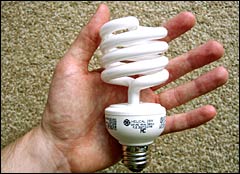
Spiraling: out of control?
Photo: armisteadbooker via Flickr
For the past five years or so I have been patiently touting compact fluorescent light bulbs and methodically deleting most of the letters decrying the mercury they contain. Bored with the topic and tired of repeating myself, I consulted no oracles. Until last week, when my Hazardous Waste Oracle and I were having a social chat and he happened to mention a nice math problem. I will convey his oracular arithmetic and hope it helps some of you CFL holdouts correctly allocate your mercury worries.

Compact fluorescent bulbs are an inexpensive, simple change one can make at the household level to reduce energy use. As home energy use is reduced, several problems upstream are addressed. For starters, electricity generation is lessened. Electricity in the United States is generated from dams, coal, natural gas, oil, nuclear, wind, etc., and most regions use a mix of all these sources. Cutting electricity use reduces the emission of mercury, a heavy metal that is a neurotoxic byproduct of coal-burning power plants. Mercury is integral to the functioning of fluorescent lamps, and can either be reclaimed from said lamps upon disposal or exude into the environment when improperly disposed. One cost/benefit calculation in buying CFLs for your home, therefore, is whether net mercury releases increase or decrease.

My Hazardous Waste Oracle shares the following calculation: On average, a U.S. kilowatt-hour generates .012 milligrams of mercury. So, a 20-watt CFL running for a (shorter than expected) lifetime of 10,000 hours would generate 2.4 mg of mercury, while a comparable 75-watt incandescent running for 10,000 hours (you would need more than one bulb, of course), would generate 9.0 mg. A big difference, as you can see. Add in the 5 mg of mercury that might reside in a CFL bulb (the high average I saw) and you get a total of 7.4 mg -- still less than the incandescent.

The American Council for an Energy Efficient Economy, an oracle available to all of us, tells us that CFLs keep two to 10 times as much mercury out of the environment as they contain. ACEEE calculates 6.5 mg mercury saved from the environment by using a CFL, with numbers even higher in states that rely heavily on coal power. The EPA's CFL fact sheet estimates 3.6 mg of mercury avoided during a five-year period of bulb use.

The EPA even developed a computer model for "Mercury Emissions from the Disposal of Fluorescent Lamps." I mention it for those of you who would like to add all the "what if" questions, such as: what if the bulb contains 12 mg, what if the bulb falls off the truck, what if I want to compare divalent and particulate mercury, etc. The agency was very open about its background data, and happy to share the model itself.

What this simple math does not address (mine, I mean, not the EPA's very large document holdings) is the differences between mercury emissions from power generation and bulb disposal. We can all help with the mercury issue by doing our job at the disposal end. And do I need to point out that mercury is only one savings when we reduce energy by using more efficient light bulbs? No, no.

Hgly,
Umbra



Tools: print | email | discuss | write to the editor | subscribe | RSS
Yours is to wonder why, hers is to answer (or try). Please send Umbra any nagging question pertaining to the environment -- but first check out her FAQs!
The claims made in this column may not reflect the views of this magazine. Neither the magazine nor the author guarantees that any advice contained in this column is wise or safe. Please use this column at your own risk.
Umbra Fisk is Grist Research Associate II, Hardcover and Periodicals Unit, floors 2B-4B.
< Previous | Next >
Comments: (17 comments)

You are not logged in. Thus, you cannot post a comment. If you have a Gristmill account, log in below. If you don't have a Gristmill account, well, by all means go make one! Meet you back here in five.

Username: Password:

Forgot your password? Enter your username and click:

Why is the light from compact fluorescents so ugly

We would like to use more compact fluorescent bulbs, but the ones we have found have such a stark, bleak white light that we find we can't live with them. Are there brands or styles that have a softer warmth?  Does the technology of  fluorescent light make possible a armer, livable light?

Green and renewable

 Nothing,I repeat nothing is totally green or bio-friendly. Solar panels produce electricty for decades,but they first have to be manufactured and that requires alot of electricty and waste.Don't forget the batteries that you have to store that electricity.Battery technology is weak right now,but improving as climate change is getting into peoples heads.
 Wind power is said to be detrimental to birds and migration patterns.Let me tell you that wind power is a pain,mostly because there are frequent break downs and somebody either has to climb the tower and/or lower the unit for repair,and you still need the batteries to store the electricity.
 Bio-diesel,don't know much about.There is always waste spills etc.. Then you have hydrogen,hydroelectric,tidal etc..Suffice it to say that everything has some sort of a downside,but that to do nothing but keep on burning oil is ignorant.

Why not ask why!?
LED bulbs?

Dear Umbra,

Have you done research on LED light bulbs which reportedly contain no mercury?  

Below are two articles from News Target and an advertisement from a LED maker.

" Compact fluorescent light bulbs contaminate the environment with 30,000 pounds of mercury each year"
http://www.newstarget.com/021907.html

"Breaking a compact fluorescent light bulb could cost you $2,000 in toxic mercury cleanup"
http://www.newstarget.com/021916.html

LED advertisement
http://www.betterlifegoods.com/SearchResults.asp?Cat=1

LED's

Do you have more information on LED's? I would like to make a change to more efficient bulbs, but the one flourescent I have in the garage truly dismays me with it's dismal light. Living in a part of the country which is already gray 9 months out of the year, bright light is very important to me.

CFLs not problem-free

I have CFLs at home where they work out, but...

  • They don't work with electronic timers (learned this by ruining a timer)
  • They don't fit in our in-cieling fixtures (1940's house)
  • They are ineffective in "track light" floodlamp units
  • They are not recommended for outside lighting
  • If used outside, they don't have "bug light" versions
  • They hummmmm when used in dimmer-controlled circuits

CFLs are good, but they need to get better. People need to know about their energy and cost savings benefits. But I'm "pro-choice" on the issue of banning incandescent lightbulbs.


CFL Problems listed above.

Most of those problems relate to older bulbs. I certainly use CFLs on timers. I use them outside without problems. You can get them with bug-lite yellow coatings. You can even use some newer models on dimmers and motion switches. If you are getting a humming noise, then your bulb isn't getting the electricity it needs in a proper flow.

CFLs produce light through plasma which needs a direct energy flow. This is opposite of your incandescent bulbs. CFLs use an electronic ballast to regulate energy flow. This is what causes the buzzing if not powered correctly. Older models had big problems with this. Newer ones do not. Newer models come in all sizes and shapes and light output varieties. The ones in my garage are the equivalent of 100 watt incandescent bulbs and give off great light.

Check out: http://www.energyfederation.org/consumer/default.php/cPat ...

There you can buy CFLs that are colored, give a "daylight" glow, are dimmable, suitable for three-way fixtures, outdoors, and for any fixture. Most home centers and discount stores only carry the bare minimum selection of these bulbs.

CFL's have come a long way

Just a couple of things..

CFL's don't work in timers, because the ballasts aren't rated to have the small amount of electricity that the timers give the bulbs.

They may fit in ceiling fixtures, if you can find the right ones, or there is a new option of hard wired fixture replacements, of which there are quite a few really nice selections for.

For the Floodlights/tracklighting you should use the ones that resemble flood lights, they do exist in both the large and small sizes.

They do have indoor/outdoor rated bulbs, just look at the packaging.

There is a bug light version, sadly they are not Energy Star rated, but do save energy.

They are not rated for dimmer switches, for the same reason as the timers, but there are dimmer versions available, they aren't perfect but do work.

The newer bulbs have a higher rating on the CRI index and the Kelvin ratings are closer to a standard incandescent bulb, making their color not so "white" they are closer to that yellow candle color we're used to.  Most bulbs are marked what their Kelvin ratings are, which should be around 2600-2700K.

The mercury contained inside the bulbs, yes is very little compared to what you end up using with incandescent bulbs and the manufacturers are striving with each generation that comes out to use less and less and if you look up the MSDS sheet on the bulbs some state that there is so little mercury the manufacturers are not required to have a MSDS sheet on them.

The flicker issues used to come from the magnetic ballasts, but as most of them have moved to an electronic ballast (flickering more times per second so most people can't pick it up) that has gotten better as well.

Always buy Energy Star bulbs.

No, I don't work for a manufacturer, I work for a utility and we have a large program supporting the use of CFL bulbs, and we have customers that ask these questions all the time.

Thanks.

The light needn't suck

I've been replacing as many of my lights with CFLs, though living in a developing country I'm not sure the waste disposal is really up to environmental standards. However, I have been trying, but the light does suck, frankly. Too white.

On the other hand, I don't know about the US, but when I was in Britain a couple of weeks ago, I found CFLs in hotel rooms--in lamp fixtures, no less. I say 'found', because it was only through curiosity that I discovered what they were, the light was so much like regular lightbulbs. So how come these lights aren't more widespread? Surely it's just a matter of filters in the glass?

Anyway, I'm not too keen on incandescent lights, as it is--too yellow. Maybe I'm just not fitted to living in the light.

If I share initials with 'Global Warming', is that a sign?

CFL's have come a long way

I'm puzzled by Nyx's statement that "CFL's don't work in timers" (because the ballasts require more current). I have been using them with timers for quite a while without problems.  I also use them with electric eyes to turn them on and off automatically, depending on ambient light.  My understanding is that unlike timers, these sensors may reduce the current available to the light, but again, I have had no problems (as long as I use a sensor with a time delay to avoid the "flicker" problem at dawn or dusk, when the ambient lighting is marginal.

What if they break?

It's one thing to dispose of a CFL and the 5mg of mercury leeches into the ground nowhere near anyone lives, but what seems dangerous is having them crack or smash in the home.  There would be 5mg of mercury right there in front of you.

Does anyone know how to clean up a break from a CFL?

Andrew Eisenberg
The gateway project is wrong---http://www.livableregion.ca

Handling CFL Breaks

Here is a page the EPA provides on household mercury cleanup linked to the section for CFL cleanup:
http://www.epa.gov/mercury/spills/index.htm#flourescent

Today's Margarine

Yeah, that mercury bothered me too when I started replacing all my bulbs with CFs.

One has to think back of all the things we were "supposed" to do in the past to save money, get healthier, help the environment...only to find that these things (margarine) were worse than what they replaced.

a little more on CFL's

The average CFL saves about 66 kilowatt hours of electricity per year. Over the life of the bulb, the energy saved is equivalent to 46 gallons of oil.

Amount of mercury vapor in an average CFL: about 5 milligrams

Amount of mercury solid in a typical home fever thermometer: about 500 milligrams

CFL's and timers

What we've been taught is the ballasts aren't rated to have the small amount of current constantly running in them and it can weaken the ballast and cause it to fail sooner or have other problems.  We also have a note from our fact library that states
"There are 2 types of timers: Mechanical and Electrical. It is important to first identify the type of timer you are using. Most mechanical timers (identified by a rotating dial) are acceptable for CFL lamp operation. Please refer to the timer manufacturer recommendations usually found on the timer label or in the instructions. In general, CFL's are not for use with electronic timers unless specified as such by the timer manufacturer. Again, this information is usually found on the timer label or in the instructions."

I think it's like many things, you have to pay attention to the instructions.

LED me, guide me

Karen,
Umbra has talked about LEDs here:
http://www.grist.org/advice/ask/2006/09/18/LEDs/index.htm ...

The links you cite are misleading and blown out of proportion (especially the second one):
http://www.treehugger.com/files/2007/05/the_real_dirt_o.p ...
http://www.treehugger.com/files/2007/05/ask_treehugger_14 ...

But this doesn't surprise me, since the person relating the story has an economic interest in LEDs (follow the money), being the purveyor of "Better Life Goods" that you cite.  It's too bad someone supporting a good technology (LEDs) uses bogus news spread by shysters like Steven Milloy and WorldNetDaily to "prove" his point.

When LEDs get to a reasonable price (i.e., below the $100 a 10-watt Eco-LED from Mike Adams costs (what's that?  that's as much energy as a CFL uses?  for 20x the price?!  wow!)), I'll be the first to buy them.

Dave

On the mercury safety issue

Thought this was a particularly good column from Mr. Green at the Sierra Club about CFLs and their saftey, etc.:

http://www.sierraclub.org/sierra/200707/mrgreen_mailbag.a ...

disposal of CFLs

A program on this problem on NPR mentioned that Ikea stores accept CFL bulbs for proper / safe disposal -- or maybe even recycling.

You are not logged in. Thus, you cannot post a comment. If you have a Gristmill account, log in below. If you don't have a Gristmill account, well, by all means go make one! Meet you back here in five.

Username: Password:

Forgot your password? Enter your username and click:

The comments of Grist users reflect the opinions of those individuals only, and do not necessarily reflect the viewpoints of Grist, its staff, its board members, their psychotherapists, or their aestheticians. Got it?


Also in Grist

The Week's Most Popular
From the Archives
Whence It Came, by Umbra Fisk. On biodegradable products.
Heads You Lose, by Umbra Fisk. On replacing toilets.
Ka-Boom, by Umbra Fisk. On fireworks.

ADVERTISING POLICY


About Grist | Support Grist | Jobs Board | Archives | Grist by Email | RSS | Podcasts
Gristmill Blog | In the News | Ask Umbra® | Muckraker | Victual Reality | 'Tis the Season | The Grist List | The Bottom Line


Grist: Environmental News and Commentary
a beacon in the smog (tm) ©2007. Grist Magazine, Inc. All rights reserved. Gloom and doom with a sense of humor®.
Webmaster | Privacy Policy | Terms of Service | Trademarks