Dear Umbra,
Grist keeps mentioning that the U.S. government gives large subsidies to oil companies, but doesn’t go further into what these subsidies are. I can’t make a good argument against the government’s subsidizing Big Oil if I don’t know more about it: Are the subsidies tax breaks, and if so, for what? Are the tax breaks larger than for most other large companies? How biased is our treatment of Big Oil?
Christine
Hillsboro, Ore.
Dearest Christine,
Just as an aside, I’m not sure such a being as Wee Oil exists.
Can we get you anything?
The word subsidy finds its origins in the Latin verb sedere, to sit, so imagine a comfy chair given only to certain groups or persons. Thinking about a chair is certainly easier than understanding the tax code, “passive loss limitation,” and all that.
Oil and gas companies do benefit from a lower corporate income tax, and they’ll reap billions in tax breaks thanks to the recently passed energy bill, but Big Oil is not alone. According to a 2004 report [PDF] from the Institute on Taxation and Economic Policy, bigger breaks from 2001 to 2003 went to the aerospace, transportation, industrial and farm equipment, telecommunications, and electronics industries. Here’s some context: on a scale of corporate tax rates from 0 to 29 percent, aerospace paid a measly 1.6 percent; oil weighed in at 13.3; and — oh, just to randomly pick one — publishing was taxed at 23 percent.
The government also has other tricky ways to support certain industries or people: selling construction bonds at low interest rates or tax-free; running a research-and-development program at no cost to the industry it benefits; assuming the legal risks of exploration and development in a company’s stead; offering below-cost loans with cherry repayment conditions; and ancillary other tactics that overwhelm my pea brain. (As usual, you need not rely entirely on me: Earth Track is a site devoted to explaining energy-related subsidies.)
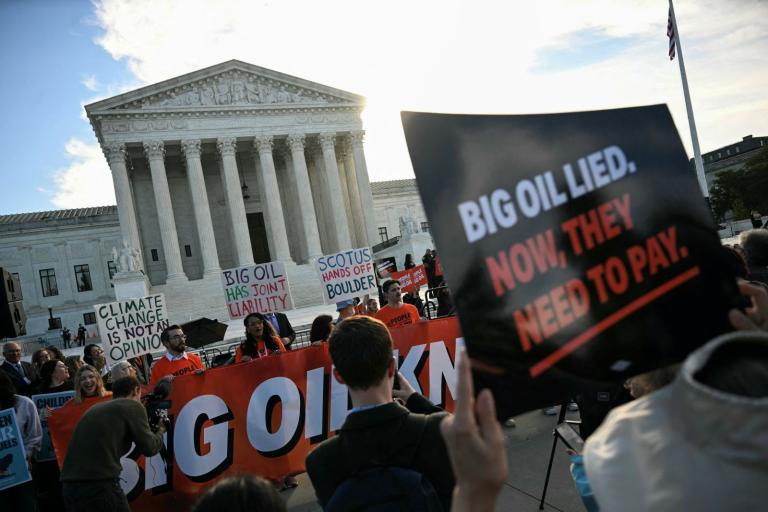
My chair metaphor may seem a bit distant from these financial ideas, but it gets apter as we look at how the government absorbs the “externalities” of oil. In a true open market, oil prices would reflect all the costs of production, transport, use, and disposal. In our current situation, state and federal governments say, “Oh, you look tired, Big Oil. Drilling and selling must be hard. Just rest here while we make sure there are no remaining barriers to the dominance of your product.” Then they take care of the highway system; tax gas at a lower rate than other consumer products; and protect the domestic oil supply by providing fire, police, and Coast Guard services. As for the global supply, well, we know where most of our military personnel are currently located.
Imagine what oil would cost if the industry had to pay to protect and clean up its own shipments. If the environmental impact of burning petroleum were considered a cost. If Big Oil were held responsible for the particulate matter in our lungs. In my personal opinion, the main positive result of the anti-tobacco decade is a blueprint for going after Big Oil, and for punishing automobiles and their advocates as one big destructive, greedy death machine.
There. Now aren’t you glad you asked?
Ungently,
Umbra