Support Grist
Support nonprofit, independent environmental journalism.
Donate to Grist.
Ask Umbra

Urine Trouble

On cat-pee stains and dry cleaning

By Umbra Fisk
02 Dec 2004
Tools: print | email | discuss | write to the editor | subscribe | RSS
Got questions about the environment? Ask Umbra.
question Dear Umbra,

I am aware of how polluting regular dry cleaners can be and therefore make a point to wash clothes at home. Recently, however, my charming cat peed on my comforter. I was wondering if you knew of any environmentally friendly ways to clean "dry clean only" clothes or, in this case, comforters.

Heidi
Falls Church, Va.

answer Dearest Heidi,

I've seen feather comforters with both dry-cleaning and home-washer options, so be sure to read the tag. If home washing is an option, plain vinegar in the washer may help remove the odor. Spot application of diluted white vinegar may also work. Give it a few tries, and completely dry the area. If that doesn't work, local health-food and/or pet shops should carry enzymatic cleaning products for pet odors and stains. These are certainly preferable to commercial dry cleaning.
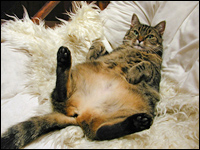
Cat
That darn cat!
In keeping with our oh-so-disposable lifestyle, you may see little "home dry cleaning" kits available at your local purveyor of individually wrapped products (you know, Target, Rite Aid, etc.). These involve a bag, a sheet, a dryer, and no carcinogenic perchloroethylene. Allow me to quote a vendor: "The special FreshCare™ Dryer-Activated Cloth works with your dryer to create a fiber-permeating mist that helps clean odors like smoke away." It works with your dryer, Heidi, in a beautiful collaboration. But from what I've read, these bags basically steam and perfume the fabric, and any actual cleaning needs to be done by hand. I suspect that they are basically useless, and I recommend passing them by.

If vinegar and enzymes fail you, the other hope is the new professional clothes-washing trend, "wet cleaning." Cleaning businesses purchase computer-controlled fabric-washing equipment the likes of which you and I have never seen: four extract speeds, air bubble power, 89 user-defined programs, residual moisture control sensors ... and that's only the beginning. Wet cleaning is environmentally preferable to dry cleaning (not to mention retro cool!). Dry cleaning relies on the solvent perchloroethylene, which is responsible for what you might call a laundry list of problems: It's a probable carcinogen, reduces sperm count, probably causes headaches, nausea, and miscarriages, accumulates in fatty tissue, and concentrates up the food chain. "Dry" cleaning means immersing clothing in this persistent toxic organochlorine. That's why we should avoid owning any fabric that requires dry cleaning, and should urge all of our cleaning establishments to transition to wet-cleaning equipment.

Look out for a wet cleaner at your dry cleaners, or elsewhere in your neighborhood. I also highly recommend asking cleaning professionals for counsel. They clean stuff for a living and may be happy to advise you on how to do it at home. Although they may not have an environmental bent, they may know certain techniques that have been lost to the layperson. Perhaps a secret wrist motion is the key.

Dryly,
Umbra


Tools: print | email | discuss | write to the editor | subscribe | RSS
Yours is to wonder why, hers is to answer (or try). Please send Umbra any nagging question pertaining to the environment -- but first check out her FAQs!
The claims made in this column may not reflect the views of this magazine. Neither the magazine nor the author guarantees that any advice contained in this column is wise or safe. Please use this column at your own risk.
Umbra Fisk is Grist Research Associate II, Hardcover and Periodicals Unit, floors 2B-4B.
< Previous | Next >
Comments: (1 comment)

You are not logged in. Thus, you cannot post a comment. If you have a Gristmill account, log in below. If you don't have a Gristmill account, well, by all means go make one! Meet you back here in five.

Username: Password:

Forgot your password? Enter your username and click:

Definitely use the enzymatic cleaners

I guess the specific question was about dry-clean only alternatives, but the source of the question was cat pee.

In my experience (and my cat has unfortunately supplied me with ample experience), the enzymatic cleaners that claim to remove cat pee odors are very good.  (Make sure to check with your local pet store to find a good one, though.)

I haven't tried vinegar, but I do know that washing with regular detergent is not a useful option (and I wouldn't be sure "wet cleaning" would be any different).  The odors remain, and the cat is tempted to use the same location again.  Whatever you use has to wipe out the odor, and enzymatic cleaners have done the trick for us.

Be sure to "spot test" the cleaner in an "out of the way place" on your item, to be sure it doesn't change colors or otherwise adversely affect your fabric.

And, as all the good cat veterinarian sites will point out, if your cat is peeing inappropriately, make sure to get the kitty checked out for possible urinary tract infections.

Dave

The comments of Grist users reflect the opinions of those individuals only, and do not necessarily reflect the viewpoints of Grist, its staff, its board members, their psychotherapists, or their aestheticians. Got it?


Also in Grist

The Week's Most Popular


From the Archives
Doo-lemma, by Umbra Fisk. On doggie-doo bags.
Another Brick in the Wal-Mart, by Umbra Fisk. On Wal-Mart.
Soy Story, by Umbra Fisk. On the environmental impacts of soy.

ADVERTISING POLICY


About Grist | Support Grist | Jobs Board | Archives | Grist by Email | RSS | Podcasts
Gristmill Blog | In the News | Ask Umbra | Muckraker | Victual Reality | 'Tis the Season | The Grist List | The Bottom Line


Grist: Environmental News and Commentary
a beacon in the smog (tm) ©2007. Grist Magazine, Inc. All rights reserved. Gloom and doom with a sense of humor®.
Webmaster | Privacy Policy | Terms of Service | Trademarks