Dear Umbra,
While you were warning folks to plan ahead for a potential water-tank failure, I thought you should mention the natural gas heat-on-demand systems that they should use to replace their tanks. Last spring, when our 50-gallon tank decided to give our basement floor a thorough cleaning, we had to scramble to find an energy-efficient alternative. First, we had trouble finding a plumber who knew how to install the new energy-friendly heat-on-demand systems. Then, we ended up paying a premium price because it seems these systems are all the rage in new McMansion construction. The suppliers were having a hard time keeping them in stock, so in true American capitalistic fashion, they raised the price during prime construction season. However, after about a week of cold showers, we got a super-efficient (and trendy to boot) hot-water system. Planning ahead definitely would have saved us time, money, and goose bumps.
Liz
Silver Spring, Md.
Dearest Liz,
Thank you for writing, and thanks to all who wrote in about water-heater options for homeowners. Truth is, I answered the earlier water-heater question in part to solicit questions about water-heater choices, since no one had yet asked.
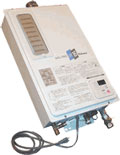
A tankless job. Photo: notanks.com
Thanks to Liz, though, we can now jump into the wily world of water heat. Heating your water is a large part of your home’s environmental burden — second only to home heating and cooling, according to some. Here are the (overwhelming) options: on-demand water heaters, storage water heaters, heat-pump water heaters, tankless coil water heaters, indirect water heaters, solar water heaters, and water heaters hooked up to the furnace in a strange symbiotic relationship. Today I’ll discuss tube-tank water heaters (my coinage) and on-demand heaters. Resources related to the others are provided in the last paragraph.
Most folks have a cylindrical tube tank in the basement or a closet. While hardly an inspiring example of industrial design, the tanks are actually pretty good at heating water. Newer tank water-heater models are well insulated, as I mentioned the last time I addressed this issue, and thus have little “standby loss” (heat lost as the tank stands idly by waiting for you to bathe).
The water in tube tanks can be heated either by electricity or natural gas. Good electric tank water heaters are 90 percent efficient or more, meaning that 90 percent of the electricity heats the water and 10 percent is wasted. Gas tank water heaters are 60 percent efficient or more. But in the gas vs. electric smackdown, electric water heaters lose on the price of electricity and the environmental costs of electricity generation. Electricity is a secondary product, like meat: one natural resource is transformed into another, which we buy. Nuclear, coal, hydro, and oil-burning electricity plants are a primary reason to be grateful for the Clean Air Act and Clean Water Act. Also, as electricity travels to your abode, some of it falls by the wayside and goes to waste. Natural gas is nonrenewable and the tube tanks are less efficient, but the gas exacts less of an environmental burden en route to your home.
Readers may have seen on-demand heaters in a foreign land or under someone’s sink. (I encountered my first one right next to my first yurt — in California, of course.) Small metal boxes mounted on the wall, they are unobtrusive and tasteful. When hot water hears you calling, the boxy little heater fires up, heating only the water you use. From what I can piece together, demand heaters are cool, but not quite as cool as you would think. Electric on-demand heaters use large amounts of power in short bursts. Instead of giving you x watts over an hour, the electric company must give you x watts in 10 minutes — requiring higher generating capacity back at the plant. Given the importance of reducing peak energy demand, that’s not an ideal solution. In fact, it’s enough to inspire a “no” vote on electric on-demand heaters.
And gas-powered on-demand heaters have cons as well. First, I talked with some experts (and regular on-demand-heater-owning folks) who were dubious of manufacturers’ claims that the devices deliver x gallons at x degrees for x minutes. On-demand heaters may not suffice in homes where two hot water taps are running simultaneously. Second, the potential for wasting water is a problem: If it’s hot enough you’ll be able to shower for hours, since you’re not limited by tank size, and if it’s not hot enough you’ll run it, waiting. And models where a pilot light burns constantly may be a gas-savings wash when compared with gas tube-tank heaters. As Liz describes, on-demand systems require advance planning. Gas heaters need a special exhaust vent, an intake pipe of a certain size to ensure the necessary gas volume, and a plumber open to new ideas. The price of the heater itself and of the installation are higher than simply replacing your old tank with a new, efficient model.
Obviously Liz loves her on-demand heater, and it may be that it’s right for her water-use habits. From what I understand, though, on-demand heaters do not thrash tank heaters when it comes to efficiency. For you water-heater shoppers, again: Plan ahead, do some math, figure out how much hot water you need, and match that number with a system and budget that work for you.
If your town, city, or county has a hotline or website where you can ask questions about appliances, take advantage of it. You may find a true expert at the other end of the line, and one who can address issues specific to your local power-generation situation as well. In addition, the American Council for an Energy-Efficient Economy’s Green Guide explains issues, presents options, and ranks appliances. It’s cheap and helpful. Keep it on hand, as it will answer your appliance questions in a timely manner — more than can be said for an overworked research assistant.
Moistly,
Umbra